admin
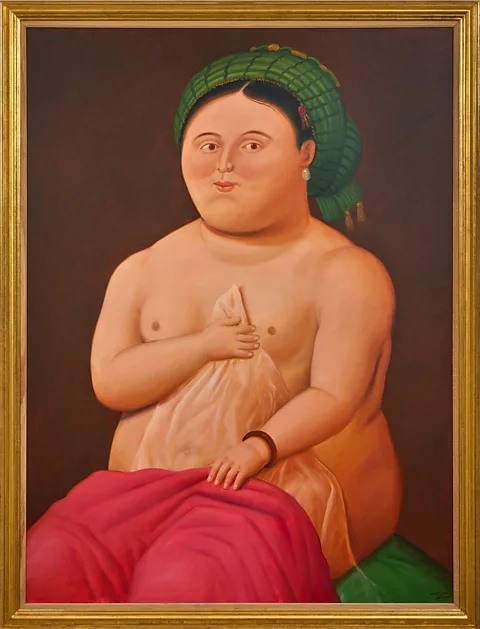
In the late Colombian artist Fernando Botero’s interpretation of the Mona Lisa, the subject stares directly at the viewer with an unwavering, placid gaze. Clad in a vibrant green dress and crowned with dark, curly hair beneath a sheer veil, the figure possesses the quintessential hallmarks of Leonardo da Vinci’s 16th-century masterpiece. However, the similarities end with the composition. In Botero’s hands, the woman’s form is dramatically expanded, her head large, and her facial features gathered in a small, concentrated cluster at the center of a voluminous face. This 1978 work, simply titled Mona Lisa, is more than a parody; it is a manifestation of "Boterismo," a signature style that redefined the visual language of the 20th century.
Botero, who passed away in September 2023 at the age of 91, remains one of the most recognizable and commercially successful artists to emerge from Latin America. His work, characterized by an obsession with volume and an amplification of form, has transcended the traditional boundaries of the gallery space, appearing in public squares from New York’s Park Avenue to the Champs-Élysées in Paris. As the Opera Gallery in London hosts the exhibition Fernando Botero: In Praise of an Amplified World through the end of November, the art world is once again examining how this Colombian master successfully bridged the gap between the European Old Masters and the vibrant, often tumultuous identity of South America.

The Foundations of Boterismo: A Philosophy of Volume
The term "Boterismo" is frequently misunderstood by the casual observer as a preoccupation with obesity. However, Botero himself spent decades clarifying that his subjects were not "fat" in a clinical or pejorative sense. Instead, he viewed the exaggeration of figures and objects as a "celebration of the presence of things." In a 2014 interview with the Spanish newspaper El Mundo, he stated, "I don’t paint fat women… No one believes me, but it’s true. If I paint a woman, a man, a dog, or a horse, I do it with volume [in mind]."
For Botero, volume was synonymous with sensuality and the "celebration of life." This aesthetic philosophy was rooted in his belief that the primary purpose of art is to provide pleasure and uplift the human spirit. His son, Fernando Botero Zea, a former Colombian Minister of Defense, notes that his father believed the history of art was a trajectory of creating pleasure through form and color. By amplifying the world, Botero sought to make the intangible physical, giving his subjects a monumental presence that commanded the viewer’s space.
The technical genesis of this style is often traced back to a specific afternoon in 1956. While living in Mexico City, Botero was sketching a mandolin. He accidentally painted the sound hole disproportionately small compared to the body of the instrument. This minor error created a visual paradox: the mandolin appeared to explode in volume, gaining a new, robust vitality. According to Botero Zea, that moment marked the birth of the Botero universe—a world where every object, from a piece of fruit to a military general, is rendered with the same expansive dignity.

Chronology of a Master: From Medellín to the Global Stage
Fernando Botero’s journey to becoming a global icon was marked by a deep academic immersion in the very European traditions he would later reimagine.
- 1932: Born in Medellín, Colombia. Growing up in a city with limited access to secular art museums, his early visual education came from the colonial-era religious paintings and baroque sculptures found within local Catholic churches.
- 1952: At the age of 20, Botero moved to Madrid. He enrolled in the prestigious Royal Academy of Fine Arts of San Fernando and spent his days at the Prado Museum, working as a copyist. Here, he studied the works of Velázquez and Goya, learning the nuances of classical composition.
- 1953–1954: After discovering a book on the 15th-century Italian painter Piero della Francesca, Botero moved to Florence. He became obsessed with the Italian Renaissance, which he considered the pinnacle of human artistic achievement. He spent this period studying fresco techniques and the use of volume by masters like Giotto and Masaccio.
- 1956: The "mandolin incident" in Mexico City solidifies his signature style.
- 1961: International recognition arrives when the Museum of Modern Art (MoMA) in New York acquires Mona Lisa, Age Twelve (1959). At a time when Abstract Expressionism dominated the New York art scene, Botero’s figurative, voluminous work was a radical departure.
- 2000: Botero donated a massive collection of his own work and his personal art collection (including pieces by Picasso, Monet, and Dalí) to the Central Bank of Colombia, leading to the creation of the Botero Museum in Bogotá.
- 2023: Following his death, his 1979 painting The Musicians fetched $5.1 million at a Christie’s auction in New York, setting a record for the artist and confirming his enduring market appeal.
Dialogue with the Old Masters
Botero’s career was defined by a continuous dialogue with the past. He did not merely copy the Old Masters; he "translated" them into the vernacular of the Americas. His reworkings of classic motifs served as a bridge between the European canon and Latin American visual culture.
One of his most significant inspirations was Piero della Francesca’s The Duke and Duchess of Urbino (c. 1473–1475). Botero’s 1998 diptych Federico da Montefeltro, Battista Sforza reimagines the iconic profile portraits. While the original duke was depicted with a broken nose and scars from a jousting tournament, Botero smoothed these features into his signature rounded aesthetic. By flipping the orientation of the figures and expanding their forms to fill the frame, Botero asserted that these historical titans could be reimagined through a lens of contemporary abundance.

Similarly, in Menina, after Velázquez (1982), Botero tackled the central figure of Diego Velázquez’s Las Meninas. The five-year-old Margaret Theresa of Spain is transformed from a delicate royal child into a sturdy, monumental presence. This transformation is not an act of mockery but an act of "amplification," as Belén Herrera Ottino, director of Opera Gallery Madrid, describes it. By applying his style to such sacred cows of art history, Botero was essentially claiming a seat at the table for Latin American artists, insisting that their "personal language" was as valid as the traditions of the Renaissance or the Baroque.
Cultural Synthesis: High Art and Popular Culture
The significance of Botero’s work also lies in how it reflects the democratization of art in Latin America. Nicolás Gómez Echeverri, director of arts at the Banco de la República in Colombia, points out that images like the Mona Lisa have a unique life in South America. They are not just museum pieces; they are part of the street-level visual culture, appearing on pizza boxes, bar murals, and advertisements.
Botero recognized that by reimagining these "high art" icons in a style that resonated with the people of Medellín and Bogotá, he was breaking down the barriers of elitism. His work synthesized European classicism with pre-Colombian influences—specifically the large, rounded forms found in indigenous pottery and sculpture. This fusion created a style that felt both ancient and modern, both European and distinctly "Mestizo."

"He always felt very Colombian and always strove to represent this country well on the international stage," Botero Zea reflects. Indeed, Botero’s refusal to embrace the "obscurity" of mid-century abstraction was a deliberate choice. He believed that a painting should "talk directly to the viewer," a populist sentiment that made him one of the few artists whose work is equally beloved by academic scholars and the general public.
Economic and Institutional Legacy
The financial data surrounding Botero’s estate underscores his status as a titan of the art market. His sculptures, which can weigh several tons, regularly sell for millions, while his paintings have shown remarkable resilience in value over decades. The $5.1 million sale of The Musicians in 2023 was not an anomaly but a reflection of a global collector base that spans from the Middle East to Asia and the Americas.
Beyond the market, his institutional legacy is cemented in the Botero Museum in Bogotá. By donating his collection to the Central Bank of Colombia, Botero ensured that his work—and the works of the European masters he admired—would be accessible to his fellow citizens for free. This act of philanthropy was a political statement: that cultural capital should be distributed among the people, not just the elite.

Implications for Modern Art History
Fernando Botero’s "amplified world" challenges the linear narrative of art history that often relegates Latin American artists to the periphery. By centering his practice on the reimagining of European masterpieces, he forced a confrontation between the "Old World" and the "New World." His work suggests that the history of art is not a closed book but a living dialogue where forms can be expanded, colors can be heightened, and joy can be a radical act of expression.
As the current exhibition in London demonstrates, Botero’s vision remains as relevant today as it was in the 1950s. In an era often characterized by digital detachment and minimalist aesthetics, the tactile, voluminous, and unashamedly joyful world of Boterismo offers a visceral reminder of the "sensuality of nature" and the enduring power of the human form. Through his "amplified" lens, the history of art becomes a broader, more inclusive, and infinitely more vibrant landscape.