admin
admin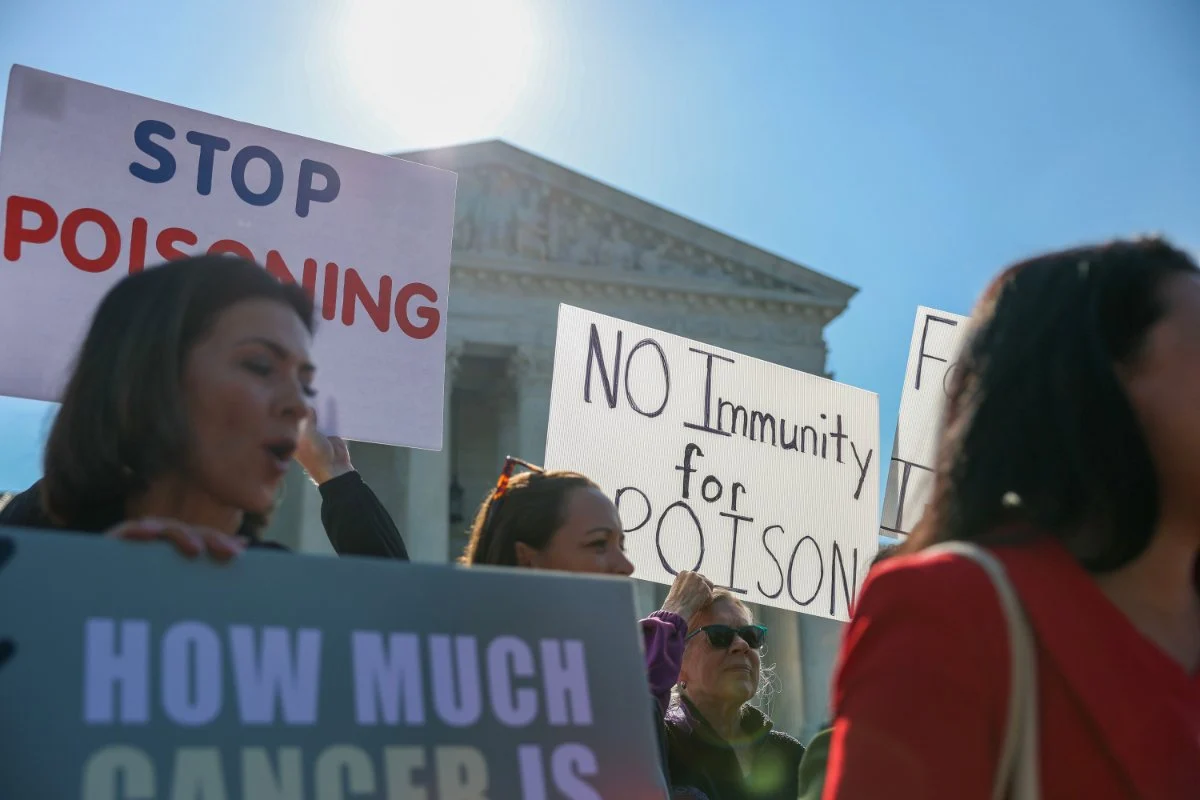
A recent Supreme Court decision delivered a significant setback to individuals suffering from health problems linked to pesticides, effectively shielding companies like Bayer from numerous lawsuits. The ruling, handed down in June 2026, has profound implications for millions of Americans whose lives have been impacted by debilitating diseases purportedly caused by exposure to federally approved chemical agents. While the specific case before the high court centered on the ubiquitous weedkiller glyphosate, the judgment’s scope extends to all pesticides sanctioned by the U.S. Environmental Protection Agency (EPA), limiting the avenues for redress for those who claim harm without adequate warning.
For years, a growing coalition of plaintiffs, environmental advocates, and public health organizations has been battling efforts, notably from the previous Trump administration and certain congressional factions, to insulate pesticide manufacturers from legal liability. This Supreme Court decision, therefore, represents a considerable blow, despite the undeniable and well-documented links between various pesticides and severe health conditions such as cancer and Parkinson’s disease. The core reality of these health risks remains unchanged; what has shifted dramatically is the arduousness with which affected individuals can seek accountability and compensation from the corporations responsible. Yet, amidst this legal defeat, a nascent sense of optimism persists, fueled by a burgeoning grassroots movement dedicated to curtailing pesticide use in the foreseeable future. This movement, gaining strength daily, is galvanized by widespread public awareness and collective action.
The High Court’s Decision: A Shield for Industry
The Supreme Court’s 6-3 decision effectively reinforced the legal doctrine of federal preemption, asserting that the EPA’s approval of a pesticide label under the Federal Insecticide, Fungicide, and Rodenticide Act (FIFRA) preempts state-level failure-to-warn claims. This means that if the EPA has approved a pesticide’s label without a specific warning about a particular health risk, individuals cannot sue the manufacturer under state law for failing to provide that warning. The ruling stemmed from a case involving Roundup, Bayer’s glyphosate-based herbicide, which has been at the center of thousands of lawsuits alleging it causes non-Hodgkin lymphoma and other cancers. Previously, juries in several high-profile trials had sided with plaintiffs, awarding multi-million dollar verdicts against Bayer (which acquired Monsanto, the original developer of Roundup, in 2018). These verdicts were based on the premise that Monsanto failed to warn consumers about the alleged cancer risks associated with glyphosate. The Supreme Court’s intervention now significantly complicates, if not entirely closes, this avenue for litigation.
Legal experts suggest that this ruling will likely lead to the dismissal of many pending lawsuits and prevent future ones from being filed on similar grounds. The implication is that the EPA is now effectively the sole arbiter of what warnings appear on pesticide labels, and its decisions are largely insulated from challenge through state tort law. This outcome has been widely lauded by the pesticide industry, which has long argued for the primacy of federal regulation and the need for a consistent national standard, free from the complexities and costs of state-by-state litigation.
A History of Litigation and Health Concerns
The saga of glyphosate litigation began in earnest following the International Agency for Research on Cancer (IARC), a division of the World Health Organization, classifying glyphosate as "probably carcinogenic to humans" in 2015. This classification ignited a wave of lawsuits across the United States, with tens of thousands of plaintiffs alleging that their exposure to Roundup led to cancer. Before the Supreme Court’s ruling, Bayer had faced considerable financial and reputational damage, having settled tens of thousands of claims for billions of dollars while still confronting a substantial backlog of cases. The previous jury verdicts, often highlighting internal company documents suggesting an awareness of potential risks and efforts to influence scientific opinion, underscored the public’s and lower courts’ concerns about corporate responsibility.
Beyond glyphosate, other widely used pesticides have also drawn scrutiny. Paraquat, a highly toxic herbicide banned in over 70 countries, has been linked to Parkinson’s disease, prompting another wave of lawsuits and public outcry. Chlorpyrifos, an organophosphate insecticide, has been associated with developmental delays and neurological issues in children, leading to its ban for food uses by the EPA in 2021, though its agricultural use remains a contentious issue in some contexts. Atrazine and dicamba are also among the chemicals that independent research has connected to a range of health problems, including birth defects and endocrine disruption. This extensive body of evidence from independent scientists, untethered to industry funding, has been a cornerstone of the legal and advocacy efforts to date.
EPA’s Role: A Decades-Long Pattern of Inaction
The Supreme Court’s decision elevates the EPA’s authority, yet it also casts an unforgiving spotlight on the agency’s long-documented shortcomings in protecting public health from hazardous pesticides. Critics argue that the EPA’s Office of Pesticide Programs (OPP) has consistently failed in its mandate. For example, a recent analysis of all currently approved pesticides revealed a startling statistic: the EPA has mandated cancer warnings on a mere 69 out of 4,919 pesticide labels (1.4%) containing a chemical it has itself designated as a "likely" human carcinogen. The situation is similarly dire for "possible" human carcinogens, with warnings on only 242 of 22,147 labels (1.1%). These figures underscore a profound systemic failure, placing the Supreme Court’s grant of "sole power" over cancer warnings squarely on an agency that, by its own data, performs this critical duty less than 2% of the time.
Further evidence of a permissive regulatory environment in the U.S. is the approval of 119 pesticides that are banned or being phased out in the European Union, China, or Brazil – a number that has grown significantly since a 2018 study identified 85 such chemicals. This disparity highlights a divergence in regulatory philosophy and a perceived prioritization of industry interests over precautionary public health measures.
Compounding these concerns is the significant industry influence within the EPA. Reports consistently detail a "revolving door" phenomenon, where top officials in the EPA’s chemicals office are former industry lobbyists, and many agency leaders transition to work for pesticide companies after their government tenure. This pervasive industry presence, critics contend, fosters a regulatory system that is inherently biased towards maintaining dangerous pesticides on the market, rather than vigorously safeguarding public well-being. This entrenched system has frequently left sick Americans with no recourse but to seek damages through tort litigation, a path now largely obstructed.
The Regulatory Response: Trump Administration’s Stance
In the immediate aftermath of the Supreme Court’s ruling, the Trump administration, through the EPA, signaled a perplexing strategy that appeared to prioritize rhetoric over substantive action regarding pesticide reform. On the very day the Supreme Court announced its decision, President Trump signed an executive order purportedly aimed at investing in regenerative and sustainable agriculture. However, instead of outlining concrete steps to reduce the nation’s escalating reliance on harmful, cancer-linked pesticides, the executive order directed the EPA to expedite the approval process for new pesticides. It also advocated for increased reliance on "New Approach Methodologies" (NAMs)—industry-supported studies that have previously been used to justify significantly higher residues of neurotoxic pesticides like acephate on food, raising serious questions about their scientific rigor and independence.
This approach was further exemplified by the EPA’s public relations efforts. The agency publicized its executive order and hosted a "roundtable discussion" on paraquat, seemingly projecting an image of proactive engagement. Yet, simultaneously, the EPA quietly approved four new "forever chemical" (PFAS) pesticides, notorious for their persistence in the environment and links to various cancers, in a single day. This, alongside significant new uses for two other pesticides, was disclosed on an obscure regulatory website, largely out of public view. This pattern of public messaging contrasting with behind-the-scenes approvals reinforces the perception that the EPA’s institutional, industry-driven bias towards keeping dangerous pesticides on the market remains deeply entrenched, unlikely to change without unprecedented external pressure.
The Shifting Landscape of Advocacy
Despite the legal setback, the movement against pesticide harm is gaining unprecedented momentum, fueled by an ever-expanding body of independent research. Studies continue to draw troubling links between widely used chemicals like glyphosate, atrazine, chlorpyrifos, paraquat, and dicamba, and severe health issues including cancer, birth defects, developmental harms in children, and neurodegenerative diseases. This scientific consensus, derived from research untainted by industry influence, has been instrumental in swaying public opinion and, until recently, jury decisions. Even with the Supreme Court’s ruling, the scientific evidence remains a formidable truth that neither the judiciary, the EPA, nor multi-billion dollar pesticide corporations can definitively evade.
Public opinion data further bolsters the calls for reform. Surveys indicate that over 70 percent of American adults express concern about harmful chemicals in food, water, and everyday products, and believe the government should do more to address these issues. This is not a partisan or niche concern but a widespread sentiment that transcends political divides. Increasingly, individuals from diverse political backgrounds are finding common ground in the fight to protect their families and communities from chemicals that contribute to illness.
Bipartisan Momentum in Congress
The growing public and scientific consensus is beginning to resonate within the halls of Congress. There is an observable shift towards greater bipartisan cooperation on legislation aimed at protecting the public from harmful pesticides. Recent legislative maneuvers illustrate this nascent change. For instance, several damaging pesticide provisions, including legal shields for pesticide companies, were notably removed from the House farm bill. This significant development saw more than 70 Republicans voting alongside nearly every Democrat to defeat these industry-backed measures—a scenario that would have been almost unthinkable just two years prior. This newfound willingness to cross the aisle on environmental and public health issues signals a maturing movement with increasing political clout. Lawmakers are recognizing that the science is unequivocal, public demand for change is robust, and the issue transcends traditional political alignments.
Statements and Reactions
While official statements from Bayer and other pesticide manufacturers were not explicitly provided in the original text, their legal victory implies a sense of vindication. They would likely emphasize that the ruling upholds the federal regulatory framework, validating the EPA’s expertise in determining product safety and labeling requirements. This perspective typically underscores the importance of a uniform national standard to avoid a patchwork of state-level regulations that could impede agricultural practices and innovation.
Conversely, advocacy groups and legal representatives for plaintiffs expressed deep disappointment but simultaneously articulated renewed determination. For instance, the Center for Biological Diversity, a prominent environmental advocacy group, publicly stated, “The Supreme Court just gave the EPA sole power over pesticide label cancer warnings, a job the agency already fails at more than 98 percent of the time.” This sentiment captures the frustration with the EPA’s historical performance and signals an intensified focus on compelling the agency to fulfill its protective duties. Legal experts, while acknowledging the immediate blow to tort litigation, also noted that the ruling effectively shifts the battleground from the courtroom to the legislative and regulatory arenas, necessitating a more proactive approach to policy reform.
The Path Forward: A Collective Imperative
The Supreme Court’s glyphosate decision serves as a stark reminder that the legal challenges faced by victims were fundamentally triggered by the EPA’s long-standing failure to adequately protect citizens from pesticide harms. The ruling, coupled with the Trump administration’s subsequent actions to expedite new pesticide approvals, is poised to act as a powerful catalyst, galvanizing millions more to join the burgeoning movement for meaningful reform of U.S. pesticide regulation.
The necessary ingredients for change are aligning: robust independent scientific evidence, widespread public concern, and a growing, albeit nascent, bipartisan willingness among lawmakers to address the issue. However, this monumental struggle for far-reaching regulatory reform will not be won solely by politicians, lawyers, or social media campaigns. It demands a profound level of civic engagement: millions of people showing up to vote on issues that directly impact future generations, engaging in challenging conversations with neighbors who rely on pesticide use, and actively participating in their local communities to demand a safer environment.
The vision is clear: a system where children are not forced to endure protracted legal battles for compensation after their lives have been irrevocably altered by chemical exposure. They deserve to grow up in a world where the "silent threat" of pervasive poisons no longer exists. If public momentum continues to build and coalesce in the coming weeks, months, and years, this Supreme Court decision, initially perceived as a defeat, may ultimately ignite an ever-widening firestorm of opposition, not just to glyphosate, but to the multitude of other EPA-approved pesticides that continue to devastate public health and environmental integrity. The fight for a healthier, less toxic future is far from over; it has merely entered a new, more collective phase.