admin
Tate Britain has unveiled a comprehensive new exhibition titled "Vanessa Bell & Duncan Grant: Inside Bloomsbury," a major retrospective that brings together more than 300 works to examine the creative and personal lives of two of the 20th century’s most influential and controversial artists. The exhibition serves as a definitive exploration of a partnership that spanned over five decades, challenging the boundaries between fine art and domestic design while navigating a complex web of social radicalism and private deception. As the primary visual architects of the Bloomsbury Group—a coterie of intellectuals that included Virginia Woolf, John Maynard Keynes, and E.M. Forster—Bell and Grant are presented not merely as painters, but as pioneers of a modern British aesthetic that sought to integrate art into every facet of daily existence.
The exhibition arrives at a time of renewed scholarly interest in the Bloomsbury Group’s legacy, particularly regarding their early adoption of queer identities and polyamorous lifestyles. However, the Tate’s curation also confronts the darker aspects of this "coterie," including allegations of elitism, hypocrisy regarding social class, and the emotional toll of the group’s commitment to unconventional domesticity. By reconstructing the studio of their Sussex farmhouse, Charleston, and displaying groundbreaking works ranging from Post-Impressionist canvases to hand-painted ceramics, the exhibition invites a nuanced reassessment of how these artists shaped the face of British modernism.

A Chronology of Radical Modernism
The trajectory of Vanessa Bell and Duncan Grant’s collaboration is marked by a series of pivotal shifts in the British cultural landscape. The timeline of their influence begins in the early 1900s, when a group of Cambridge-educated intellectuals and their associates began meeting at the Bell family home in Bloomsbury, London.
In 1910 and 1912, the art critic Roger Fry organized the first Post-Impressionist exhibitions in London, introducing British audiences to the works of Manet, Cézanne, and Picasso. This served as a catalyst for Bell and Grant, who began experimenting with bold colors and abstraction. By 1913, alongside Fry, they co-founded the Omega Workshops. This radical design enterprise aimed to bridge the gap between "high art" and interior decoration, producing furniture, textiles, and pottery that featured avant-garde patterns.
The move to Charleston farmhouse in 1916 during World War I represented a significant turning point. Grant, a conscientious objector, worked on the land to avoid military service, while Bell transformed the house into a living canvas. This period saw the birth of their daughter, Angelica, in 1918—an event that would later become the center of the group’s most enduring private scandal. Throughout the 1920s and 1930s, Bell and Grant’s productivity peaked, resulting in projects like the "Famous Women Dinner Service" (1932–1934), a 50-piece set celebrating historical and contemporary female figures.

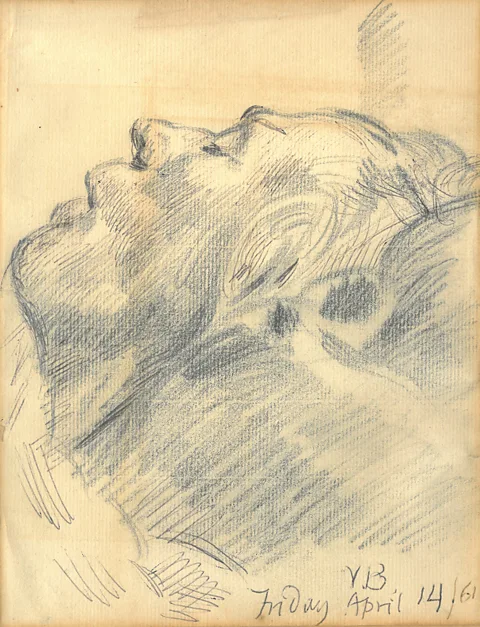
The partnership continued until Bell’s death in 1961. Even in her final years, the creative dialogue remained uninterrupted; one of the exhibition’s most poignant inclusions is a recently discovered 1961 pencil and biro drawing of Bell by Grant, executed shortly after her passing. This work, currently undergoing conservation at Charleston, is viewed by historians as the final articulation of a life where portraiture was inseparable from love.
The Artistic Philosophy of Charleston and the Omega Workshops
At the heart of the Tate Britain exhibition is the concept of the "total work of art." For Bell and Grant, the domestic sphere was not a retreat from the world but a laboratory for artistic experimentation. This is most vividly expressed in the reconstruction of their Charleston studio. The farmhouse was characterized by stencil-printed walls, decorated bedposts, and hand-painted mantelpieces, reflecting Bell’s belief that art should permeate everyday life.
Thomas Kennedy, co-curator of the exhibition, notes that the collaboration between the two artists was often so seamless that it became difficult to distinguish their individual hands. A prime example is the "Famous Women Dinner Service." Commissioned by the art historian Kenneth Clark, the service features portraits of women ranging from Sappho and Elizabeth I to Jane Austen and Greta Garbo. Kennedy explains that for each plate, the artists worked so closely that "it’s really difficult to see who the artist is." This blurring of authorship was a central tenet of the Omega Workshops, where items were often sold without signatures to emphasize the aesthetic value over the celebrity of the creator.

The exhibition also highlights their technical innovations. By displaying Bell’s "Still Life on Corner of a Mantelpiece" alongside Grant’s "The Mantelpiece" (both 1914), conservators have revealed that the pair used the same tubes of paint and shared canvases. While Bell utilized bright, bold blocks of color influenced by her sister Virginia Woolf’s rhythmic prose, Grant often incorporated collage elements, reflecting a more tactile engagement with the material world.
The "Devastating Deception" and Social Complexity
While the Bloomsbury Group is often celebrated for its progressive stance on sexuality and gender, the exhibition does not shy away from the "precarious paradise" described by Angelica Bell in her 1984 memoir, Deceived with Kindness. The central deception involved Angelica’s paternity; although she was raised as the daughter of Bell’s husband, Clive Bell, her biological father was Duncan Grant.
This secret was kept from Angelica until she was 18, a decision that Dr. Jon King, author of Vanessa Bell and Charleston: Motherhood, Queerness and the Domestic Imagination, attributes to a desire for social propriety and the protection of her inheritance. Duncan Grant’s painting The Hammock, Charleston (c. 1921–23) is analyzed in the exhibition as a visual representation of this hidden tension. Though it appears to be a familial idyll, King notes that "each figure is isolated" within the composition, and the young Angelica is depicted walking her own path, separate from the adults who held her secret.

The emotional fallout of this deception was profound. Angelica eventually married David "Bunny" Garnett, a man who had been a former lover of her father and a suitor of her mother. Garnett had infamously declared his intention to marry Angelica when she was only a newborn. Angelica later wrote that her marriage was a "continuation" of the search for the father figure she had been denied through the group’s silence.
Critical Reactions and Historical Contextualization
The Bloomsbury Group’s legacy has long been a subject of intense debate. During their own era, they were frequently targeted by critics who viewed them as a snobbish, self-congratulatory clique. The novelist Wyndham Lewis satirized them in The Apes of God (1930), attacking what he perceived as their salon politics. Similarly, D.H. Lawrence expressed a "black fury" toward the group, claiming their intellectualism lacked genuine feeling.
Modern critics have added layers to this "Bloomsbury bashing" by examining the group’s relationship with their domestic staff. Researcher Alison Light has pointed out the irony of the Bell sisters’ "bohemian" freedom, which was entirely dependent on a traditional hierarchy of servants. Furthermore, the antisemitic remarks found in Virginia Woolf’s diaries—despite her marriage to Leonard Woolf—remain a significant point of contention for historians evaluating the group’s moral standing.

However, the Tate exhibition argues that much of the historical criticism was fueled by contemporary homophobia and misogyny. At a time when homosexual activity was illegal in the United Kingdom, Grant’s private homoerotic drawings—more than 400 of which were found hidden under a bed in 2020—represent a courageous, albeit secret, exploration of identity. Several of these drawings are featured in the exhibition, providing a stark contrast to the more "acceptable" domestic scenes for which the group is famous.
Broader Impact and Implications for British Art
The enduring impact of Vanessa Bell and Duncan Grant lies in their role as the primary conduits for European Modernism into the British Isles. By breaking down the barriers between fine art and the decorative arts, they paved the way for future generations of designers and artists who viewed the home as a site of political and aesthetic resistance.
Virginia Nicholson, Vanessa Bell’s granddaughter, suggests that the true legacy of the pair is one of unpretentious joy. "They were people who, I think, embraced the observable world in a very direct way," she states in the exhibition catalogue. This sentiment is echoed by curators who hope the show will shift the focus from the sensationalism of their private lives back to their artistic output.

The exhibition at Tate Britain serves as a reminder that the "modern" Britain we inhabit—characterized by an openness to queer identities and the integration of high design into the mass market—owes a significant debt to the experiments conducted at Bloomsbury and Charleston. While the group’s failures and hypocrisies are laid bare, their vision of a life where "every chair, every plate, and every wall" could be a source of creative expression remains a powerful and relevant ideal. As visitors walk through the reconstructed rooms of Charleston, the message is clear: the Bloomsbury Group did not just live in squares and love in triangles; they redesigned the very fabric of British life.