admin
The history of women’s fashion in Paris is often viewed through the lens of glamour and haute couture, yet beneath the silk and lace lies a centuries-long legal battle for the right to wear trousers. For over 200 years, a police ordinance in the French capital strictly forbade women from donning "masculine" attire, a law that was not merely a stylistic preference but a tool of political and social subjugation. From the revolutionary barricades of the 18th century to the formal repeal of the ban in 2013, the struggle for sartorial freedom serves as a vital chapter in the broader narrative of women’s rights in France.

The prohibition, formally enacted in 1800, was a direct reaction to the perceived "excesses" of the French Revolution. During the 1790s, women had increasingly participated in political life, often adopting the trousers of the working-class sans-culottes to join protestors on the streets. This visibility was met with severe backlash. Olympe de Gouges, who famously penned the Declaration of the Rights of Woman and of the Female Citizen, was executed in 1793, with her critics labeling her an "unnatural" woman for her political ambitions. By the time Napoleon Bonaparte rose to power, the state sought to return women to the domestic sphere. The Decree of 16 Brumaire, Year IX (November 7, 1800), was the legal instrument of this domesticity, mandating that any woman wishing to "dress as a man" must obtain a special permit from the police.
The Revolutionary Backlash and the Birth of the Ban
The 1800 ordinance was specifically designed to strip women of the agency they had briefly tasted during the Revolution. According to Marine Kisiel, a curator at the Palais Galliera and an expert on 19th-century dissident femininities, the ban was a calculated move to "put an end to the period when women were demanding rights and wishing to participate in the political life of their society." In the eyes of the post-revolutionary male establishment, the bifurcated garment—the trouser—was the ultimate symbol of male authority and citizenship. To wear it was to claim equality, a claim the state was determined to suppress.

Throughout the early 19th century, the "Amazon" style became a rare exception. This fashion, imported from England, consisted of a masculine-style riding habit. While these tailored jackets and coats were considered fashionable, they were viewed with a mix of fascination and apprehension. The term "Amazon," referencing the warrior women of Greek mythology, suggested that these agile, horse-riding women were a potential threat to the established gender order. However, because the riding habit still involved a skirt, it remained within the bounds of legal femininity, even as it pushed the aesthetic boundaries of the time.
George Sand and the Practicality of Rebellion
One of the most famous figures to flout the 1800 ban was Amantine Lucile Aurore Dupin, better known by her pen name, George Sand. For Sand, who became a titan of French literature, masculine clothing was not just a political statement but a matter of economic and social survival. Wearing men’s trousers and coats allowed her to move freely through Paris, accessing spaces like theatre stalls where women were either barred or expected to pay exorbitant prices for seating that accommodated voluminous dresses.

Sand’s defiance was rooted in a desire for "freedom of movement and action," as Kisiel notes. By dressing as a man, Sand avoided the "stifling restrictions" of corsets and crinolines, enabling her to conduct her work as a journalist and novelist with an independence rarely afforded to her female peers. While she was frequently mocked in the press and faced social ostracization, her success as a writer provided a degree of protection that many other women did not possess.
The Permission de Travestissement: Legalizing the Exception
While the ban was strict, the French state did provide a loophole: the permission de travestissement (permit to cross-dress). To obtain this permit, a woman had to provide a medical certificate or a professional justification. This system created a tiered level of freedom, where women’s identities were constantly scrutinized by the police and medical establishment.

Two prominent figures who utilized or bypassed these permits were the artist Rosa Bonheur and the archaeologist Jane Dieulafoy. Bonheur, the most famous female painter of the 19th century, was granted a permit to wear trousers for "health reasons" and to facilitate her work in abattoirs and horse markets, where she studied animal anatomy. For Bonheur, the trousers were a tool of her trade, though they eventually became a signature part of her public identity.
Jane Dieulafoy took a more integrated approach. After fighting alongside her husband in the Franco-Prussian War, she adopted masculine attire during their archaeological expeditions to Persia. Upon returning to Paris, she continued to wear dapper men’s suits in her daily life. Despite the illegality of her dress, Dieulafoy remained a prominent society figure, hosting influential salons attended by prime ministers and presidents. Her status and her contributions to French science essentially made her "untouchable" by the police, illustrating how class and professional prestige could occasionally override gender laws.

Military Service and the Irregular Corps
The 19th century also saw women using masculine clothing to enter the most male-dominated of all spheres: the military. Although women were officially excluded from the French Army, several managed to serve in irregular volunteer corps, particularly during times of national crisis like the Franco-Prussian War (1870-71).
Marie-Antoinette Lix is perhaps the most celebrated example of this phenomenon. Dressed in a lieutenant’s uniform, Lix took part in the defense of the Vosges and distinguished herself at the Battle of Nompatelize. For women like Lix, the uniform was not an act of "passing" as a man in the traditional sense, but a functional necessity for combat. These women proved that the "feminine nature" cited by lawmakers as a reason for their exclusion was a social construct that crumbled on the battlefield.

The Belle Époque and the Rise of Lesbian Subculture
By the late 19th and early 20th centuries, the struggle for sartorial freedom intersected with the burgeoning lesbian subculture in Paris. For many queer women, masculine clothing was a way to express an identity that the medical establishment of the time labeled as "inversion."
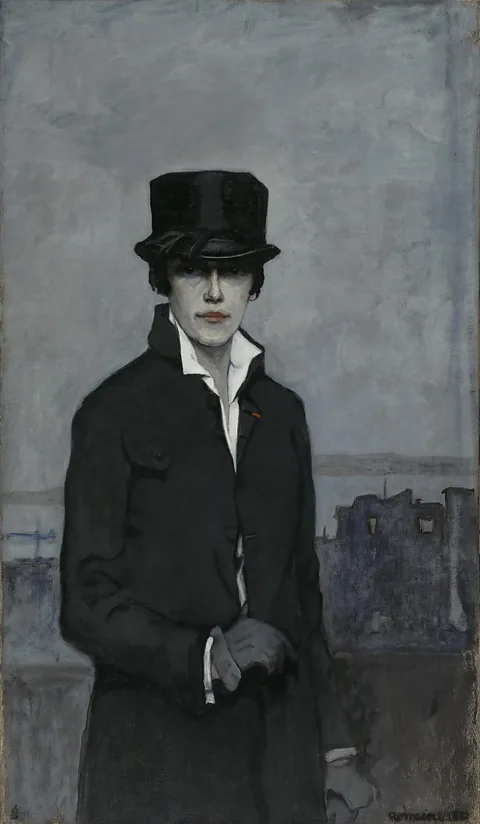
Mathilde de Morny, known as "Missy," was a leading figure in this movement. A member of the high aristocracy, Missy lived openly as a man for much of their life, adopting a flamboyant masculine style and engaging in high-profile relationships, most notably with the writer Colette. This period also saw the rise of artists like Romaine Brooks, whose 1923 self-portrait in a tailored suit and top hat remains an iconic image of androgynous elegance.

However, as art historian Lola Charnay points out, these women bore the brunt of intense hostility. They were frequently caricatured in the press as "scandalous" or "unnatural," serving as scapegoats for a society anxious about the shifting boundaries of gender. The press used these images to "tame defiance" and maintain heteropatriarchal control, even as the subculture continued to grow in the shadows of the Belle Époque.
The Technological Pivot: Cycling and the Law
The eventual undoing of the trouser ban began not with a political decree, but with a technological innovation: the bicycle. In the 1890s, cycling became a craze in France, and it soon became apparent that riding a bicycle in a traditional long skirt was both difficult and dangerous.

Faced with a surge of women adopting "bloomers" or split skirts for cycling, the medical establishment and the police were forced to adapt. Doctors, who had previously condemned trousers, began to argue that cycling was beneficial for women’s health, potentially producing "vigorous mothers" for the French nation. In 1892 and 1909, the law was amended to allow women to wear trousers, provided they were "holding a bicycle handlebar or the reins of a horse." This "conditional freedom" was a major victory, as the bicycle became a powerful symbol of female emancipation and physical liberty.
Chronology of the Paris Trouser Ban
- 1789-1799: French Revolution. Women wear trousers on barricades and demand equal rights.
- 1793: Execution of Olympe de Gouges; women’s political clubs are banned.
- 1800 (16 Brumaire, Year IX): Police ordinance formally bans women from wearing trousers in Paris.
- 1830s-1850s: George Sand defies the ban for practical and economic reasons.
- 1850s-1890s: Rosa Bonheur and Jane Dieulafoy obtain permits or social immunity for masculine dress.
- 1870-1871: Franco-Prussian War; women like Marie-Antoinette Lix serve in uniform in irregular corps.
- 1892: Law amended to allow trousers for women while cycling.
- 1909: Law further amended to allow trousers for women while horse riding.
- 1946: The French Constitution proclaims equal rights for men and women in all spheres, though the 1800 ban remains on the books.
- 2013: The French Ministry of Women’s Rights formally repeals the 1800 ordinance, declaring it incompatible with modern French values.
Analysis of Implications and Legacy
The fact that the 1800 ban remained on the statute books until 2013—long after it had ceased to be enforced—is a testament to the symbolic power of the law. For over two centuries, the legal restriction served as a reminder that women’s presence in the public sphere was, at least theoretically, subject to male permission.

The repeal in 2013, initiated by then-Minister for Women’s Rights Najat Vallaud-Belkacem, was a formal recognition that the law was "incompatible with the principles of equality between women and men." While the repeal was largely symbolic by the 21st century, it honored the "multitude" of ordinary women whose names are lost to history but whose photographs remain—anonymous couples and workers who braved police harassment to dress in a way that reflected their true selves.
Today, the history of the Paris trouser ban is a reminder that fashion is never just about aesthetics. It is a battlefield of identity, power, and autonomy. The dissident women of the 19th and 20th centuries did not just change the way women dressed; they expanded the definition of what it meant to be a woman in a modern society. Every woman in Paris who walks the streets in trousers today is a beneficiary of their courage, their defiance, and their refusal to be confined by the fabric of their time.