admin
admin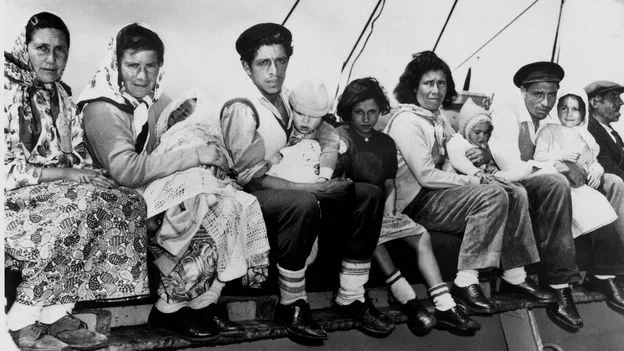
On October 10, 1961, the geological stability of the world’s most isolated human settlement was shattered by a sudden volcanic eruption. Tristan da Cunha, a tiny British Overseas Territory situated in the vast expanse of the South Atlantic, became the site of an extraordinary humanitarian evacuation that would eventually lead a community of 264 islanders into a jarring confrontation with the 20th century. For a population that had lived for generations without internal combustion engines, television, or a monetary economy, the forced migration to the United Kingdom represented more than a temporary escape from natural disaster; it was a profound cultural collision between a 19th-century subsistence society and the height of the British industrial era.
The Geography of Isolation
Tristan da Cunha is often cited by geographers as the most remote inhabited archipelago on Earth. Located approximately 1,510 miles (2,430 kilometers) from Saint Helena, 1,750 miles (2,816 kilometers) from South Africa, and 2,088 miles (3,360 kilometers) from South America, the island is the summit of a massive shield volcano rising from the Mid-Atlantic Ridge. The only settlement, Edinburgh of the Seven Seas—locally known simply as "The Settlement"—sits on a small plateau beneath the 6,765-foot (2,062-meter) peak of Queen Mary’s Peak.
The island’s accessibility is severely limited by its lack of an airstrip. To this day, the only way to reach or leave the island is by sea, a journey that typically takes seven days from Cape Town, South Africa, on polar research vessels or commercial fishing boats. This geographical seclusion allowed the islanders to develop a unique social structure and a dialect of English that preserved archaic features lost elsewhere.
Chronology of the 1961 Eruption
The events leading to the 1961 evacuation began with a series of seismic tremors that intensified throughout August and September. While the islanders were accustomed to the occasional vibration of the earth, the frequency and magnitude of the shocks in early October signaled a significant subterranean shift.
On October 8 and 9, large cracks appeared in the ground near the eastern edge of the village. By the morning of October 10, a dome of earth and rock began to rise rapidly from the ground, eventually bursting to release lava and sulphurous smoke. Mary Swain, a resident at the time, later recalled the terror of the moment, describing how she urged her husband, Fred, to flee as the earth literally opened before them.
The Administrator of the island, recognizing that the lava flow threatened the village’s water supply and the only canning factory—the community’s sole source of external revenue—ordered an immediate evacuation to Nightingale Island, a smaller, uninhabited landmass 18 miles to the southwest. The 264 inhabitants took to their traditional longboats, carrying only the most essential items: overcoats, lamps, and basic tools.
The timing of the disaster was fortuitous in one regard: the Dutch passenger liner Tjisadane happened to be in the vicinity the following day. The vessel intercepted the islanders on Nightingale Island and transported them to Cape Town. From there, the British government arranged for their passage to the United Kingdom aboard the RMS Stirling Castle.
The Cultural Shock of Modern Britain
Upon arriving in England in early November 1961, the Tristanians were greeted by a world they had only read about in outdated magazines or heard of through infrequent radio broadcasts. They were initially housed at a former RAF base at Calshot, near Southampton. The transition was immediately difficult.
Journalist Tim Brinton, reporting for the BBC in 1963, noted that the islanders had never seen a road with traffic, a building taller than a cottage, or a shop. In Tristan, the economy was based on communal labor and barter. Potatoes were the primary currency and dietary staple; if a family needed fish, they caught it. The concept of an income tax form, a utility bill, or a 40-hour work week was entirely alien.

The physical environment of industrial Britain also took a toll. Joey Repetto, an islander, described the air quality in the UK as suffocating, stating that the "gas and smoke" of the city caused him to cough incessantly. This was likely exacerbated by the Great Smog of London and the general industrial pollution of the early 1960s, which stood in stark contrast to the pristine air of the South Atlantic.
Socially, the islanders struggled with the loss of their communal security. On Tristan, crime was virtually non-existent, and the island’s lone policeman rarely had to exercise his authority. In England, the community was traumatized when a member was mugged by two youths who stole and smashed his gold watch. The incident reinforced the islanders’ perception of the outside world as a place of unnecessary cruelty and complication.
Historical Context and Settlement
To understand why the islanders were so determined to return to their volcanic rock, one must look at the history of the settlement. The UK formally annexed Tristan da Cunha in 1816. The primary motivation was strategic: the British feared that the island could be used as a staging ground by the French to rescue Napoleon Bonaparte, who was then imprisoned on Saint Helena.
When the British garrison was withdrawn in 1817, a Scottish corporal named William Glass stayed behind with his family, seeking to create a community based on equality and shared resources. Over the next century, the population grew through the arrival of shipwrecked sailors and women from Saint Helena. By 1961, the entire population shared only seven surnames: Glass, Green, Hagan, Lavarello, Repetto, Rogers, and Swain. This genetic and social homogeneity created a bond of interdependence that proved more resilient than the comforts of British modernity.
The Ballot and the Return
By 1962, the volcanic activity on Tristan had subsided. The British Colonial Office, which had initially hoped to integrate the Tristanians into the UK population to save on the high costs of administering such a remote territory, sent a Royal Society expedition to assess the damage. The geologists reported that the new volcanic cone was dormant and that the village of Edinburgh had escaped major damage, though some livestock had been lost to feral dogs and some houses had been looted by passing sailors.
In 1963, the British government conducted a secret ballot at the Calshot camp to determine the community’s future. The results were overwhelming: 148 islanders voted to return home, while only five voted to remain in England. Despite the availability of modern healthcare, education, and entertainment, the pull of their "free life"—a life defined by the natural rhythms of fishing and farming—was irresistible.
The return was staged in two phases. An advance party went back in early 1963 to repair the cottages and plant the potato crop. In November 1963, the bulk of the population arrived back at the island, greeted by the sight of their familiar cliffs and the smoking, but quiet, volcano.
Long-Term Implications and Modern Status
The 1961 eruption and the subsequent two-year exile served as a pivotal turning point in the island’s history. While the majority returned, the contact with the outside world could not be undone. The younger generation had developed a taste for "the twist," country and western music, and consumer goods. Consequently, the Tristan of the post-return era was more connected to the global economy than the one that had existed before the disaster.
Today, Tristan da Cunha remains a British Overseas Territory. Its economy is largely supported by the sustainable harvesting of the Tristan Rock Lobster (Jasus tristani), which is exported primarily to the United States and Japan. The island has also become a leader in marine conservation; in 2020, the Tristan da Cunha government declared 90% of its waters a Marine Protection Zone, the largest no-take zone in the Atlantic.
The 1961 eruption remains etched in the collective memory of the islanders. It stands as a testament to the resilience of a community that, when offered the full breadth of modern civilization, chose instead the isolation and hardship of their ancestral home. As Elaine Repetto noted decades after the event, the volcano remains a "smoking reminder" of the islanders’ unique identity—a people defined by their ability to survive at the very edge of the world.