admin
The history of Western art has long been characterized by the male gaze, yet the emergence of Lavinia Fontana in the late 16th century challenged the foundational gender norms of the High Renaissance and early Baroque periods. Fontana, a Bolognese painter of immense technical skill, is increasingly recognized by modern art historians not only as the first professional woman artist to operate on the same commercial level as her male peers but also as a pioneer who ventured into the controversial realm of the female nude. Her body of work presents a striking paradox: on one hand, she produced pious altarpieces and virtuous self-portraits; on the other, she created some of the most overtly suggestive and erotic paintings of her era. This duality has prompted a re-evaluation of her motivations, suggesting a complex interplay between commercial shrewdness, artistic rebellion, and personal agency.
The Professional Ascent in Counter-Reformation Bologna
Lavinia Fontana was born in Bologna in 1552, a city that provided a unique sociopolitical environment for a budding female intellectual. Unlike many other Italian city-states, Bologna was home to one of Europe’s oldest universities and maintained a tradition of celebrating female achievement in academia and the arts. Her father, Prospero Fontana, was a prominent Mannerist painter who provided her with a rigorous education in the family workshop.

During the late 1500s, Bologna was a focal point of the Counter-Reformation. Cardinal Gabriele Paleotti, the city’s Archbishop, authored the "Discorso delle pitture sacre e profane," a treatise that sought to regulate artistic production to ensure it aligned with Catholic morality. In this restrictive atmosphere, Prospero Fontana’s influence was significant. He recognized his daughter’s talent early on and positioned her as a portraitist for the Bolognese nobility. By 1577, Fontana had established herself as a refined and cultured figure, as evidenced by her famous "Self-Portrait at the Spinet." In this work, she is depicted in an elegant gown and expensive jewelry, signaling her high social standing and intellectual cultivation, while her easel stands prominently in the background as a symbol of her professional vocation.
A Chronology of Achievement and Artistic Evolution
The trajectory of Fontana’s career is marked by several key milestones that distinguish her from other female contemporaries like Sofonisba Anguissola, who largely remained a court lady-in-waiting rather than a commercial professional.
- 1577: Completion of her "Self-Portrait at the Spinet," marking her entry into the upper echelons of the Bolognese art market.
- 1580s: Fontana begins receiving commissions for large-scale altarpieces, a genre previously reserved for men due to the perceived physical and intellectual demands of the format.
- 1585-1590: The production of "Venus and Cupid," her earliest known erotic work, which utilized mythological themes to explore the female form.
- 1597: The death of her father, Prospero Fontana. This event is viewed by many historians as a turning point that allowed her greater creative and financial freedom.
- 1603: Fontana moves her family to Rome at the invitation of Pope Clement VIII, becoming an official portraitist at the papal court.
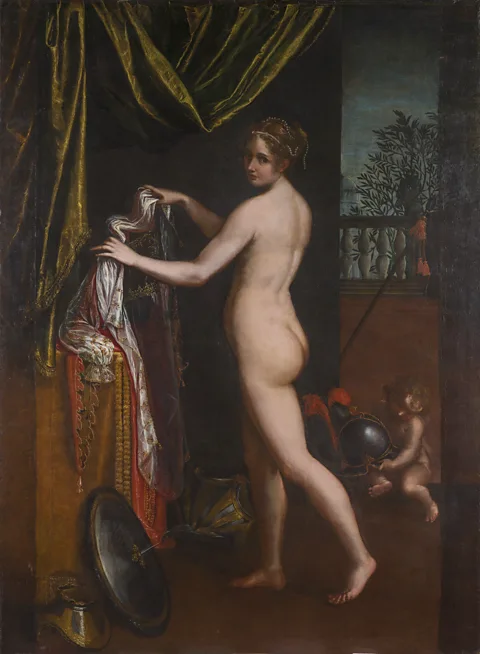
- 1613: Completion of "Minerva in the Act of Dressing" for Cardinal Scipione Borghese, one of the most powerful art patrons in history.
- 1614: Death of Lavinia Fontana in Rome, leaving behind a legacy of over 100 documented works.
The Commercial and Psychological Mechanics of the Nude
The discovery and recent re-attribution of several erotic works have reshaped the understanding of Fontana’s oeuvre. While male artists of the period, such as Titian and Veronese, frequently painted nudes under the guise of mythology, Fontana’s approach was often more explicit and tactually suggestive.

One of her most significant works in this genre is "Mars and Venus" (c. 1594-95). In this composition, the god of war is depicted in a state of blatant arousal, his hand placed firmly on Venus’s buttocks—a detail that Enrico Maria Dal Pozzolo, author of "Lavinia Fontana: Erotic Paintings," notes was a boundary even her male peers rarely crossed. Dal Pozzolo argues that Fontana’s decision to paint such scenes was a deliberate act of self-promotion. By excelling in a genre that was socially "forbidden" to women, she demonstrated a compositional boldness that set her apart in a crowded marketplace.
Furthermore, the "Three Female Nudes" (c. 1600), painted on reflective slate, showcases her technical mastery. The work is believed to be a contemporary "Judgement of Paris," featuring identifiable noblewomen of the time, including Maria de Medici and Clelia Farnese. The use of slate allowed the patron to see their own reflection alongside the painted figures, creating an intimate and immersive experience that was highly valued in private collections.
Financial Constraints and the Rebellion Against Prospero
A critical factor in Fontana’s professional development was the legal and financial control exerted by her father. Historical records indicate that Prospero Fontana required his daughter to sign a contract stipulating that all her earnings be handed over to him until his death. This arrangement was likely born of necessity, as Prospero’s own career had waned as he aged, leaving the family dependent on Lavinia’s income.

Art historian Elizabeth Cropper suggests that the "prudish" public image Fontana maintained—that of the virtuous wife and mother of eleven children—may have been a necessary mask for a woman navigating a male-dominated industry. However, the shift in her work toward more daring subject matter following Prospero’s death in 1597 suggests a release from patriarchal oversight. The eroticism in her later works, such as the "Venus Callipyge" themes (focusing on the beauty of the buttocks), may have been a silent rebellion against the moralizing constraints her father and the Church had placed upon her earlier career.
Patronage and the Roman Influence
Fontana’s move to Rome in 1603 marked her final transition into the highest tier of the art world. In the papal city, she was no longer just a "lady painter" of Bologna but a celebrated master. Her patronage by Cardinal Scipione Borghese, a man known for his voracious and sometimes unscrupulous appetite for art, cemented her status.
The "Minerva in the Act of Dressing" (1613) remains one of her most complex works. Commissioned by Borghese, it depicts the goddess of wisdom not in her traditional armor, but in a moment of vulnerability and sensuality. The painting was intended for a sophisticated audience of male connoisseurs who would have found the fact of a female artist painting such a scene particularly intriguing. Unlike her early self-portraits, which emphasized modesty, the Minerva looks directly at the viewer with a gaze that is both coy and self-assured.

Broader Impact and Modern Re-evaluation
The recent exhibition "(Woman) Painter" at The National Museum of Oslo has brought Fontana’s work to a new generation, highlighting the "hidden multitudes" of her artistic identity. The re-attribution of her erotic paintings serves as a reminder of the limitations of historical records, which often sought to sanitize the biographies of female artists to fit social ideals of femininity.
Modern analysis of Fontana’s work offers several key insights into the Renaissance art market:
- Professional Equality: Fontana was the first woman to be elected to the Accademia di San Luca in Rome, proving that female artists could achieve institutional recognition.
- Market Versatility: Her ability to pivot between sacred altarpieces and profane erotica demonstrated a level of commercial flexibility that was essential for long-term survival in the 17th century.
- The Female Perspective on the Nude: By painting the female form, Fontana provided a rare historical example of a woman’s interpretation of female beauty and sensuality, which differed in its focus on detail—such as the exquisite rendering of jewels and veils—compared to the more anatomical focus of her male contemporaries.
Implications for Art History
The legacy of Lavinia Fontana challenges the narrative that women in the Renaissance were merely passive observers or limited to "minor" genres like still life or flower painting. Her career provides evidence of a woman who successfully navigated the complexities of the Counter-Reformation, handled the pressures of a demanding family life, and competed at the highest levels of international patronage.

As more of her works are identified and studied, the image of Fontana as a "prim and proper" woman of the Renaissance continues to dissolve. In its place emerges a portrait of a savvy, courageous, and multi-faceted professional who used her brush to claim a space for women in the most challenging arenas of art. Her "Minerva" and "Venus" are not just mythological figures; they are testimonies to the agency of a woman who, in an era of strict moral codes, dared to paint the world—and the human body—on her own terms. Through the dual lenses of virtue and eroticism, Lavinia Fontana remains a singular figure whose work continues to provoke dialogue about the intersection of gender, power, and creativity.