admin
The Houston Center for Contemporary Craft (HCCC) marked a significant milestone in its institutional history on October 23, hosting its 25th-anniversary celebration through a highly curated, experimental dining experience. In a unique collaboration with the Amsterdam-based design studio Steinbeisser, the event served as the Texas debut of the world-renowned "Experimental Gastronomy" initiative. Set within the HCCC’s main gallery amidst the exhibition A Material Inheritance, the evening brought together 50 guests at a singular long table, transforming a traditional formal dinner into a multisensory exploration of craft, utility, and culinary artistry.
Founded in 2009 by Jouw Wijnsma and Martin Kullik, Steinbeisser has spent over a decade challenging the conventions of dining. Since the launch of its Experimental Gastronomy series in 2012, the studio has partnered with over 100 artists and numerous Michelin-starred chefs to create dinners where the tools of consumption are as vital as the food itself. The Houston event represented one of the few instances the initiative has been staged in the United States, highlighting the growing international stature of the Houston craft and culinary scenes.
The Evolution of Experimental Gastronomy and the HCCC Anniversary
The choice of Steinbeisser to commemorate the HCCC’s 25th anniversary reflects a broader institutional commitment to pushing the boundaries of what constitutes "craft." Since its inception in 2001, the Houston Center for Contemporary Craft has served as a pivotal resource for artists working in fiber, clay, glass, metal, and wood. By integrating a gala-style fundraiser with a performance-based dining event, the HCCC emphasized that craft is not merely a static object to be viewed behind glass, but a functional, living medium that shapes human interaction.

The evening was meticulously structured to mirror the themes of the concurrent exhibition, A Material Inheritance, which investigates the cultural and metaphorical weight of silver and other traditional materials. By utilizing reclaimed, foraged, and unconventional materials in the creation of the evening’s cutlery and plating, the participating artists provided a physical manifestation of the institution’s mission to celebrate material innovation.
A Chronology of the Sensory Experience
The event commenced with a choreographed "amuse-bouche" experience that set the tone for the evening’s focus on interaction and sound. Guests were introduced to Singing Buoys, an interactive installation by artist Bohyun Yoon. The work featured a water table populated by blown-glass vessels carrying small bites. Using handheld remotes, guests steered these vessels across the water’s surface; upon collision, the glass buoys emitted bell-like tones, turning the act of selecting an appetizer into a collective sonic performance.

Following the interactive opening, guests were seated for a multi-course, entirely plant-based menu. The culinary offerings were the result of a collaboration between two of the region’s most acclaimed dining establishments: Tatemó in Houston and Nicosi in San Antonio. Both restaurants have gained national recognition for their commitment to heirloom ingredients and innovative techniques, with Tatemó’s Chef Emmanuel Chavez recently earning a Michelin star and Nicosi’s Jorge Luis Hernández and Ben Hjelm known for their avant-garde approach to dessert and masa-based dishes.
The First Course: Reclaiming Tradition
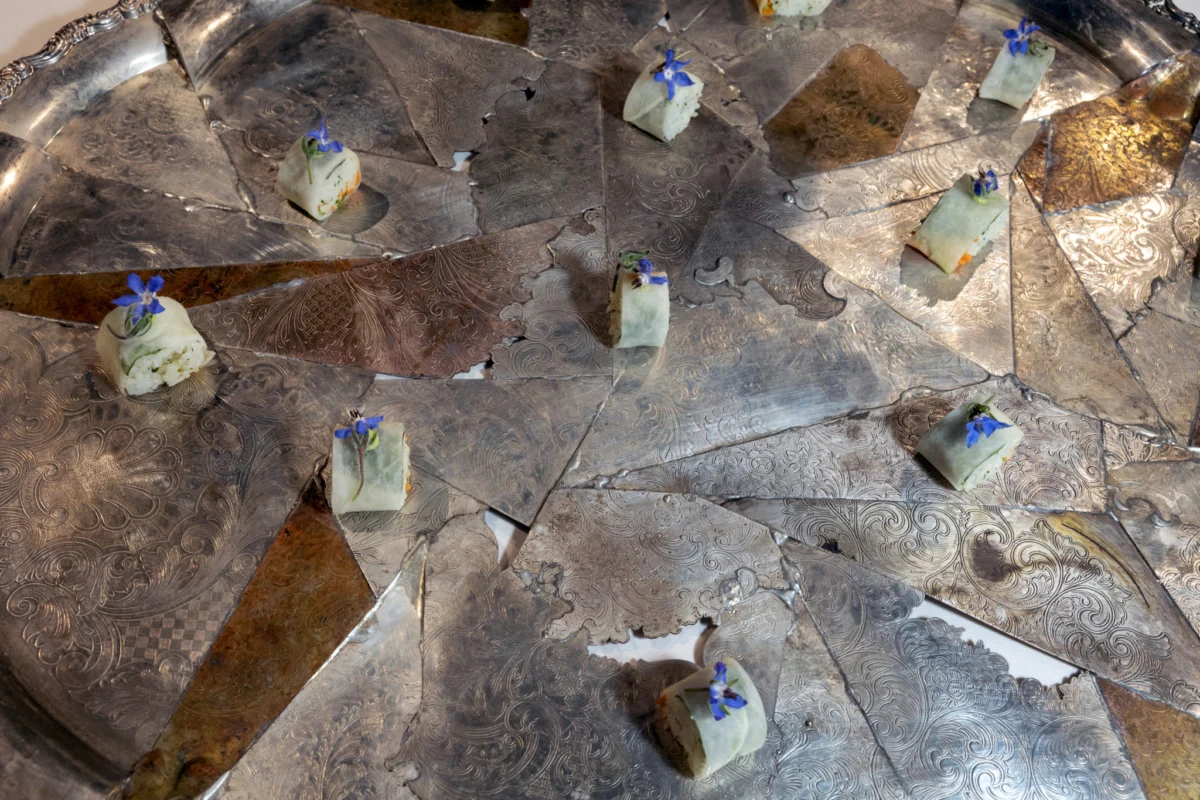
The first course, prepared by Tatemó, featured nixtamalized squash, Koshihikari rice, kosho, and carrot. The dish was served on Sustenance #1, a sculptural platter created by artist Jaydan Moore. Moore, a metalsmith known for his work with found objects, assembled the platter from salvaged antique silver-plated serving pieces. By deconstructing and reassembling these relics of 19th and 20th-century domesticity, Moore’s work directly addressed the exhibition’s theme of material inheritance, forcing guests to confront the history of the objects they used to eat.

The Second Course: Fractured Ceramics and Foraged Materials
The second course shifted the focus to geological and organic textures. Nicosi presented a Kudzumochi Tamal, composed of pumpkin juice, mushroom, masa foam, hoja santa, and gold leaf. This complex dish arrived on Adam Knoche’s Exploding Plate. Knoche utilized crushed basalt clay, pressed and fired at 2,250 degrees Fahrenheit, a process designed to cause intentional fracturing.
Accompanying the plates were carafes and sauce bowls also crafted by Knoche, which incorporated foraged Texas clay and Galveston seashells. Guests consumed the course using Utensilia spoons by Italian artist Lisa Marcolongo. These spoons featured bowls carved from trees felled by storms in Milan, joined to gnarled handles made of electroformed recycled copper. The juxtaposition of the refined tamal against the rugged, fractured ceramics and storm-reclaimed wood highlighted the tension between nature and artifice.

The Third Course: Ancient Lacquer and Monumental Scale
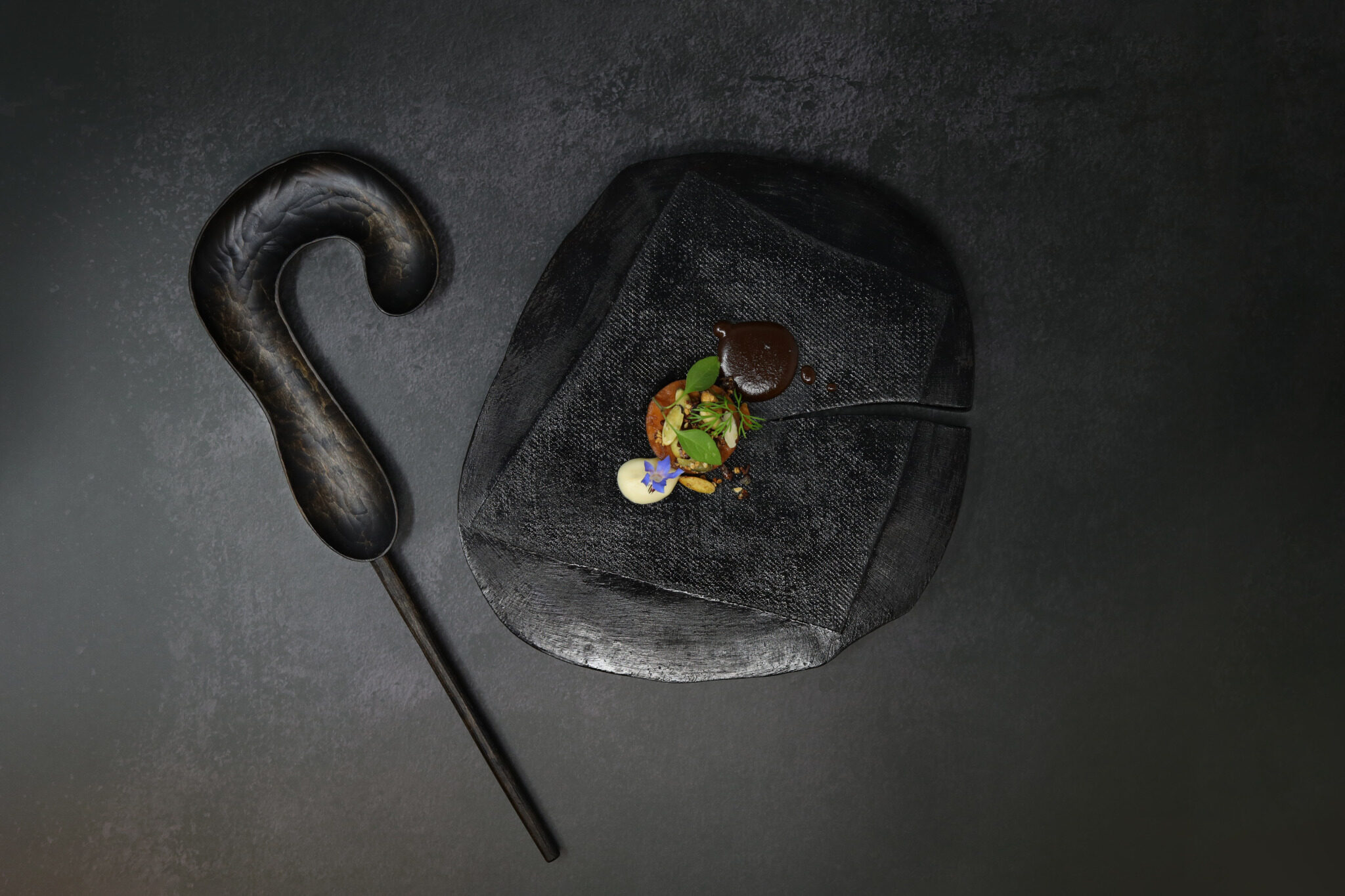
The final savory course from Tatemó highlighted smoked sweet potato, savory granola, and a duo of moles. This was served on Seok-hyeon Yoon’s Zwaart Plate, which utilized the ancient ottchil technique. Ottchil is a traditional Korean lacquer made from the refined sap of the lacquer tree, a material used by monastic artisans for over 2,000 years for its durability and antimicrobial properties.
The physical experience of the third course was further augmented by the scale of the utensils. Guests utilized lacquered maple spoons by Kyungwon Hwang and were presented with Heejoo Kim’s Gokkal Cups, made from paper and lacquer. Looming over the table were Mark Reddy’s Standing Spoons, monumental hand-carved wooden objects that challenged the ergonomic expectations of traditional cutlery.

Materiality and the Curator’s Vision
The selection of the 13 participating artists was led by HCCC Curator Sarah Darro. In her curatorial statement, Darro described the dinner table as a "site of experimentation, sensory discovery, and material invention." She noted that through the diverse processes of carving, casting, firing, and weaving, "familiar utensils become sculptural provocations."
The roster of artists included international figures such as Jakob Niemann (Sweden), Namgwon Lyu (South Korea), and Mark Reddy (UK), alongside American innovators like Molly Koehn and Edward Lane McCartney. This global perspective is central to the Steinbeisser philosophy, which seeks to decouple dining from the efficiency of modern mass production and return it to a state of slow, conscious engagement.

Analysis of Implications: Sustainability and the "Slow Craft" Movement
The Steinbeisser dinner at HCCC serves as a case study for several emerging trends in the global art and design sectors. First, it highlights the increasing intersection of sustainability and luxury. By mandating a seasonal, organic, and biodynamic plant-based menu, the organizers aligned the event with environmental ethics. Furthermore, the use of reclaimed materials—from storm-felled timber to salvaged silver—demonstrates how high-end craft can serve as a vehicle for circular economy principles.
Second, the event underscores the rise of "experience design" within museum settings. As cultural institutions seek new ways to engage donors and the public, the transition from passive observation to active participation (such as using a fractured plate or a remote-controlled buoy) provides a more memorable and impactful connection to the artwork.

Finally, the collaboration between Michelin-caliber chefs and craft artists reflects a blurring of the lines between the "fine arts" and the "applied arts." In this context, the chef is viewed as a material artist whose medium is ephemeral, while the artist provides the permanent vessel that dictates the pace and rhythm of the meal.
Broader Impact on the Houston Arts Community
For the Houston Center for Contemporary Craft, the 25th-anniversary dinner was more than a celebratory meal; it was a successful fundraising initiative that secured vital support for the institution’s future programming. By the end of the evening, guests were given the opportunity to purchase the unique pieces of tableware they had used, further bridging the gap between the gallery and the domestic space.

The event’s success reinforces Houston’s position as a significant hub for the American craft movement. By hosting the Texas debut of Steinbeisser, the HCCC has demonstrated its ability to attract international collaborations that challenge regional perspectives on art and utility. As the institution enters its next quarter-century, the 25th-anniversary dinner stands as a testament to the enduring relevance of craft in a digital age—proving that the most profound insights often come from the simple, yet reimagined, act of sharing a meal.
The participating artists who contributed to this milestone event included:

- Bohyun Yoon (USA): Glass and interactive installations.
- Jaydan Moore (USA): Metalsmithing and reclaimed silver.
- Adam Knoche (USA): Ceramics and foraged minerals.
- Lisa Marcolongo (Italy): Contemporary jewelry and reclaimed wood.
- Seok-hyeon Yoon (Netherlands/South Korea): Design and traditional lacquer.
- Kyungwon Hwang (South Korea): Wood and ottchil.
- Heejoo Kim (South Korea): Jewelry and lacquerware.
- Mark Reddy (UK): Contemporary woodcarving.
- Kaye Winwood & Nuala Clooney (USA/UK): Glass and sensory design.
- Molly Koehn (USA): Fiber and structural craft.
- Namgwon Lyu (South Korea): Traditional craftsmanship.
- Edward Lane McCartney (USA): Multimedia and jewelry.
- Jakob Niemann (Sweden): Woodwork.
Through these diverse contributions, the HCCC and Steinbeisser successfully argued that craft is an essential, usable, and transformative part of the human experience.