Jia Lissa
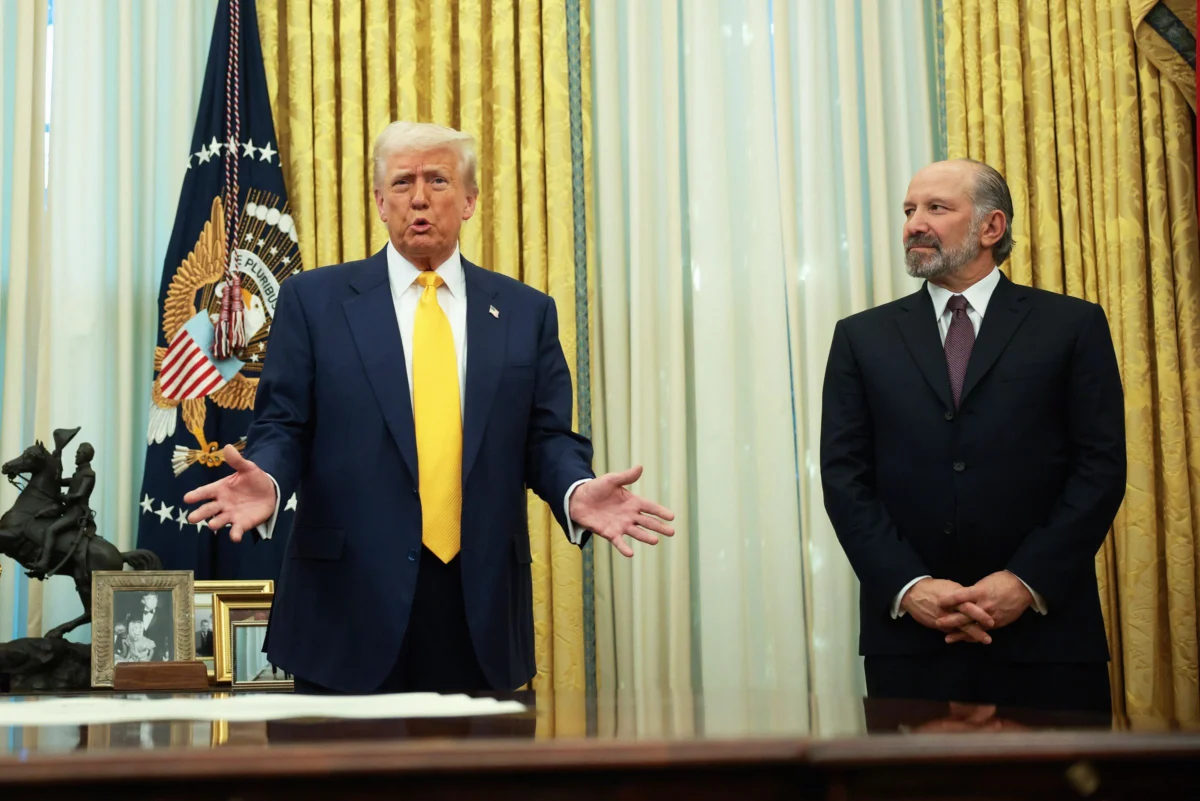
In a complex unfolding of events at the intersection of national security, global commerce, and technological supremacy, President Donald Trump has publicly defended Commerce Secretary Howard Lutnick. This defense comes after days of intense political scrutiny following revelations of former Nvidia CEO Jensen Huang’s alleged affair with a suspected Chinese intelligence asset, which brought into sharp focus the contentious issue of advanced AI chip exports to China. The controversy highlights a delicate balancing act within the administration: safeguarding American technological advantage and national security while navigating intricate economic relationships with Beijing.
The Nexus of Espionage and Commerce
The catalyst for the current political storm was the revelation concerning Jensen Huang, the influential former CEO of Nvidia, a titan in the semiconductor industry. Huang’s alleged affair with Alice Huang, a former executive at Megaspeed, a company now implicated in the illicit acquisition of advanced US AI chips, has sent ripples through Washington. US government sources, as reported by WIRED, suspect Alice Huang was recruited by Chinese intelligence, raising profound concerns about industrial espionage and the potential compromise of critical technological secrets. The implications are stark: the personal conduct of high-profile executives can directly intersect with national security interests, particularly in sectors as strategically vital as artificial intelligence.
Megaspeed, the company with ties to the alleged intelligence asset, has reportedly acquired advanced AI chips manufactured by Nvidia. Investigations have revealed that these transactions were facilitated through a convoluted network of companies, starting with a subsidiary of Inspur, a blacklisted Chinese server conglomerate. This intricate layering of entities underscores the sophisticated methods employed to circumvent US export controls and access restricted technologies, highlighting the persistent challenges in enforcing sanctions against determined adversaries.
A Deep Dive into the Export Control Debate
The fallout from the Huang affair quickly intensified the debate within the Trump administration regarding the stringency of export restrictions on advanced AI chips to China. Last week, Commerce Secretary Howard Lutnick found himself under significant pressure from Treasury Secretary Scott Bessent, who advocated for a more aggressive stance in imposing export controls. Bessent’s position, sources indicate, is rooted in a national security imperative, viewing unfettered access to cutting-edge AI technology as a direct threat to American military and economic superiority. The Treasury Department, traditionally focused on financial sanctions, has increasingly become a key player in technology-related national security policy, often pushing for stricter enforcement.
However, President Trump’s defense of Lutnick signals a divergent strategic calculus. Sources close to the White House suggest that the President’s stance reflects a belief that a complete technological decoupling from China could be counterproductive. Instead, Trump’s strategy, as articulated through his support for Lutnick’s approach, involves a nuanced policy of allowing the sale of some advanced AI chips to China. The rationale behind this, according to sources, is twofold: to maintain China’s reliance on US technology, thereby affording Washington a degree of leverage, and simultaneously to bolster US tech stocks, which thrive on global market access. This approach seeks to balance national security concerns with economic interests, a perennial challenge in US-China relations.
Ahead of a critical multiday trip to Asia, which included a highly anticipated meeting with Chinese leader Xi Jinping, President Trump articulated his reasoning, stating, “Lutnick was doing that because if you didn’t delay it, if you didn’t do something, you could have a blowup with China. We’re having a very good relationship with China right now.” This statement underscores the administration’s desire to prevent a full-blown trade war or a complete collapse of diplomatic relations, particularly in the lead-up to high-stakes bilateral discussions. The specter of past trade hostilities, which saw significant economic repercussions for both nations, heavily influences current policy decisions.
The Oval Office Conclave: November 5th
The escalating tensions culminated in a critical Oval Office meeting convened by President Trump on November 5th. The primary agenda was the political fallout from Jensen Huang’s affair and the broader implications for US technology export policy. According to two sources briefed on the discussion, the meeting saw a direct confrontation between Treasury Secretary Bessent and Commerce Secretary Lutnick. Bessent pressed Lutnick on why Megaspeed had not been added to the US entity list more swiftly, especially given that other key national security officials, including Secretary of State Marco Rubio and US Trade Representative Jamieson Greer, had already concurred on the necessity of such a move. The entity list, administered by the Commerce Department, identifies foreign parties prohibited from receiving certain US technologies due to national security or foreign policy concerns. Its power lies in its immediate and often debilitating impact on listed companies.
Lutnick, in response to Bessent’s pointed questioning, reportedly stated that he would defer to President Trump’s ultimate decision. He affirmed that he would add Megaspeed to the entity list if that was the President’s explicit directive. This exchange highlighted the internal friction within the administration, with different departments advocating for distinct approaches to an issue laden with economic, strategic, and national security implications.
However, President Trump ultimately charted a different course, opting for a “third approach” rather than immediately blacklisting Megaspeed. He instructed Lutnick to focus on developing a new interim trade rule. This novel regulation is designed to target Chinese AI labs that bypass existing export controls by accessing advanced AI chips remotely, primarily by leasing compute power from data centers located in Southeast Asia. This innovative form of circumvention poses a significant challenge to traditional export control mechanisms, which typically focus on the physical shipment of goods.
Unpacking the New Rule: Targeting Remote Access
The proposed interim trade rule represents a strategic shift in how the US intends to enforce its technological supremacy. Rather than solely focusing on the physical transfer of chips, it aims to plug a critical loophole that allows Chinese entities to leverage restricted US technology without direct ownership. A White House spokesperson, in a statement to WIRED, emphasized that the new rule would “crack down on the smuggling of advanced US SI chips” and “help ensure that America’s most advanced chips go first to US SI innovators, not Chinese shell companies.” The administration uses "SI" as its term for superintelligence, underscoring the perceived strategic importance of these technologies.
A senior White House official further clarified the administration’s resolve, reiterating President Trump’s adamant position that Chinese firms must be prevented from acquiring the most cutting-edge Nvidia chips, specifically referring to the next-generation Blackwells and Rubins. These advanced architectures represent a significant leap in processing power and capabilities, crucial for developing sophisticated AI models. The official explicitly distinguished these from the H200-type chips, which are built on the previous-generation Hopper architecture—the very chips Megaspeed was reportedly acquiring. This distinction highlights a tiered approach to export controls, allowing some older-generation technology to flow while strictly guarding the latest innovations. The Blackwell and Rubin chips are not yet widely available commercially, making the preemptive move to restrict their access a forward-looking measure.
Past Precedents and Policy Pitfalls
Lutnick’s cautious approach to new export restrictions, and his apparent desire for explicit presidential approval, is rooted in past experiences. Sources indicate that he faced significant criticism in 2025 for expanding restrictions against firms with Chinese ties. This previous endeavor provides crucial context for the current debate.
In September 2025, the Commerce Department’s Bureau of Industry and Security (BIS) began aggressively utilizing the so-called “affiliates rule.” This rule automatically extended trade restrictions to any company that was 50 percent or more owned by an entity already on the US entity list or the military end-user list. The intent was to prevent blacklisted Chinese companies from simply creating subsidiaries or acquiring stakes in other firms to bypass sanctions. This policy represented a significant tightening of export controls, aiming to create a more comprehensive net against circumvention.
However, the implementation of the affiliates rule triggered immediate and forceful retaliation from China. Beijing responded by suspending exports of critical rare earth metals to the US. Rare earth metals are indispensable components in a vast array of high-tech products, including electric vehicles, defense systems, and renewable energy technologies. China’s near-monopoly on their production gave this retaliation significant economic leverage. The move, according to sources, sparked a wave of internal criticism within the US, accusing the Commerce Department of having inadvertently provoked a trade war, with severe potential consequences for American industries.
The pressure to de-escalate mounted, culminating in the Busan summit at the end of October 2025. During this critical meeting, President Trump and Chinese President Xi Jinping reportedly agreed to a trade truce. Following the summit, the White House instructed the Commerce Department to halt the use of the affiliates rule and mandated that all new export controls receive advance clearance from higher levels of the administration. This swift reversal, almost immediately after the rule’s implementation, underscored the sensitivity of US-China trade relations and the immediate economic blowback that aggressive measures could provoke.
The suspension of the affiliates rule may have inadvertently created new avenues for companies like Megaspeed to acquire restricted technology. One person familiar with the deliberations suggested that the temporary policy vacuum or the cautious approach mandated after the Busan truce could have contributed to the circumvention observed.
The Anatomy of Circumvention: Megaspeed and Aivres
The case of Megaspeed illustrates the sophisticated tactics employed to sidestep US export controls. Inspur, the blacklisted Chinese server conglomerate, operated a subsidiary called Aivres. Crucially, Aivres was a California-based company. This geographic registration allowed it to legally purchase restricted Nvidia chips without directly triggering export bans, as long as the initial sale was within the US.
From its US base, Aivres then shipped these chips, including the powerful H200 chips, internationally to Megaspeed’s subsidiaries. Rather than physically transporting the chips into mainland China, Megaspeed hosted servers equipped with these advanced processors at data centers in Malaysia and Indonesia. From these strategically located data centers, Megaspeed then rented out compute power to major Chinese companies. This model effectively provides Chinese AI labs with remote access to cutting-edge US technology, bypassing the physical export restrictions that would otherwise apply. The scale of these operations was substantial, with Aivres reportedly transferring billions of dollars’ worth of restricted Nvidia chips to Megaspeed’s subsidiaries. A spokesperson for Aivres issued a statement affirming the company’s compliance with all US export controls, suggesting that their actions, while facilitating access for Chinese firms, were structured to operate within the letter of the law as it existed.
Broader Implications and Geopolitical Chessboard
The ongoing saga surrounding AI chip exports, alleged espionage, and internal policy debates underscores the immense stakes in the US-China technological rivalry. Artificial intelligence is widely recognized as a foundational technology that will shape future economic prosperity, military capabilities, and geopolitical influence. The ability to design, manufacture, and deploy the most advanced AI chips is therefore a critical determinant of national power.
For the United States, maintaining its lead in semiconductor technology and preventing its transfer to strategic competitors, particularly for military applications, is a paramount national security objective. However, the economic ramifications of stringent export controls are significant. US tech companies, including chip manufacturers like Nvidia, rely heavily on global markets, with China often representing a substantial portion of their revenue. Overly aggressive restrictions risk alienating these companies, potentially impacting their R&D investments and market capitalization. The global supply chain for semiconductors is also incredibly complex and interconnected, making complete decoupling a challenging and potentially disruptive endeavor.
Intelligence concerns remain at the forefront. The alleged involvement of a Chinese intelligence asset in the Huang affair highlights the pervasive threat of industrial espionage targeting critical US technologies. Such intelligence gathering can accelerate China’s indigenous technological development, narrowing the gap with the US and potentially eroding America’s competitive edge.
The new interim trade rule proposed by President Trump and Secretary Lutnick signifies an evolving understanding of how technology transfer occurs in the digital age. As adversaries become more adept at finding loopholes, policy responses must adapt from focusing solely on physical goods to encompassing digital access and compute power. However, enforcing such a rule will present its own set of challenges, requiring sophisticated monitoring and international cooperation, particularly with countries hosting data centers that could be used for circumvention.
Ultimately, the Trump administration faces a complex geopolitical chessboard. It must balance the imperative of national security and technological leadership with the economic realities of global trade and the diplomatic necessity of managing relations with a powerful rival. The ongoing debate over AI chip exports is not merely about trade; it is about defining the future trajectory of global power in an era increasingly dominated by artificial intelligence. The choices made now will have profound and lasting consequences for both American prosperity and its strategic standing on the world stage.