admin
A significant shift is underway in American agriculture as farmers, increasingly reliant on advanced technology, confront powerful equipment and seed companies over the control and monetization of their valuable farm data. At the forefront of this emerging battle is Nebraska, which has enacted the nation’s first law establishing explicit data ownership rights for agricultural producers. This landmark legislation, the Nebraska Agricultural Data Privacy Act, passed unanimously and took effect in July 2026, marking a pivotal moment in the fight for farmer autonomy in an increasingly data-driven industry. While similar legislative efforts in other states have faced setbacks, Nebraska’s precedent is fueling a broader national conversation, with federal proposals now on the table, reflecting widespread unease among producers about how their operational data is collected, used, and potentially exploited by corporate entities.
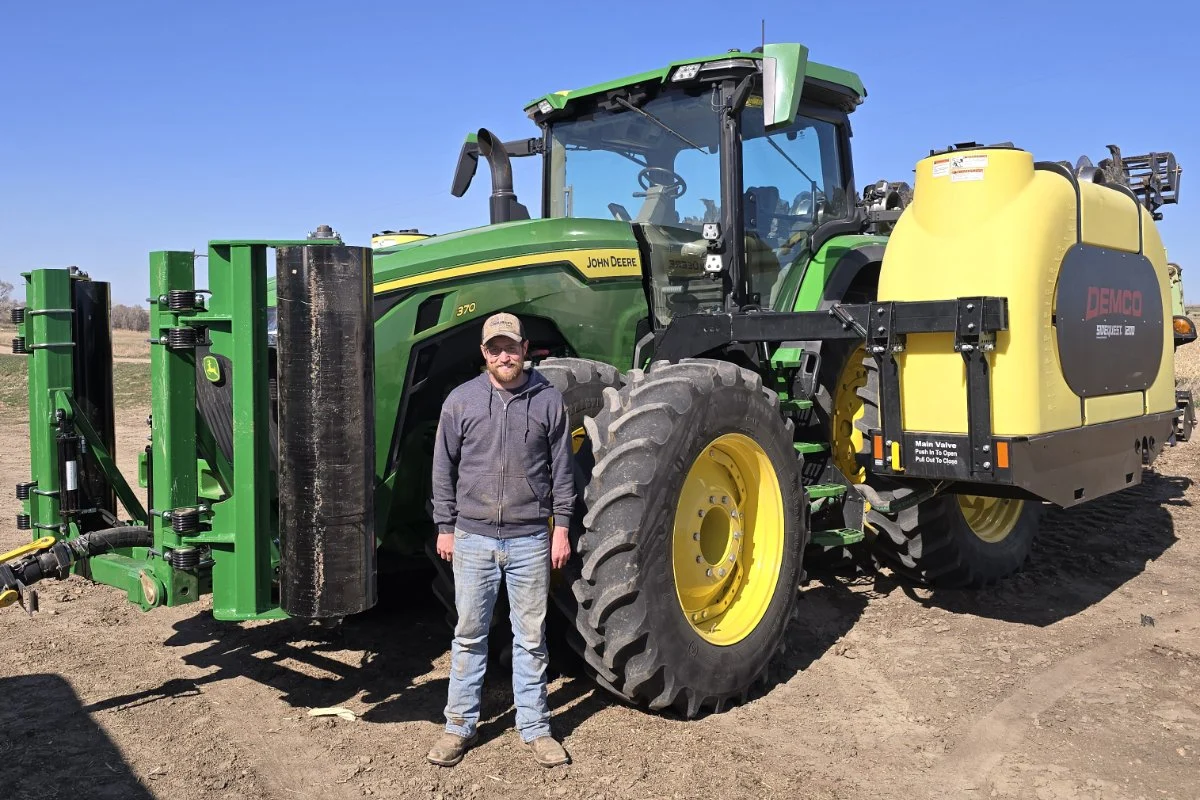
For Guy Mills, who cultivates corn, soy, and alfalfa in central Nebraska, farming is, as he describes it, a “giant science experiment.” His operation is a testament to modern precision agriculture, where meticulous data collection is integral to maximizing efficiency and yield. Mills diligently gathers information on soil types, pH levels, and nutrient uptake, supplementing his handwritten notes and spreadsheets with sophisticated digital tools. He utilizes AgLeader software to precisely track planted seeds and their performance, and the Deere Operations Center portal for creating detailed fertilizer and seed prescriptions. This deep engagement with data, however, brought a startling realization: a single John Deere combine collected an astonishing 36,000 data points during his harvest last fall.
This immense volume of automatically collected data ignited a profound concern for Mills. “I don’t want people collecting that data, because they can use it against me,” he states emphatically. His fears are tangible: companies could gain intimate knowledge of his operations—every yield, every input applied, the exact quantities, planting times, and even the mechanical performance of his machinery. This granular insight, he worries, could be leveraged by corporate monopolies in equipment, software, seeds, and other agricultural inputs, making it increasingly difficult for independent and young farmers to compete. Mills openly expresses distrust of corporate assurances regarding farmers’ full ownership of their data, seeing a clear power imbalance. However, the recent enactment of Nebraska’s data privacy law has provided him with a measure of reassurance, believing it will prevent companies from freely taking or selling his crucial business intelligence.
Nebraska’s Landmark Legislation: A Framework for Farmer Data Rights
The Nebraska Agricultural Data Privacy Act, introduced as Legislative Bill 525 (LB525), represents a pioneering effort to codify farmer data ownership. Initially introduced in January 2025 by State Sen. Mike Jacobson at the request of Governor Jim Pillen, both Republicans, the bill faced initial delays but ultimately garnered unanimous support, passing in April 2026 and becoming effective just three months later. The core of the law defines agricultural data generated from a farm, land, or equipment as a “proprietary business asset,” unequivocally granting producers ownership and control over this information.
The legislation specifically covers data across six critical categories: agronomic, climate and weather, land, livestock, management, and sustainability. A key provision prohibits third parties from selling farm data without the prior written consent of the producer. Crucially, this consent must be obtained separately from other general terms of service or data-use agreements, preventing companies from burying data-sharing permissions within broad contracts. Businesses operating in Nebraska that process farm data are mandated to adjust their contracts to comply with these new regulations by January 1, 2027. Enforcement falls to the Nebraska attorney general, who can seek injunctions against non-compliant companies or levy a $1,000 penalty per violation, though companies are typically granted a 45-day curing period to address security violations before fines are imposed.
A National Ripple Effect and the Broader Context
Nebraska’s legislative success has quickly reverberated across the nation, fueling a larger dialogue about agricultural data rights. In September 2026, Nebraska Senator Pete Ricketts, a Republican, introduced a federal version of his state’s bill, the Agricultural Data Privacy Act, to the U.S. Congress. Concurrently, a separate draft of federal legislation, backed by Democrats, is circulating, aiming to advance data rights for agricultural producers. The Democratic proposal reviewed by Civil Eats indicates an intention to cover both raw and aggregated data, and critically, would provide farmers with a direct right to sue suspected violators—a feature absent in the Nebraska law.

This legislative momentum is not occurring in a vacuum. It aligns with a broader "populist wave" of Big Tech legislation aimed at consumer protection and privacy, which attorney Reed Freeman, a data privacy specialist at ArentFox Schiff, notes is gaining traction in states across the political spectrum. Furthermore, the issue of data rights is deeply intertwined with the growing "right-to-repair" movement. With right-to-repair bills passed in 10 states and dozens more under consideration, many addressing farm equipment software, diagnostics, and data, farmers and advocates are increasingly vocal about regaining control over their machinery and the information it generates. The parallels are clear: just as farmers seek the right to repair their physical assets, they now demand ownership of their digital ones.
Unlike sectors such as healthcare and finance, which have established regulatory frameworks for data handling, agriculture has historically lacked comprehensive oversight in this area. Freeman points out that "big equipment in all industries is generating enormous amounts of machine data, and there is a fight over whose data that is, and this is just one manifestation" of this larger trend in agriculture. This regulatory vacuum has allowed agricultural technology companies to operate with significant freedom in data collection and usage, raising alarms among farmers who feel their economic viability is increasingly dependent on technologies they do not fully control. The timing is particularly critical as inflation and tariffs continue to squeeze farmers’ margins, while U.S. Department of Agriculture (USDA) budget cuts further diminish traditional support systems, leaving producers more vulnerable to corporate pressures.
Industry Reactions and Advocacy’s Cautious Optimism
The passage of Nebraska’s LB525, particularly its unanimous vote, was noteworthy for the subdued reaction from major agricultural technology companies. While John Deere Assistant General Counsel April Price testified as "neutral" during a February committee hearing, she advocated for changing the language from data "ownership" to "control"—a suggestion ultimately rejected by lawmakers, who retained the stronger "ownership" terminology. Other major ag-tech players were notably absent from the legislative record. This quiet passage has raised questions among observers like Freeman, who found it "curious that this bill made it through without a big equipment or tech company saying, ‘Absolutely not now, not ever.’"
In response to the new law, a Deere spokesperson indicated to Civil Eats that the company is "currently in the process of developing a full data policy that supports farmers." AGCO also stated it is reviewing the legislation’s impact on its offerings. Conversely, Bayer, the provider of Climate FieldView software, maintained that Nebraska’s law would not affect its existing practices, according to a company statement. Corteva did not respond to requests for comment.
Farmers’ rights advocates, however, view the industry’s muted response with a degree of skepticism. Watchdogs like Kevin Kenney, a diesel equipment engineer and vocal critic, suggest that companies may have found the final version of the Nebraska bill to be less restrictive than initially proposed. Kenney, who refers to precision agriculture as "the biggest transfer of wealth from traditional farm families to a few corporate entities that share this data among themselves," argues that the amendments significantly watered down the original intent of LB525.
The initial draft of LB525 was more robust, requiring third parties to obtain explicit written consent from farmers before analyzing, sharing, or processing their data. It also included financial protections, such as prohibiting companies from charging more for services to farmers who opted out of data sharing. The enacted law, however, while prohibiting the sale of farm data without consent, does not prohibit companies from sharing data for processing or authorized services. This distinction allows precision agriculture businesses to continue practices they deem routine, such as outsourcing data storage to cloud providers like Amazon Web Services or Microsoft Azure, or running data through proprietary algorithms and artificial intelligence (AI) models. While the law mandates "reasonable safeguards" for data protection, it does not define what constitutes "reasonable," leaving room for interpretation. Furthermore, the absence of a private right to sue means farmers must rely solely on the Nebraska attorney general’s office for enforcement, potentially limiting their recourse.
The Unresolved Frontier: Derived Data, Aggregation, and AI
The central limitation of the Nebraska law, and a key point of contention for advocates, lies in its scope. The law does not protect "derived" data—information that has been "modified, processed, analyzed, or compiled" to generate "agronomic insights, reports, and predictive models." Nor does it extend to "aggregated data," which gains immense value when combined and analyzed across numerous farms. This distinction is critical because, as Ben Craker, president of the nonprofit Agricultural Data Coalition, observes, "the aggregated data set is what’s worth something."

This "murky intellectual property middle ground" between farmers’ raw data and proprietary corporate algorithms, including emerging AI models, is where much of the potential profit lies. Joshua Hjelmaas, a research specialist at the Iowa State University Center for Agricultural Law and Taxation, explains, "The raw data is not worth really anything on an individual scale, but when it’s scaled up to thousands of farm operations, put into a model where they can derive analytical insights, that’s worth millions."
The precision agriculture market, already valued at $9.35 billion in 2025, is projected to surge by 12.2 percent annually to reach $16.73 billion by 2030. Companies like John Deere openly acknowledge the immense financial potential, with Deere describing an "incremental addressable market opportunity" of $150 billion across its businesses, including precision farming, connectivity, and autonomous technologies. While Deere states this value would be shared with customers, estimating its digital technologies could deliver $72 per acre in value to a theoretical Iowa commodity farm, advocates question the true distribution of this wealth.
Willie Cade, an agricultural rights advocate and board member of the Repair Association, challenges the notion that only aggregated data holds significant value. He argues that "data from even a single machine or field can yield lucrative insights for farmers and software providers alike," debunking what he calls "a myth that only the large row-crop guys have data." Attorney Todd Janzen, founder of Janzen Schroeder Ag Law and administrator of Ag Data Transparent, agrees that farms of all sizes generate valuable data, which producers can leverage to differentiate their products, benchmark performance, and highlight sustainable practices.
Artificial intelligence promises to unlock unprecedented insights from agricultural data, but farmers like Guy Mills remain skeptical of handing over control. Mills insists that he and other experienced farmers do not necessarily need tech giants to analyze their operations. "Anyone can learn," he says, drawing on his 52 seasons of farming. Yet, to advocates like Kevin Kenney, allowing agribusinesses unfettered access to these data sets has already created an unfair advantage. "The assault versus the family farm is way more efficient when they have your playbook," Kenney asserts. "They’ve got our playbook, and they’re playing it against us."
Challenges and the Path Forward: The Second Harvest
While Nebraska has set a precedent, the path for broader, more comprehensive data rights legislation remains challenging. Earlier in 2026, several states introduced bills that aimed to go further than Nebraska’s final version, but none became law. In Iowa, the House overwhelmingly voted to add data-rights protections to an existing right-to-repair bill (HF2763). This addition sought to cover farmers’ rights to data from their farms, as well as data "processed, analyzed, aggregated, compiled, or otherwise transformed through the application of proprietary algorithms, analytical methods, creative arrangement, or other intellectual processes." The bill’s text explicitly highlighted the grievance that "seed companies, insurers, commodity traders, agricultural technology firms, financial institutions, government agencies, and others pay premium prices for agricultural data insights, while agricultural producers receive no portion of that value." Despite passing the House, the Iowa Agricultural Data Ownership and Market Competition Act failed to receive a vote in the state Senate before adjournment.
Similarly, in Colorado, House Bill 26-1270, which would have given farmers the rights to own and monetize both their raw and transformed data, was openly opposed by Deere and other equipment makers and subsequently postponed in March. Missouri House Bill 3409 also failed, despite encompassing farmers’ rights to aggregated data and proposing heftier penalties of up to $50,000 per violation, along with a direct right for farmers to sue for $10,000 in statutory damages. The failure of these more expansive bills underscores the significant corporate opposition that comprehensive data rights legislation faces.
Despite these legislative setbacks in other states, the battle for farm data rights is far from over. Bruce Rieker, senior director of state legislative affairs for the Nebraska Farm Bureau, acknowledges the Nebraska law as an "important step" but recognizes that "agricultural data policy will continue to evolve as technology advances."
For advocates on the ground, this is not merely routine business regulation; it is a fight for the very survival of independent farming. Willie Cade encapsulates this sentiment powerfully: "I call agricultural data the second harvest. It’s another way in which farmers produce value that can go to market and make money, if they aren’t excluded from it by corporate restraints." As farming becomes increasingly intertwined with digital technologies and artificial intelligence, the question of who owns and profits from agricultural data will remain a defining challenge, shaping the economic landscape and autonomy of farmers for generations to come.