admin
admin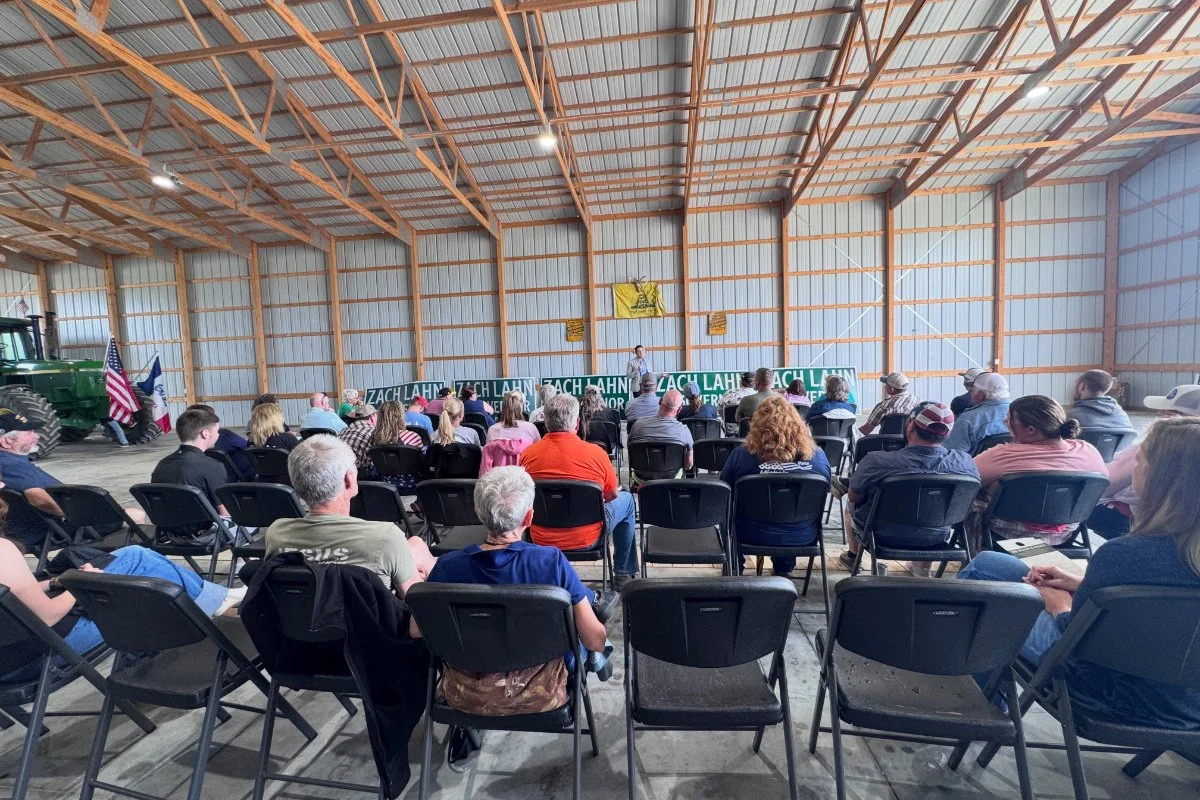
Republican gubernatorial candidate Zach Lahn, fresh off a decisive primary victory under his "Iowa First" banner, has captured significant attention with a populist message promising to dismantle agricultural monopolies and secure a "fair deal" for Iowa farmers. However, a closer examination of Lahn’s professional and personal history reveals enduring connections to the Koch family, one of the nation’s most influential pro-industry forces known for its extensive lobbying against environmental regulations and for policies that benefit large corporations. This inherent tension between Lahn’s campaign rhetoric and his past affiliations is sparking skepticism among political observers, environmental advocates, and even some within the agricultural sector, raising fundamental questions about his commitment to the very causes he now champions.
Lahn’s Ascent: From Primary Victory to Populist Promise
On June 2, Zach Lahn celebrated a resounding win in the Republican primary, taking the stage in West Des Moines before an enthusiastic crowd. His "Iowa First" campaign resonated with voters, as he declared, "They said Iowa doesn’t belong to the political class. They said our state does not belong to the lobbyists, special interests, and corporate giants." He specifically targeted corporate monopolies in Iowa agriculture, echoing a shouted demand from the crowd with a fervent, "Bust ’em up! Let’s go! I will take on the Big Ag cartels. I will break up their monopolies. I will get Iowa farmers a fair deal."
Lahn’s campaign departed from conventional Republican talking points, notably addressing the potential links between heavy chemical pesticide and fertilizer use, water quality degradation, and rising chronic disease rates in Iowa. His message gained national traction through an endorsement from Robert F. Kennedy Jr.’s Make America Healthy Again (MAHA) movement, MAHA Action, and later from Kennedy himself. This alignment with MAHA, which advocates for stricter regulations on pesticides and challenges corporate influence in health and agriculture, positions Lahn as a somewhat unconventional Republican candidate.
The current election cycle in Iowa places an unprecedented focus on issues surrounding corporate impact on farmers, public health, and quality of life. The state faces increasingly widespread pollution in its drinking water, with nitrate levels in major rivers often exceeding safety standards, and a troubling rise in cancer rates even as national rates decline. In this politically charged environment, Lahn’s anti-monopoly, pro-farmer rhetoric strikes a chord, yet his past raises immediate questions about the sincerity and feasibility of his policy promises.
A Career Forged in the Koch Network: Americans for Prosperity
Zach Lahn’s political journey began in earnest years before his gubernatorial bid. His early views were publicly documented as far back as 2009 when, as an undergraduate at the University of Colorado Boulder, he challenged then-President Barack Obama on the public option for healthcare during a town hall, arguing it would hinder private insurance companies. After college, Lahn moved to Washington, D.C., serving as staff for Republican Representatives Cory Gardner of Colorado and Steve Daines of Montana.
A pivotal chapter in Lahn’s career began in 2014 when he joined Americans for Prosperity (AFP) as its Montana operations director. AFP, a conservative political advocacy group, was co-founded and heavily funded by brothers David H. and Charles Koch, who built Koch Industries into one of the largest privately held companies in the U.S. David Koch passed away in 2019, leaving Charles Koch as the CEO, overseeing a vast network of businesses, including significant chemical fertilizer production facilities in Iowa. AFP’s primary mission has been to lobby for policies that deregulate industries, reduce environmental protections, and generally expand corporate power.
During Lahn’s tenure, AFP was actively deploying operatives nationwide to prevent states from expanding Medicaid under the Affordable Care Act. Lahn’s role in Montana was to oppose Medicaid expansion, an effort that ultimately failed as Montanans voted to expand coverage. Since then, AFP Montana has continued to advocate for expanded fossil fuel extraction and against industry regulations. Across the country, AFP has a documented history of lobbying for policies beneficial to fossil fuel and petrochemical industries, while actively campaigning against environmental regulations designed to curb pollution. This long-standing agenda stands in stark contrast to Lahn’s current campaign promises to address environmental degradation and corporate influence.

Even after his direct employment with AFP, Lahn maintained ties to the Koch family. He collaborated with Chase Koch, Charles Koch’s son, to co-found and operate Wonder, a private school in Kansas. As recently as March 2025, Lahn and his wife, Annie (formerly married to Chase Koch), were listed as staff at the school and now serve on its Board of Directors. This continued proximity to the Koch family, whose corporate empire includes the very "Big Ag" entities Lahn criticizes, raises further "red flags" for critics like progressive blogger David Bradley, who suggests these ties signal an intent to "cripple any regulatory power that state government has, giving businesses a green light to screw workers and consumers without much thought."
Iowa’s Agricultural Landscape: A Battleground for Corporate Power
Iowa’s agricultural sector, a cornerstone of its economy and identity, has become a microcosm of the national debate over corporate consolidation and its impact on independent farmers and the environment. Farmers are increasingly vocal about the stranglehold of monopolies, particularly in critical input sectors like nitrogen fertilizer. According to Farm Action, just four companies—CF Industries, Nutrien, Yara-USA, and Koch Industries—control an astounding 84 percent of U.S. fertilizer production. This concentration has led to concerns about price manipulation, reduced competition, and increased economic pressure on farmers.
Lahn’s campaign has tapped into this discontent, with him stating in an April video shared by Farm Action that farmers’ struggles are "a product of a lot of consolidation across a lot of industries." In early July, he promised Iowans he would "lead the charge to bring anti-trust suits against these companies and to give farmers a fair shake."
However, Lahn’s promise to take on these powerful entities is complicated by Koch Industries’ own significant footprint in the Iowa fertilizer market. In 2023, Koch Industries acquired Iowa Fertilizer Co., a plant initially built with $100 million in Iowa taxpayer money specifically to foster competition in the consolidated market. As Iowa State Representative J.D. Scholten, a Democrat on the agriculture committee, noted, "The state of Iowa put in $100 million to create competition, and then for Koch to come and buy them 10 years later is exactly the thing it was supposed to be going against." Lahn’s campaign has not responded to specific questions about whether he would have supported this sale as governor, leaving a significant gap in his stated anti-monopoly stance.
The Pesticide Immunity Bill: A Defining Conflict
One of the most immediate and controversial issues highlighting the disconnect between Lahn’s current platform and his past associations is the debate over pesticide company immunity bills. These bills, vehemently opposed by the MAHA movement and its supporters, seek to limit the right of individuals to sue pesticide companies when products linked to cancer and other health issues cause harm.
Lahn has unequivocally stated his opposition to such legislation, declaring in a May Instagram post, "No company should ever have immunity from liability. I would veto any pesticide immunity bill that would come up." This position aligns him directly with MAHA activists who have rallied outside the Supreme Court, helped block federal legislation that would remove the right to sue, and fought similar liability shield bills in states nationwide.
Yet, AFP, Lahn’s former employer and a key component of the Koch network, has been on the opposite side of this fight. Iowa legislative records show that earlier this year, AFP had two lobbyists at the Iowa Capitol actively pushing for a pesticide company immunity bill proposed in the state legislature. This direct contradiction between Lahn’s stated policy and the lobbying efforts of his former benefactors underscores the complexity of his position.
Lahn’s campaign has consistently declined to comment on his prior work with Americans for Prosperity or address specific questions about these conflicts. In a July PBS interview, when questioned about his AFP relationship, Lahn vaguely referenced his work on Affordable Care Act loopholes but did not distance himself from AFP’s broader political agenda. During a primary debate in May, while reiterating his opposition to pesticide immunity and pledging to fight agricultural companies "lying to farmers about the safety of chemicals," he offered no concrete plans to reduce pesticide exposure.

Further amplifying skepticism is Lahn’s choice of running mate, Iowa Representative Derek Wulf. Political journalist Laura Belin reported that in 2024, Bayer’s Modern Ag Alliance, an industry group, ran an advertisement in the Des Moines Register listing Wulf among legislators "advocating for this crucial legislation" (referring to a pesticide immunity bill). While Wulf maintains he did not support the legislation and that his name appeared in the ad without his knowledge or consent, campaign finance records show he received $1,000 from a Bayer PAC in both 2024 and 2025, alongside numerous other contributions from agribusiness. This funding, while common in Iowa politics, adds another layer of scrutiny to the Lahn-Wulf ticket’s stance on corporate liability.
The Broader Implications: Trust, Policy, and Iowa’s Future
Lahn’s campaign represents a significant political paradox. He has successfully tapped into a deep vein of discontent among Iowans—particularly farmers—who feel disenfranchised by corporate power and concerned about the health and environmental consequences of industrial agriculture. His embrace of the MAHA movement, which seeks to challenge the very industries the Koch network champions, is a testament to the shifting political landscape.
MAHA-affiliated activists like Kelly Ryerson, founder of American Regeneration, remain optimistic. Ryerson, who advocates for stricter pesticide regulations, expressed her enthusiasm, stating, "I’m so thrilled he is wanting to support off-ramps from the chemical treadmill and dependency on corporations. He is acknowledging the poisoning of the water and the land throughout Iowa and how that’s making communities sick and destroying the rural fabric. I’m choosing to be optimistic that this really could be the change." If elected, Ryerson hopes Lahn would pursue policies like banning paraquat, a pesticide linked to Parkinson’s Disease, and restricting pre-harvest desiccation, a practice that increases pesticide residues in food.
However, for many others working on food system and environmental issues in Iowa, Lahn’s promises fall short without concrete policy proposals that include regulation. Jennifer Breon, an Iowa City-based organizer with Food and Water Action, criticizes Lahn for talking about the issues but stopping "short of any policy solutions that would regulate the industry." Given his history of working "essentially for industry groups," she views his promises as mirroring a national Republican trend of courting MAHA voters with rhetoric while simultaneously slashing environmental regulations, approving new pesticides, and siding with big agribusiness.
The debate over voluntary versus regulatory approaches to environmental protection is central to Iowa’s challenges. The state’s Nutrient Reduction Strategy, which has encouraged voluntary conservation practices for over 13 years, has yielded mixed results, with nitrate levels in Iowa’s water remaining persistently high. In 2025, Iowa reported 36 violations of nitrate levels in drinking water, double that of the previous year. Breon argues that meaningful progress on water quality is unlikely without new regulations, which would "level the playing field if everyone was required to do this, and that’s the only way we’re going to get clean water in Iowa."
Iowa Farmers Union President Aaron Lehman emphasizes that farmers, not multinational corporations, should be at the forefront of conversations about clean water and conservation. He notes that while Lahn’s language might resonate, farmers are still weighing who to trust. "Just because there is language that might resonate on some of these issues, the reality is that it takes real commitment across the board to deal with corporate control of our family farm system," Lehman said.
As the gubernatorial race intensifies, Zach Lahn faces the formidable task of convincing a skeptical electorate that his populist anti-corporate stance is genuine, despite his deep and long-standing ties to the very industrial forces he now pledges to challenge. His ability to translate rhetoric into concrete policy actions that truly prioritize Iowa’s farmers and environment over corporate interests will be the ultimate test of his leadership.