admin
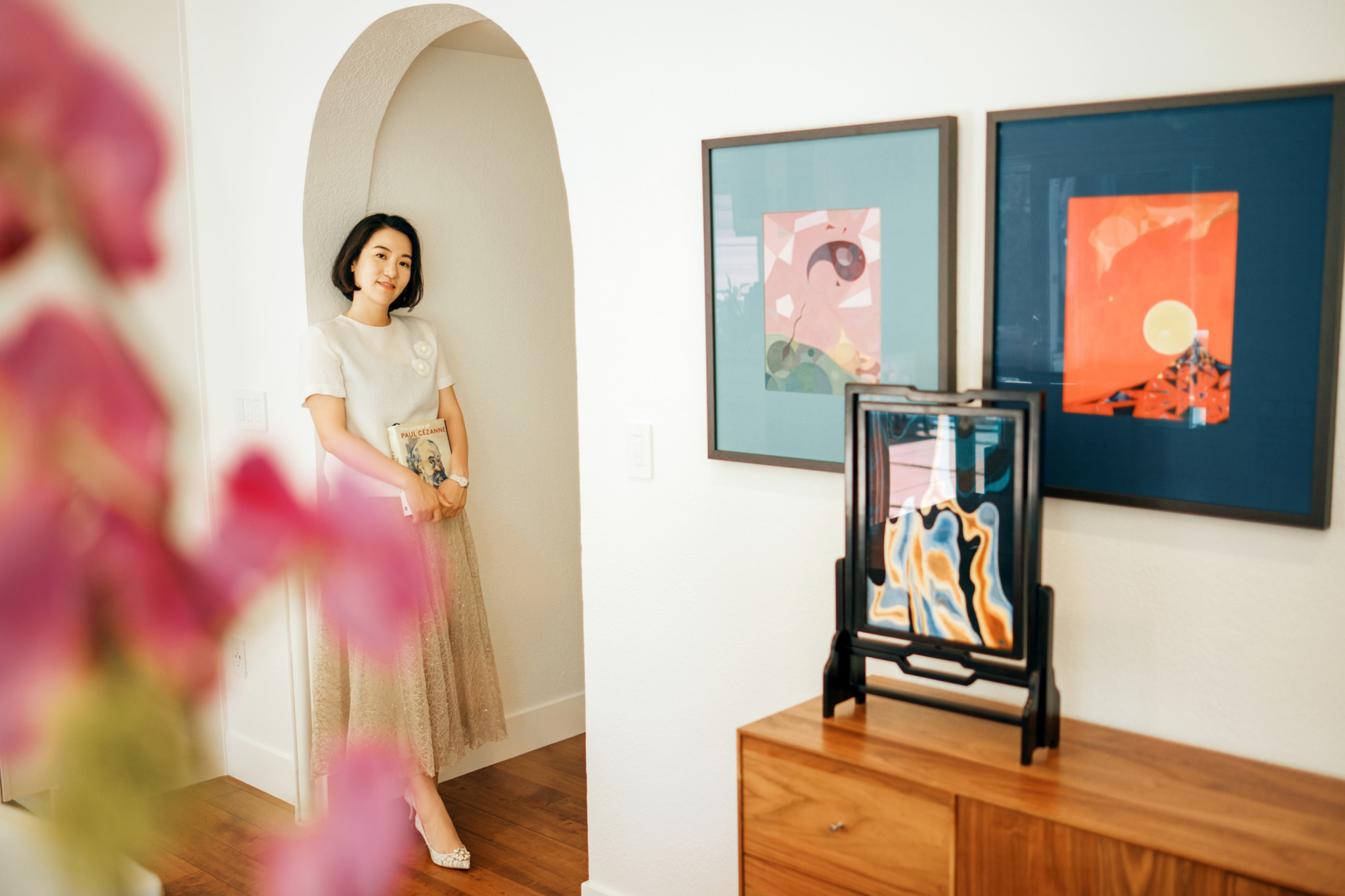
The intersection of high-stakes financial markets and the contemplative world of fine art is often viewed as a dichotomy, yet for San Francisco-based artist and finance professional Grace Zhang, these spheres are inextricably linked through a shared pursuit of structural order and pattern recognition. Currently on display at the GCS Agency gallery in San Francisco, Zhang’s debut public exhibition, Spacetime Monologue, serves as a physical manifestation of this dual existence. Running through October 25, the collection features 32 distinct works that synthesize diverse influences—ranging from quantum physics and Buddhist philosophy to the volatility of global markets and the precision of haute couture.
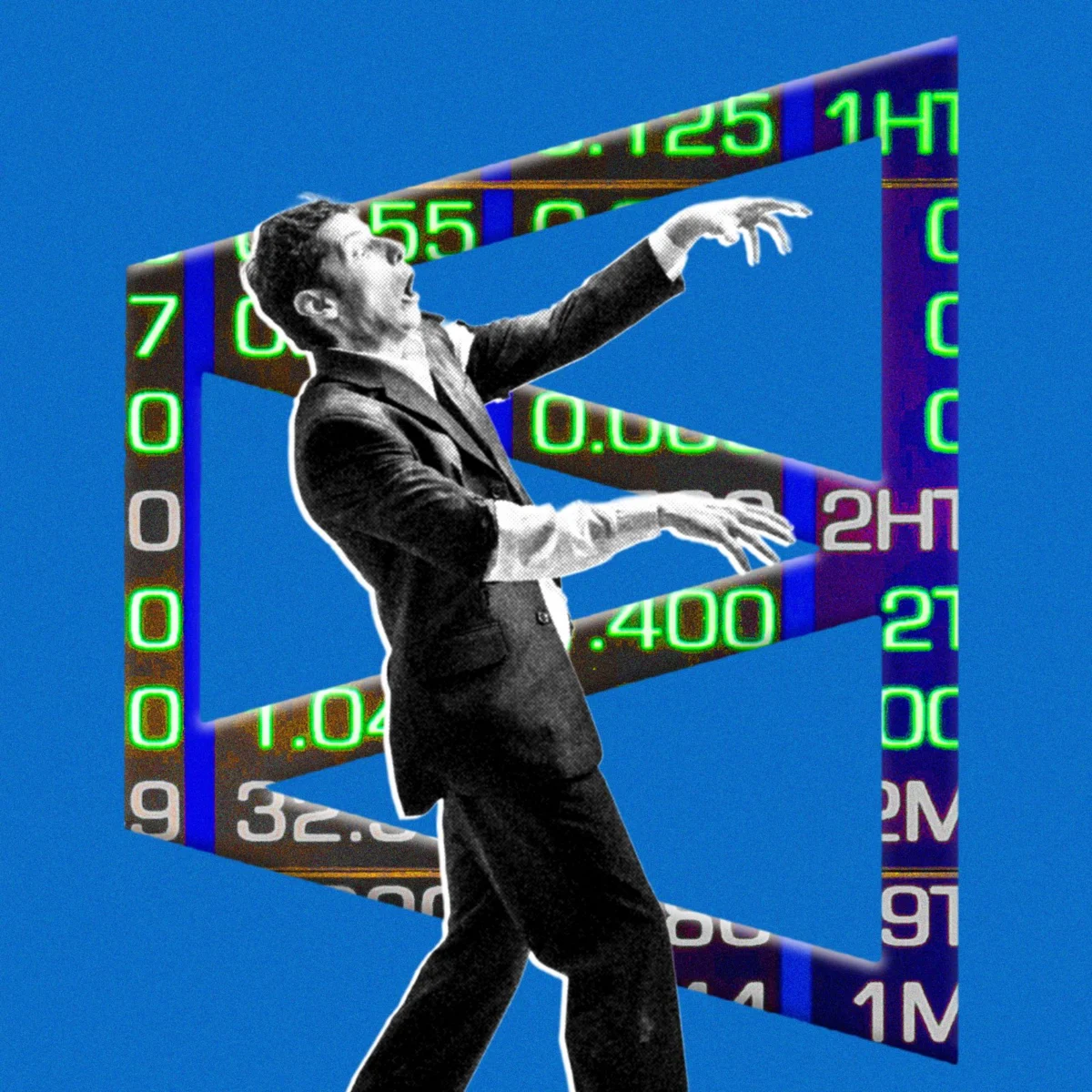
Zhang, a graduate of Columbia University’s international affairs program, manages a demanding career in the financial sector while maintaining a rigorous artistic practice. Her daily routine involves a literal and figurative movement between a Bloomberg Terminal and an easel, a process she describes as a search for the underlying principles of the universe. In a professional landscape where "multihyphenate" careers are becoming increasingly common, Zhang’s work offers a sophisticated case study in how analytical disciplines can inform and enrich creative output.
The Architecture of a Dual Career: From Markets to Motifs
The foundation of Zhang’s artistic perspective is built upon her education and her professional immersion in global finance. At Columbia University, her studies in international affairs provided a macro-level understanding of global systems, a perspective that transitioned naturally into the world of market analysis. In finance, the ability to discern signals from noise is paramount; Zhang applies this same methodology to her canvas.
Her paintings are characterized by saturated, contrasting colors, geometric forms, and recurring "dot-and-wave" motifs. These elements are not merely aesthetic choices but are representations of systemic structures. Zhang views her painting practice as a counterpoint to the intensity of the markets—a way to decompress—but also as a different lens through which to view the same complexities. This search for balance is a central theme in Spacetime Monologue, where the artist seeks to reconcile the rigid logic of financial data with the fluid, emotional resonance of visual art.
Beyond the canvas, Zhang’s creative reach extends to the design of original jewelry and fine watches. In these mediums, she draws heavily from the structural approach to color and form pioneered by Paul Cézanne. By treating jewelry and timepieces as miniature sculptures, she reinforces her commitment to the idea that art is not a separate entity from functional life, but rather a framework for understanding it.

Scientific and Financial Catalysts: Elliott Waves and Quantum Theory
A significant portion of the exhibition is dedicated to interpreting abstract scientific and economic theories through a visual medium. Two primary concepts serve as the backbone for several key works: Elliott Wave Theory and the "double-slit" experiment in quantum mechanics.
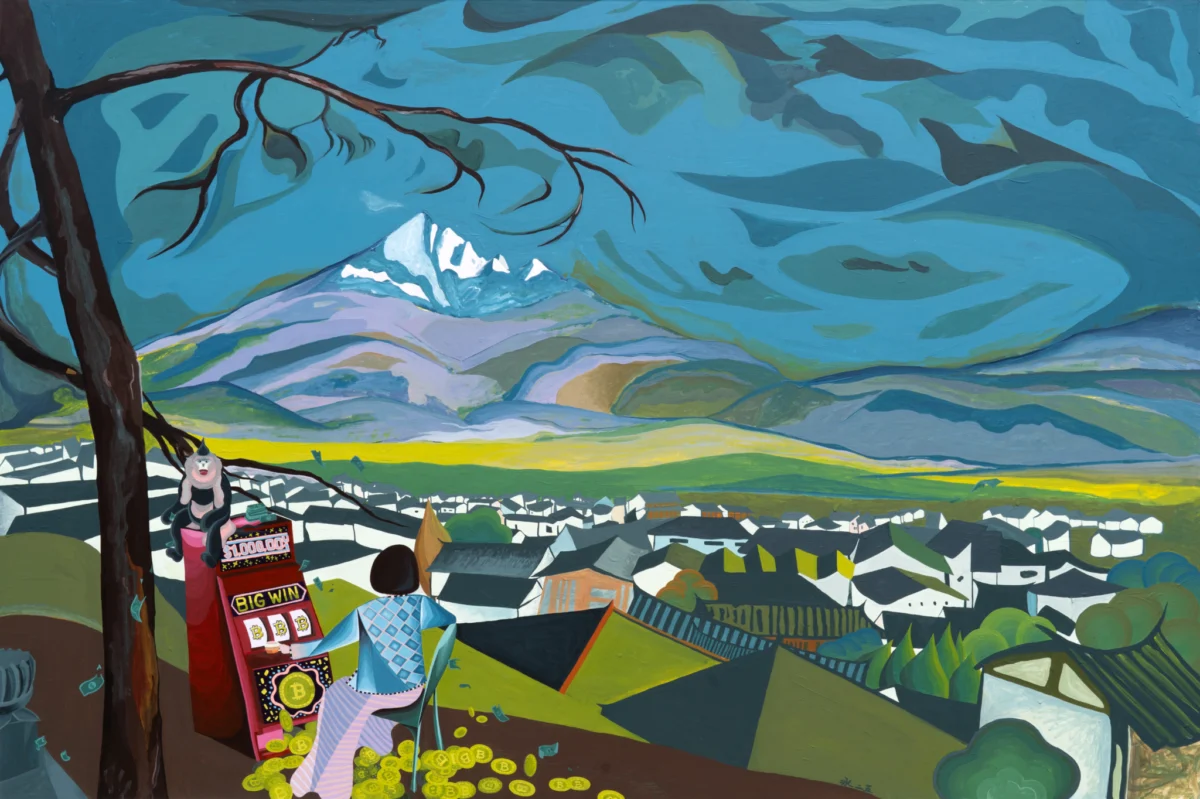
In the world of technical analysis, Elliott Wave Theory—developed by Ralph Nelson Elliott in the 1930s—suggests that stock market prices move in repetitive cycles (waves) driven by collective investor psychology. These patterns are influenced by alternating moods of optimism and pessimism, ranging from euphoria to despair. Zhang’s painting Jade Hash serves as a direct interpretation of this theory. While traveling in Lijiang, China, Zhang observed the jagged ridgeline of the Jade Dragon Snow Mountain. To her eyes, the mountain’s silhouette mirrored the peaks and troughs of market charts, specifically those of cryptocurrency and U.S. debt. In the painting, the landscape is transformed into a wave-like form, connecting the permanence of the earth with the ephemeral fluctuations of the global economy.
Parallel to her interest in finance is a fascination with the "duality of light." The double-slit experiment, a cornerstone of modern physics, demonstrates that light can behave as both a particle and a wave, depending on whether it is being observed. This paradox is explored in Zhang’s work Quantum Whisper. Here, dots and waves become a visual vocabulary for this duality. The painting attempts to capture the moment where the act of observation changes the nature of reality, reflecting Zhang’s belief that the "looker" or the artist plays an active role in shaping the perceived world.

The Influence of Music and Philosophy: Bach and Buddhism
While science and finance provide the structural logic for Zhang’s work, Johann Sebastian Bach and Buddhist philosophy provide its emotional and spiritual depth. Zhang cites Bach’s Fugue No. 24 in B minor as the single creative work that has left the deepest impression on her. The piece, known for its intricate counterpoint and harmonic complexity, represents a perfect equilibrium between mathematical structure and profound emotion.
Zhang strives for a similar harmony in her paintings. She describes her style as "Buddhist philosophy meets the structural logic of Cézanne." This synthesis is evident in her exploration of life, death, and the cosmos. Her latest series, Aurora Undae Country Club, takes this exploration into a unique territory: the golf course. Zhang reimagines the sport not just as a leisure activity, but as a "portal between earthly experience and cosmic space." By placing the familiar green of the golf course against the backdrop of the universe, she invites viewers to consider the interconnectedness of human activity and the infinite.
The use of Buddhist teachings allows Zhang to approach her work with a sense of "transcendence." This is particularly evident in her use of "dot" motifs, which can represent both the infinitesimal particles of the physical world and the vast, distant stars of the universe.

Haute Couture as Self-Portraiture: The Influence of Chanel and Dior
A notable segment of Spacetime Monologue consists of self-portraits that draw inspiration from the world of high fashion, specifically the haute couture collections of Chanel and Dior. For Zhang, fashion is not merely about vanity or trend; it is another form of complex structure and artistic expression.
In Self Portrait I, Zhang uses a Chanel haute couture jacket from the Spring-Summer 2021 collection as a primary motif. She was drawn to the garment’s wave-like pattern, which she reinterpreted through the lens of light physics. The blue and yellow tones of the jacket are set against a red, universe-inspired background, while the reflective details of the embroidery are transformed into celestial bodies.
Similarly, Self-Portrait—One Night at Dar El Bacha incorporates a look from Chanel’s Spring-Summer 2024 collection. This work connects Zhang’s travels in Morocco with the geometric traditions of Islamic art. The dark, embellished ensemble serves as a metaphor for the night sky, symbolizing humanity’s enduring fascination with the cosmos. By placing herself within these intricate sartorial structures, Zhang explores the relationship between the individual and the grand designs of history and culture.

Chronology and Context: The Path to Spacetime Monologue
The path to this exhibition has been one of gradual accumulation and refinement. While Zhang has been practicing art privately for years, the decision to hold a public exhibition marks a significant milestone in her career.
- 2021-2023: Development of the haute couture-inspired self-portraits and the initial exploration of the "dot-and-wave" motif.
- Late 2023: Conceptualization of the Aurora Undae Country Club series, blending the artist’s interest in golf with cosmic themes.
- Early 2024: Completion of Jade Hash and Quantum Whisper, solidifying the connection between financial market analysis and quantum physics in her work.
- October 2024: Opening of Spacetime Monologue at GCS Agency, San Francisco.
The exhibition at GCS Agency is strategically timed. San Francisco’s art scene has seen a resurgence of interest in artists who bridge the gap between the city’s dominant technology/finance sectors and the traditional arts. GCS Agency, known for representing multidisciplinary talent, provides an ideal venue for an artist whose work requires an understanding of both technical precision and abstract thought.
Broader Implications: The Rise of the Polymath in Contemporary Art
The emergence of artists like Grace Zhang reflects a broader trend in the contemporary art market: the rise of the professional polymath. As the boundaries between industries become more porous, collectors and galleries are increasingly drawn to artists who bring specialized knowledge from other fields—such as science, finance, or engineering—into their creative practice.

Zhang’s work suggests that the skills required for success in finance—pattern recognition, risk assessment, and an understanding of global cycles—are not as far removed from the artistic process as once thought. By using the Bloomberg Terminal as a source of inspiration rather than just a tool for commerce, Zhang challenges the traditional "starving artist" narrative and proposes a model where professional stability and creative excellence can coexist and feed into one another.
Furthermore, the exhibition highlights the growing importance of "intellectual art"—work that requires the viewer to engage with complex external theories to fully appreciate the visual output. In a world saturated with quick-consumption digital media, Zhang’s paintings demand a slower, more analytical form of engagement, much like the Bach fugues she admires.
Final Reflections on Spacetime Monologue
As Spacetime Monologue nears the end of its run on October 25, it leaves behind a compelling narrative about the search for order in a chaotic world. Grace Zhang’s ability to find common ground between the fluctuating numbers of a market chart and the steady ridgeline of a mountain, or between the stitches of a couture jacket and the stars of a distant galaxy, offers a unique perspective on the interconnectedness of all things.

For the San Francisco community and the broader art world, Zhang represents a new wave of creators who refuse to be confined to a single discipline. Her work is a reminder that whether one is looking at a financial terminal or a blank canvas, the goal remains the same: to make sense of complexity and to find the harmony that lies beneath the surface of the lived experience.
The exhibition remains open to the public at GCS Agency, providing a rare opportunity to witness the synthesis of finance, science, and fine art through the eyes of a modern-day polymath. Following the close of the San Francisco show, Zhang is expected to continue her exploration of these themes, with future works potentially delving deeper into the intersection of artificial intelligence and human creativity—a natural progression for an artist so deeply rooted in the structures of the future.