admin
admin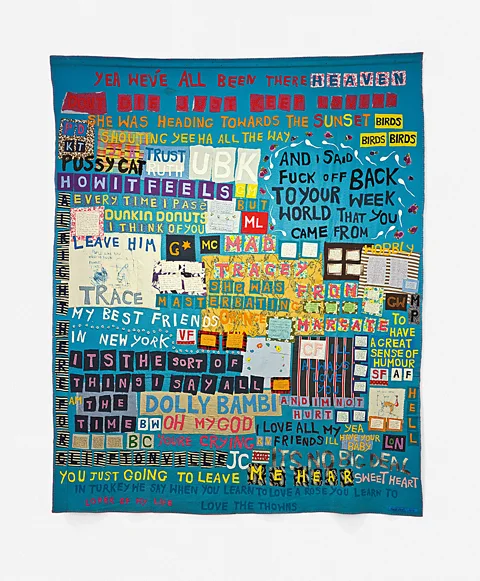
In the late 1990s, the British contemporary art scene underwent a radical transformation that challenged the boundaries of traditional aesthetics and public decency, culminating in the 1999 exhibition of Tracey Emin’s seminal work, My Bed. This installation, a dishevelled divan surrounded by the intimate debris of a personal crisis, did more than just polarize critics; it signaled a shift in how personal narrative and domestic reality could be canonized within the institutional framework of high art. Today, as the Tate Modern hosts the career-spanning retrospective "A Second Life," the work is being re-evaluated not as a provocation, but as a poignant historical document of human vulnerability.
The Genesis of a Cultural Flashpoint
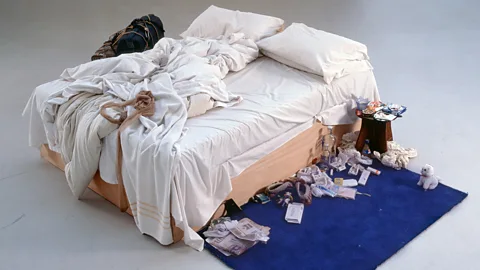
Tracey Emin’s My Bed (1998) was born from a period of intense emotional distress following a traumatic relationship breakdown. For several days, Emin remained confined to her bed in a state of depressive inertia, consuming only alcohol and neglecting her physical environment. Upon finally emerging from this state, she looked back at the chaos and recognized it as a self-portrait. The resulting installation featured a stained mattress, rumpled sheets, and a surrounding "crime scene" of detritus: empty vodka bottles, cigarette butts, used condoms, blood-stained underwear, and pregnancy tests.
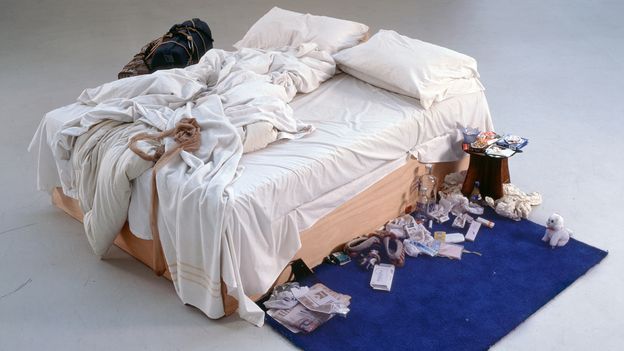
When the work was shortlisted for the Turner Prize in 1999 and displayed at Tate Britain, it ignited a media firestorm. The British press, led by tabloids like The Daily Mail, characterized the work as a "stomach Turner," while broadsheets questioned whether such "sordid" displays belonged in national galleries. Despite the vitriol, the work became a phenomenon, drawing record crowds and cementing Emin’s status as a central figure in the Young British Artists (YBA) movement.
A Chronology of Controversy and Acclaim
The trajectory of My Bed from a scandalous installation to a multimillion-pound masterpiece reflects the broader evolution of the art market and public taste over the last three decades.
- 1998: Emin creates My Bed in her Waterloo apartment.
- 1999: The work is exhibited at Tate Britain for the Turner Prize. Although Emin does not win—the prize went to film artist Steve McQueen—she dominates the cultural conversation. Two performance artists, Yuan Chai and Jian Jun Xi, jump onto the bed to stage a pillow fight, adding to the spectacle.
- 2000: The work is purchased by Charles Saatchi, the advertising mogul and influential art collector who championed the YBAs, for £150,000.
- 2014: After being housed in Saatchi’s private collection for over a decade, My Bed is put up for auction at Christie’s. It sells for £2.54 million ($4.35 million), a record for Emin’s work, and is subsequently loaned back to the Tate by the purchaser, German businessman Christian Duerckheim.
- 2015–2025: The work is exhibited internationally, often paired with classical works by artists like William Blake or Francis Bacon to highlight its thematic depth regarding the human condition.
- 2026: The retrospective "A Second Life" opens at Tate Modern, positioning My Bed as the centerpiece of Emin’s transition from a "bad girl" of the YBA era to a Royal Academician and Dame.
The Young British Artists and the "Cool Britannia" Era
To understand the impact of My Bed, one must consider the socio-political climate of the 1990s. The YBA movement, which included figures like Damien Hirst, Sarah Lucas, and the Chapman brothers, thrived on a "shock and awe" strategy that mirrored the brashness of Britpop and the "Cool Britannia" branding of the Tony Blair era.
Art during this period moved out of the ivory tower and into the streets, clubs, and tabloids. Emin, however, occupied a unique space within this constellation. While Hirst used formaldehyde and Lucas used found objects to explore mortality and gender, Emin used her own life as raw material. Her work was inherently "autofictive"—a term suggested by Tate Director Maria Balshaw to describe the blend of authentic experience and performative craft. In the 90s, this was often dismissed as "confessional" or "attention-seeking," terms that were frequently weaponized against working-class women in the public eye.
Technical Conservation: Preserving the Ephemeral
One of the most complex aspects of My Bed is its status as a meticulously conserved museum object. Despite its appearance of spontaneous disarray, every element of the installation is cataloged and preserved with the rigor applied to a Renaissance painting.
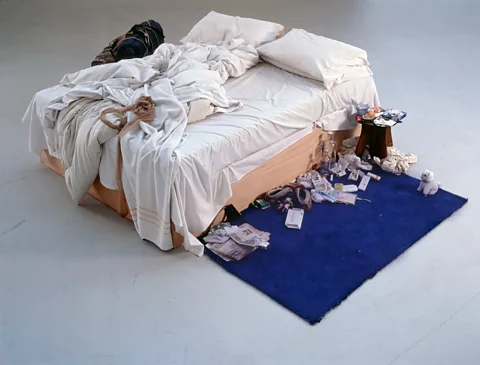
According to curatorial records, the installation consists of dozens of individual components, each housed in labeled archival bags. These include specific "empty Duracell packets," "three lager cans," and "crumpled pillows." Emin provides precise instructions for the reconstruction of the bed, demanding that the sheets be rumpled in a way that looks "natural" yet consistent with the original 1998 state. The conservation of the organic material—such as the stains on the mattress and the discarded food items—requires specialized environmental controls to prevent decay while maintaining the "authentic" filth that defines the work.
In the 2026 exhibition at Tate Modern, curators have implemented advanced security measures, including floor-level laser alarms, to prevent the types of "interventions" seen in 1999, such as the infamous housewife who attempted to "clean" the bed with disinfectant.
From Scandal to the National Curriculum
Perhaps the most significant indicator of the work’s cultural absorption is its presence in the British educational system. Once decried as a sign of the "death of art," My Bed is now a staple of the GCSE and A-Level Art curriculum in the United Kingdom.
Educational experts note that the work serves as an accessible entry point for students to discuss concepts such as installation art, readymades (in the tradition of Marcel Duchamp), and the role of the artist’s biography in their work. By de-emphasizing traditional craftsmanship in favor of conceptual honesty, Emin’s work has encouraged generations of young artists to explore personal identity and mental health through their creative output.
A Second Life: The 2026 Retrospective and Emin’s Maturity
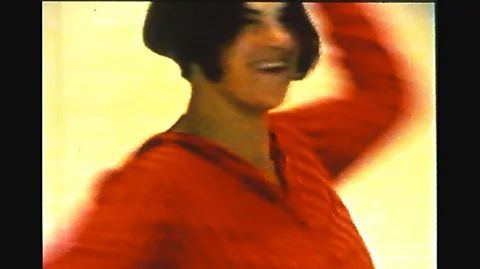
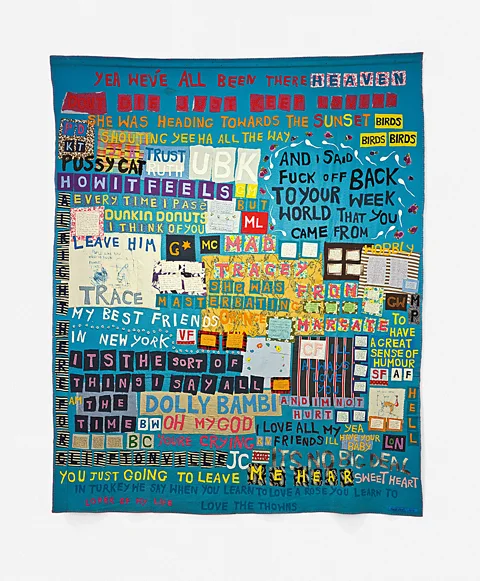
The 2026 exhibition "A Second Life" arrives at a pivotal moment in Emin’s life. Now 62 and a survivor of aggressive bladder cancer, Emin’s recent work has shifted toward themes of mortality, resurrection, and the endurance of the physical body. The retrospective links her early autobiographical films, such as Why I Never Became a Dancer (1995), with her recent large-scale bronze sculptures and lucid, visceral paintings.
Dr. Vivienne Gaskin, a senior lecturer and former director of live arts at the ICA, suggests that the current cultural moment allows for a "sober" evaluation of Emin’s legacy. "The lack of self-consciousness is lovely, but it’s the emotional work which hits really hard," Gaskin noted. The "shouting" of the YBA era has faded, leaving behind the core of Emin’s practice: an unwavering commitment to "truth" over mere "confession."
In the context of the 2026 show, My Bed acts as a bridge. It represents the "first life" of an artist defined by turmoil and public scrutiny, leading toward a "second life" characterized by resilience and institutional respect.
Legacy and the Shift in Public Perception
The reaction of the 2026 audience differs markedly from that of 1999. In a world saturated with "oversharing" on social media, the initial shock of seeing a woman’s intimate life on display has dissipated. Instead, visitors at the Tate Modern often report feelings of empathy and nostalgia.
Maria Balshaw observes that modern audiences "see the trace of a human being" in the work. The "unladylike" qualities that once offended critics are now recognized as a brave reclamation of the female experience. Emin herself has noted that the bed has taken on its own entity, separate from her personal history. "Now, when people see it they don’t go ‘oh,’ they go ‘ah,’" Emin stated in the exhibition catalog. "Because it looks so sweet. It’s so sad. It’s got this whole history."
Ultimately, the enduring power of My Bed lies in its ability to transform the mundane and the "sordid" into something universal. By placing her most vulnerable moment in the center of the gallery, Tracey Emin forced the art world to look at the reality of the human condition—unfiltered, unmade, and unapologetic. As the work continues its international tour to Denmark, South Korea, and Australia, it stands as a testament to the fact that the most personal art is often the most enduring.