admin
In the autumn of 1800, the Prefecture of Police in Paris issued a decree that would remain on the statute books for more than two centuries: a formal ban on women wearing trousers in public. This legal maneuver was not merely a matter of aesthetic preference but a calculated political instrument designed to suppress the rising tide of female autonomy that had surged during the French Revolution. For the next 113 years, until the law began to erode under the pressure of the cycling craze and eventually the world wars, thousands of women engaged in a quiet but persistent insurrection. They flouted the law, navigated bureaucratic loopholes, and redefined the boundaries of gender through their wardrobes. Today, the Palais Galliera in Paris honors this legacy with the exhibition, "A Wardrobe of One’s Own: Dissident Femininities in the 19th Century," which meticulously documents the bravery of those who traded corsets for pantaloons.

The Revolutionary Context and the Decree of 1800
The roots of the trouser ban are found in the chaotic fervor of the French Revolution (1789–1799). During this decade of upheaval, Parisian women were not merely spectators; they were active participants on the barricades. Many adopted the "sans-culottes" style—the long trousers worn by working-class revolutionaries—to signal their alignment with the movement’s ideals of liberty and equality. The Declaration of the Rights of Woman and of the Female Citizen, penned by Olympe de Gouges in 1791, argued that if women had the right to mount the scaffold, they must also have the right to mount the speaker’s rostrum.
However, the post-revolutionary establishment viewed female political engagement with profound suspicion. After the execution of de Gouges in 1793—who was condemned as "unnatural" for her political ambitions—the Napoleonic era sought to restore a rigid patriarchal order. Marine Kisiel, curator at the Palais Galliera, notes that the 1800 ban was a direct response to women demanding the right to participate in the political life of their society. By stripping women of the practical garments associated with male labor and mobility, the state effectively sought to tether them to the domestic sphere.

The Bureaucracy of "Cross-Dressing" Permits
While the law was strict, it was not absolute for those with the means or a "valid" excuse. To wear trousers legally, a woman had to apply for a permission de travestissement (permission to cross-dress) from the Prefecture of Police. These permits were notoriously difficult to obtain and were usually granted only on medical grounds—certified by a doctor—or for specific professional requirements.
Historical records suggest that the number of permits issued remained remarkably low, often fewer than a dozen per year in a city of hundreds of thousands. The application process was invasive and designed to discourage all but the most determined. For those who could not secure official sanction, wearing trousers was an act of criminal "dissidence" that carried the risk of fines, social ostracization, and police harassment.

A Chronology of Sartorial Defiance
The evolution of the "Amazon" and the masculine silhouette in women’s fashion moved through several distinct phases during the 19th and early 20th centuries.
1790s–1820s: The Rise of the Amazon
The first socially "tolerated" version of masculine attire appeared in the form of the riding habit. Heavily influenced by English tailoring, these outfits featured structured jackets and waistcoats. Women who wore them were nicknamed "Amazons," a term that carried a dual meaning: it evoked the legendary strength of female warriors but also hinted at a perceived threat to the natural order. While these outfits included skirts, the upper-body tailoring was purely masculine, marking the first step toward gender-fluid fashion.

1830s: George Sand and the Practicality of Prose
The author Amantine Lucile Aurore Dupin, known by her pseudonym George Sand, became the most famous violator of the trouser ban. For Sand, the choice was economic and logistical rather than purely symbolic. Men’s clothing was sturdier, cheaper, and allowed her to move through the streets of Paris—and enter venues like theatre stalls—without the constraints and expenses of high-society female dress. Her defiance was a assertion of her right to exist in the public intellectual space on her own terms.
1870s: The Women at War
During the Franco-Prussian War, the rigid boundaries of the Napoleonic Code blurred under the necessity of national defense. Women like Marie-Antoinette Lix joined irregular volunteer corps (franc-tireurs). Lix served as a lieutenant and distinguished herself in combat at the Battle of Nompatelize. For these women, trousers were a functional necessity of the battlefield, proving that "feminine" frailty was a social construct that dissolved in the face of military utility.

1880s–1890s: Professional Justification
As women began to enter male-dominated professions, the "permit" system became a tool for career survival. Jane Dieulafoy, an archaeologist who conducted extensive excavations in Persia, wore men’s suits for both safety and convenience during her travels. Upon returning to Paris, she continued to wear masculine attire, hosting high-society salons while dressed in dapper three-piece suits. Similarly, the celebrated animal painter Rosa Bonheur obtained a permit to wear trousers so she could visit abattoirs and livestock markets to study anatomy without being harassed.
The Bicycle: A Catalyst for Mass Liberation
The late 19th century brought a technological shift that the police could not contain: the bicycle. As cycling became a national obsession during the Belle Époque, the traditional long skirts of the era proved dangerous, frequently catching in spokes and chains.

Faced with a surge of women adopting "bloomers" and "split skirts," the medical establishment and the police were forced to compromise. Doctors eventually argued that cycling was beneficial for the health of future mothers, leading to a 1892 amendment that allowed women to wear trousers—but only while holding the handlebars of a bicycle. This "mobile permit" was one of the first major cracks in the 1800 decree, signaling that fashion would eventually follow function.
Queer Identity and the Belle Époque Subculture
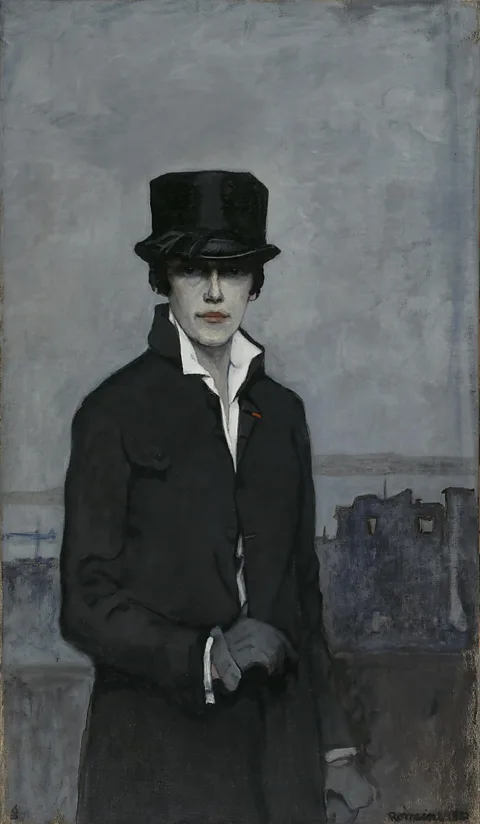
Toward the turn of the century, the "masculine" woman became a central figure in Paris’s burgeoning lesbian subculture. Figures like Mathilde de Morny (known as "Missy") and the artist Romaine Brooks used masculine tailoring to express their sexuality and gender identity.

Lola Charnay, an art historian, explains that these women were "doubly dissident" because they eluded both gender norms and heteropatriarchal control. This period saw a rise in media backlash, with newspapers like Le Charivari publishing caricatures that mocked "masculinized" women. The press attempted to frame these women as "inverts"—a pseudo-medical term used to pathologize their behavior—but for the women themselves, the suit was a symbol of authenticity and liberation.
Impact and the Long Path to Repeal
The 1800 ordinance was technically still in effect throughout most of the 20th century. While the rise of designers like Coco Chanel in the 1920s and the labor demands of World War I and II made trousers common for women, the law remained a dormant but "active" piece of legislation. It was amended in 1909 to allow trousers if a woman was "holding the reins of a horse," but the fundamental prohibition remained.

It was not until January 31, 2013, that the French government formally repealed the law. Najat Vallaud-Belkacem, the Minister of Women’s Rights at the time, declared the ban "incompatible with the principles of equality between women and men."
Analysis of the Sartorial Legacy
The history of women in trousers is not merely a footnote in fashion; it is a barometer of political liberty. The 19th-century struggle for the right to wear "male" clothing was inextricably linked to the right to vote, the right to work, and the right to bodily autonomy. By adopting the masculine silhouette, women were not trying to "become" men; they were claiming the agency, mobility, and authority that society had exclusively granted to men.

The Palais Galliera’s exhibition serves as a reminder that the clothes we wear are often the front lines of social change. The 10 images of bravery—from the battlefield portraits of Marie-Antoinette Lix to the androgynous self-portraits of Romaine Brooks—represent a lineage of defiance. Every modern Parisian woman who walks the Rue de Rivoli in a pair of jeans is, perhaps unknowingly, exercising a right that was won through a century of legal battles, social ridicule, and unwavering courage. The transition from "dissident femininity" to everyday fashion is one of the most successful, yet overlooked, revolutions in French history.