admin
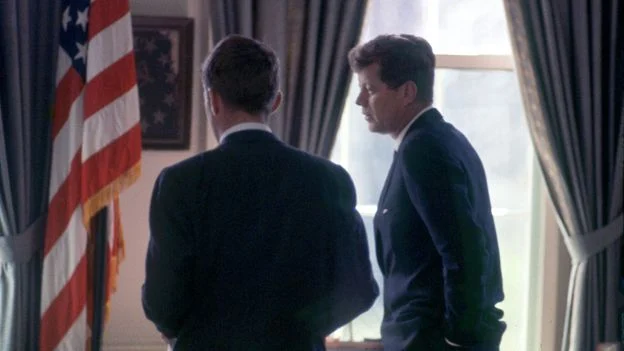
Between October 14 and October 28, 1962, the human race faced its most existential threat as the United States and the Soviet Union engaged in a high-stakes nuclear standoff. This fourteen-day period, often characterized as the "most dangerous week in the whole history of mankind," brought the world to the precipice of a global thermonuclear exchange. While the crisis is frequently viewed through the lens of military posturing, historical records and insider testimonies reveal that the resolution was a product of calculated statesmanship by President John F. Kennedy and his brother, Attorney General Robert Kennedy, alongside a series of intelligence misunderstandings that unexpectedly cooled the fires of war.
The crisis began in earnest on October 14, 1962, when a United States U-2 surveillance aircraft, piloted by Major Richard Heyser, captured high-altitude photographs of the San Cristobal region in Cuba. These images provided undeniable proof that the Soviet Union was covertly constructing sites for medium-range and intermediate-range ballistic missiles (MRBMs and IRBMs). The discovery shattered the prevailing assumption within the American intelligence community that Premier Nikita Khrushchev would never risk such a provocative move in the Western Hemisphere.
The Geopolitical Context and Soviet Motivations
To understand the gravity of the October 1962 standoff, one must look back at the preceding years of Cold War friction. Following the failed Bay of Pigs invasion in 1961, Cuban leader Fidel Castro sought a guarantee of security from the Soviet Union. Simultaneously, Nikita Khrushchev sought to address a perceived strategic imbalance; the United States had recently deployed Jupiter nuclear missiles in Turkey and Italy, within easy striking distance of Moscow and other major Soviet cities. By placing missiles in Cuba, just 90 miles from the Florida coast, Khrushchev aimed to achieve nuclear parity and protect the Cuban Revolution from further American intervention.
Throughout the summer of 1962, the Soviet Union executed "Operation Anadyr," a massive logistical undertaking that transported over 40,000 Soviet soldiers, engineers, and technicians to Cuba. Under the guise of agricultural specialists and tourists, these personnel began the rapid assembly of R-12 (SS-4) and R-14 (SS-5) missile systems. The R-12 missiles possessed a range of approximately 2,000 kilometers, capable of reaching Washington D.C., while the R-14s had a range of 4,500 kilometers, placing nearly the entire continental United States within their reach.
A Chronology of the Thirteen Days
The timeline of the crisis reflects a rapid escalation from discovery to the brink of conflict.
October 14: Major Heyser’s U-2 flight captures the first photographic evidence of missile silos.
October 16: President Kennedy is briefed on the findings. He immediately convenes the Executive Committee of the National Security Council (ExComm), a group of his most trusted advisors, to deliberate on a response.
October 18: Kennedy meets with Soviet Foreign Minister Andrei Gromyko. In a masterclass of diplomatic restraint, Kennedy does not reveal that he has photographic proof of the missiles, despite having the images in his desk drawer. Gromyko maintains the Soviet line that all aid to Cuba is purely defensive.
October 22: President Kennedy delivers a televised address to the nation, revealing the presence of the missiles and announcing a naval "quarantine" of Cuba to prevent further military shipments. He demands the immediate dismantling and removal of the weapons.
October 24: The Soviet ships approaching the quarantine line either stop or turn back, but construction on the missile sites in Cuba continues at an accelerated pace.
October 26: Khrushchev sends a relatively conciliatory letter to Kennedy, suggesting a withdrawal of missiles if the U.S. promises not to invade Cuba.
October 27: Known as "Black Saturday," the crisis reaches its peak. A U-2 plane is shot down over Cuba, killing the pilot, Major Rudolf Anderson. Simultaneously, a second, more aggressive letter arrives from Khrushchev, demanding the removal of U.S. missiles from Turkey.
October 28: Khrushchev publicly announces that the Soviet Union will dismantle the weapons and return them to the Soviet Union.
The Poker Game of Diplomatic Deception
The meeting on October 18 between Kennedy and Gromyko remains one of the most studied interactions of the Cold War. Viktor Sukhodrev, Gromyko’s translator, later described the atmosphere in the Oval Office as civil but intensely strained. Kennedy, sitting in his rocking chair, listened as Gromyko asserted that Soviet assistance was intended only to bolster Cuba’s agricultural and defensive capabilities.
Kennedy’s decision not to confront Gromyko with the photographs was a strategic gamble. By keeping his cards hidden, Kennedy allowed himself time to formulate a response that avoided an immediate military confrontation. This "poker game," as described by observers, was played with the lives of hundreds of millions at stake. The President’s restraint prevented a premature rupture in diplomatic channels, which would have likely forced an immediate American airstrike and a subsequent Soviet retaliation in Berlin or Europe.

Intelligence Errors and the Barroom Catalyst
While high-level diplomacy was central to the resolution, a peculiar incident involving a Washington bartender and a KGB agent played a surprising role in Khrushchev’s decision to retreat. On the night of October 24, Anatoly Gorsky, an undercover KGB agent posing as a Soviet news correspondent, visited the National Press Club. He engaged in a conversation with Johnny Prokoff, a Russian-emigre bartender.
Prokoff relayed a rumor he had supposedly overheard from two journalists, Warren Rogers and Robert Donovan of the New York Herald Tribune. He claimed that Donovan was preparing to fly to Miami to join an imminent U.S. invasion force. Gorsky, fearing the information was a confirmed leak, rushed to the Soviet embassy to alert Moscow. In reality, the journalists had merely been discussing contingency plans for how they would cover an invasion if one were to occur. This misunderstanding created a sense of extreme urgency in the Kremlin, leading Khrushchev to believe that his window for negotiation was closing rapidly.
The Role of the Kennedy Brothers and Allied Perspectives
The internal deliberations of the ExComm revealed a sharp divide between military leaders and the Kennedy brothers. The Joint Chiefs of Staff, led by General Maxwell Taylor and supported by General Curtis LeMay, argued that a surgical airstrike was the only way to guarantee the removal of the missiles. They believed the Soviets would not risk a general nuclear war over Cuba.
However, John and Robert Kennedy were deeply skeptical of military "certainties." Robert McNamara, the Secretary of Defense, noted that the President was haunted by the possibility of a miscalculation leading to "the final failure." Robert Kennedy, acting as the President’s primary emissary, held secret meetings with Soviet Ambassador Anatoly Dobrynin. During these sessions, the younger Kennedy offered a "carrot and stick" approach: the U.S. would publicly pledge not to invade Cuba, and privately, it would agree to remove its Jupiter missiles from Turkey within a few months, provided the Soviet withdrawal from Cuba began immediately.
British Prime Minister Harold Macmillan, who was in constant contact with Kennedy during the crisis, later praised the "statesmanship" of the Kennedy brothers. Macmillan observed that they possessed the rare ability to see the situation from the opponent’s perspective. They understood that Khrushchev needed a way to withdraw without losing face domestically or within the communist bloc. By providing Khrushchev with a "golden bridge" to retreat—the non-invasion pledge—the Kennedys averted a cornered-rat scenario that could have triggered a launch.
Broader Impact and Historical Implications
The Cuban Missile Crisis served as a profound wake-up call for the international community. The sheer proximity to total destruction led to several significant shifts in Cold War policy. In 1963, the "Hotline" was established—a direct communication link between the White House and the Kremlin—to ensure that future crises would not be exacerbated by delays in diplomatic messaging.
Furthermore, the crisis accelerated the movement toward nuclear arms control. In August 1963, the United States, the Soviet Union, and the United Kingdom signed the Limited Nuclear Test Ban Treaty, which prohibited nuclear weapons tests in the atmosphere, outer space, and underwater.
The political fallout was equally significant. While Kennedy’s reputation was bolstered, Khrushchev’s perceived retreat contributed to his eventual ousting by hardliners in the Kremlin in 1964. For the world at large, the events of October 1962 remains the definitive case study in crisis management, illustrating that in the nuclear age, the most potent weapons are not missiles, but the clarity, restraint, and empathy of those in power. The expertise of the Kennedy brothers, combined with the bizarre intervention of a misinformed bartender, ensured that the "most dangerous week" did not become humanity’s last.