admin

Canada’s ambitious pursuit of an Artificial Intelligence (AI) strategy faces significant hurdles, particularly concerning the colossal energy demands of burgeoning data centres, a challenge exacerbated by complex federal-provincial jurisdictional divisions. AI Minister Evan Solomon recently informed a Senate committee that the federal government is "not responsible" for power regulation and, consequently, cannot directly control power usage by AI data centres, underscoring a critical policy gap as the nation prepares for a massive influx of these energy-intensive facilities.
Speaking before the Senate Committee on Social Affairs, Science and Technology on Thursday, Minister Solomon articulated the federal stance, stating, "The federal government is not responsible for power. That is the purview of provincial regulators. So, we can’t put federal obligations on the power regulation." This declaration highlights a fundamental constitutional reality in Canada, where electricity generation, transmission, and distribution largely fall under provincial jurisdiction, granting provincial governments and their regulatory bodies the authority over energy policies, rates, and infrastructure development. However, this established division of powers is now colliding with the emergent and rapidly accelerating demands of the AI sector, presenting an unprecedented challenge to Canada’s energy grids and environmental commitments.
Despite this jurisdictional limitation, the federal government acknowledges the strategic importance of the infrastructure underpinning the AI revolution. Both information technology (IT) and electricity grids are officially designated as "critical infrastructure" by the federal government. This designation empowers Public Safety Canada to "manage risks and reduce vulnerabilities" associated with these essential systems, as outlined in the National Strategy for Critical Infrastructure. This dual perspective creates a nuanced federal role: while direct regulation of power consumption remains out of reach, the federal government retains a mandate to ensure the resilience and security of the energy and digital backbone upon which AI development depends. The tension between these roles—indirect oversight versus direct regulation—is set to define much of the national discourse surrounding AI infrastructure development in the coming years.
The Unprecedented Demand for Digital Infrastructure
The scale of Canada’s planned AI expansion is staggering. Minister Solomon revealed that the federal government has received proposals for "over 160" new data centres. These are not modest operations; large data centre projects are projected to require approximately 100 megawatts (MW) of power per facility, a demand comparable to that of a small city or tens of thousands of homes. To put this into perspective, the average Canadian home consumes around 8,900 kilowatt-hours (kWh) per year, or approximately 1 kilowatt (kW) continuously. A single 100 MW data centre could, therefore, consume enough electricity to power roughly 100,000 homes, depending on their specific consumption patterns.
This anticipated surge in demand necessitates a monumental overhaul of Canada’s energy infrastructure. Minister Solomon emphasized that "doubling the capacity of Canada’s energy grid was absolutely critical" to the successful implementation of Canada’s AI strategy. This expansion is not merely about increasing supply; it also entails modernizing aging grids, integrating more renewable energy sources, and ensuring grid stability against concentrated loads. The commitment to such a significant energy expansion underscores the federal government’s belief in AI as a pivotal economic driver for the nation, but also reveals the immense infrastructure investment required to support this vision.

Federal Principles for Responsible Development
In recognition of the significant environmental and economic implications, the federal government has recently released its "Responsible Data Centre Development Principles." These principles aim to guide companies building new data centre projects, focusing on two key areas: ensuring that new developments "do not shift electricity costs onto Canadians" and that they "minimize water use and environmental impacts."
The first principle, preventing cost shifting, implicitly acknowledges the potential for large-scale industrial consumers to strain existing grids, potentially leading to increased costs for residential and small business consumers. While the federal government cannot directly regulate power rates, these principles suggest an expectation for data centre operators to either secure their own power generation, invest in grid upgrades, or negotiate pricing structures with provincial utilities that reflect the true cost of their consumption without burdening the public.
The second principle, minimizing environmental impacts, addresses growing concerns about the ecological footprint of data centres. These facilities are not only electricity hogs but also often prodigious consumers of water, primarily for cooling their vast arrays of servers. Solomon noted that the government "works very closely with best practices around the world to develop very high standards on water use, energy use, investment in the community, strategic importance, consultation, and most importantly, transparency on the promises so you can actually hold them to account." Such standards would likely encompass metrics like Power Usage Effectiveness (PUE) to measure energy efficiency, and innovative cooling solutions to reduce water consumption, moving towards closed-loop systems or even air-cooling where feasible.
A Glimpse into the Future: The EverWind/Anthropic Project
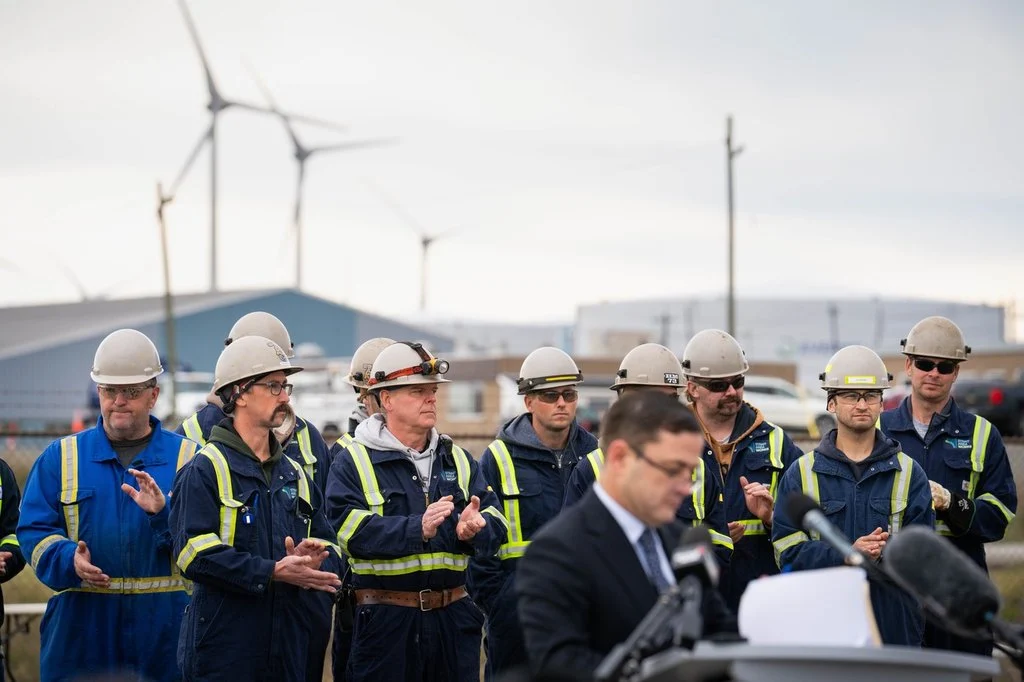
The national debate is vividly illustrated by specific projects already underway or proposed. One notable example is the ambitious $10-billion AI data centre planned for Point Tupper, Nova Scotia, spearheaded by EverWind Fuels in partnership with U.S. AI company Anthropic. This project, which EverWind describes as the largest private investment in Nova Scotia’s history, exemplifies both the promise and the perils of Canada’s AI aspirations.
Under a 20-year lease, Anthropic will occupy an 18,600-square-metre data centre. The initial phase, scheduled to come online late next year (2025), is projected to draw 95 MW of electricity. A substantial expansion is anticipated by mid-2028, adding another 325 MW, bringing the development’s total energy demand to a staggering 420 MW. To put this in context, Nova Scotia’s total peak electricity demand is typically around 1,700-2,000 MW. A single facility demanding 420 MW represents a significant portion of the provincial grid’s capacity and highlights the imperative for substantial upgrades and new generation sources.

The project also brings environmental considerations to the forefront, particularly concerning water usage. The data centre plans to use water from nearby Landrie Lake for cooling its servers. EverWind Fuels has stressed its commitment to safeguarding the water supply, stating that the cooling system will be closed-loop, akin to a car’s radiator, with cooling fluid recycled or disposed of off-site rather than discharged into local waterways. In its first phase, the system is expected to use an average of 100,000 litres of water per day, which EverWind compares to the consumption of a large shopping mall. Upon completion of the expansion, this figure is projected to rise to an average draw of 500,000 litres per day. While EverWind maintains this will represent only about one percent of the lake’s safe daily yield of 34 million litres, such figures inevitably raise questions and concerns among local residents and environmental groups regarding long-term ecological impact and resource allocation. Indeed, the original article notes the emergence of a petition against the AI data centre in Cape Breton, signalling community apprehension.
Provincial Perspectives and Economic Imperatives
Nova Scotia Premier Tim Houston has publicly championed the EverWind/Anthropic project, hailing it as a "major vote of confidence" in the rural area and a critical step toward addressing Canada’s perceived lack of secure data infrastructure. Premier Houston’s remarks underscore a broader provincial perspective that views such large-scale investments as essential for economic growth, job creation, and positioning their respective provinces as hubs for the burgeoning digital economy. The promise of high-tech jobs and significant capital injection often outweighs immediate concerns about energy and environmental impacts in the eyes of provincial governments keen to attract investment.
Other provinces, like Saskatchewan, are also actively developing their own data centre specific laws, indicating a decentralized but concerted effort across Canada to manage this new industrial growth. These provincial laws will likely cover aspects such as site selection, environmental impact assessments, grid connection requirements, and perhaps even incentives for sustainable practices, reflecting local priorities and energy realities.
Broader Implications and the Path Forward
The rapid proliferation of AI data centres and the associated energy demands present several critical implications for Canada:
-
Energy Security and Grid Modernization: The need to double Canada’s energy grid capacity is a monumental undertaking. It will require massive investments in new generation (preferably renewable), transmission lines, and smart grid technologies. This challenge is compounded by Canada’s commitment to decarbonization, meaning new capacity must align with climate goals, avoiding reliance on fossil fuels. The federal government’s role in facilitating these investments, through funding programs or policy frameworks, becomes crucial despite its limited regulatory power over provincial utilities.

-
Environmental Stewardship and Water Resources: While "closed-loop" cooling systems are a step towards minimizing water consumption, the sheer volume of water required for cooling at the projected scale remains a concern. Furthermore, data centres generate significant heat, and managing this waste heat effectively is another environmental consideration. The "Responsible Data Centre Development Principles" are a start, but their effectiveness will depend on robust enforcement mechanisms and transparent reporting from companies.
-
Federal-Provincial Cooperation: The jurisdictional split necessitates an unprecedented level of collaboration between federal and provincial governments. A fragmented approach, where each province develops its own disparate regulations, could lead to inefficiencies, regulatory arbitrage, and an inability to address the national implications of AI data centre growth. A national strategy, developed collaboratively, could provide a consistent framework for sustainable development, shared best practices, and coordinated infrastructure planning. This could involve federal incentives for provinces adopting specific green energy standards for data centres or joint task forces to assess national grid resilience.
-
Economic Competitiveness vs. Data Sovereignty: Minister Solomon expressed a desire to support the "building of Canadian data that are Canadian-owned." However, the reality, as exemplified by the EverWind/Anthropic partnership, is that major projects often involve U.S. tech giants. This raises questions about data sovereignty, the retention of intellectual property within Canada, and whether the economic benefits of this AI boom will primarily accrue to foreign entities or significantly contribute to Canada’s domestic technological ecosystem. Policies encouraging Canadian ownership, innovation, and local supply chains could be vital.
-
Public Engagement and Social License: As seen with the Cape Breton petition, communities are increasingly aware of the local impacts of large industrial projects. Ensuring transparency, genuine consultation, and addressing local concerns about resource allocation and environmental impact will be critical for gaining and maintaining public support—the "social license"—for these developments.
Canada stands at a pivotal moment, balancing the immense potential of AI with the practical challenges of energy supply, environmental sustainability, and intergovernmental coordination. The discussions at the Senate committee, while clarifying jurisdictional boundaries, also underscore the urgent need for a cohesive and forward-looking national strategy. The federal government, through its principles and critical infrastructure designation, can set the tone and direction, but the ultimate success of Canada’s AI ambition will depend on the provinces’ willingness and ability to integrate these massive digital demands into their energy futures, all while ensuring that growth is responsible, sustainable, and truly benefits all Canadians. The journey to double the national grid capacity and responsibly house over 160 new data centres will be a defining test of Canada’s capacity for innovation and governance in the 21st century.