admin
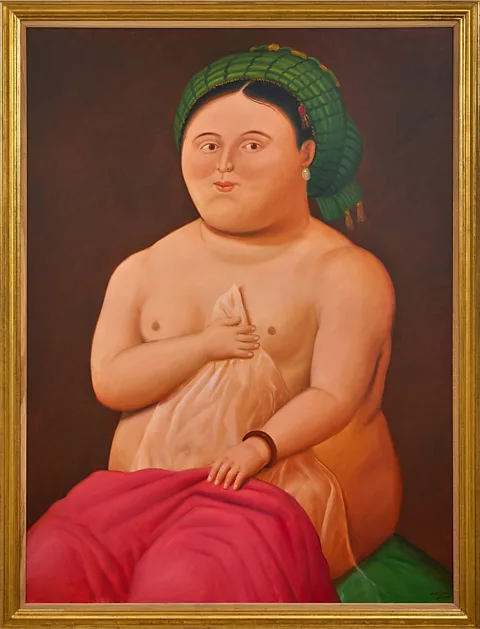
In a striking oil painting completed in 1978, a woman draped in a verdant green dress gazes with a steady, enigmatic focus at her audience. Behind her lies a soft, atmospheric landscape, while a delicate, translucent veil rests upon her dark curls. To any student of art history, the reference is instantaneous: this is Leonardo da Vinci’s Mona Lisa. However, the execution is radically different from the High Renaissance original. The figure possesses a monumental roundness, a disproportionately large head, and diminutive facial features that seem to float within the vast expanse of her countenance. This is the work of Fernando Botero, the late Colombian maestro whose singular aesthetic—known globally as "Boterismo"—transformed the way the world perceives volume, beauty, and the historical canon of Western art.

Botero’s 1978 interpretation of the Mona Lisa is merely one entry in a vast oeuvre dedicated to reimagining the most iconic motifs of European art through a Latin American lens. Following his death in September 2023, the art world has seen a resurgence of interest in his work, exemplified by the current exhibition at Opera Gallery’s London branch, "Fernando Botero: In Praise of an Amplified World." This retrospective, running through late November, serves as a poignant reminder of Botero’s status as one of the most recognizable and commercially successful artists to ever emerge from South America. His ability to bridge the gap between the classical traditions of the Old World and the vibrant, often turbulent reality of the New World has secured his place as a titan of 20th-century art.
The Genesis of Boterismo: From Medellín to Mexico City
The evolution of Botero’s signature style was neither immediate nor intentional, but rather the result of a serendipitous technical "error." Born in Medellín, Colombia, in 1932, Botero grew up in an environment where access to major art museums was non-existent. His early exposure to visual culture was limited to the colonial-era religious sculptures and baroque paintings found within the Catholic churches of the Andes. This foundation in religious iconography, characterized by a certain stiffness and dramatic devotion, would later inform his approach to portraiture.

The pivotal moment in his career occurred in 1956 while he was living in Mexico City. While working on a piece titled "Still Life with Mandolin," Botero painted the sound hole of the instrument significantly smaller than its traditional proportions. According to his son, Fernando Botero Zea, the artist observed that this minor adjustment made the mandolin appear to "explode" in volume and form. This realization—that the manipulation of scale and internal proportions could create a sense of monumental presence—marked the birth of Boterismo.
From that day forward, Botero committed himself to a universe where everything—men, women, animals, and inanimate objects—occupied space with an amplified, sensuous density. While critics often colloquially described his subjects as "fat," Botero himself consistently rejected the term. He maintained that he did not paint "fat people," but rather explored the "sensuality of form" and the "pleasure of volume." To Botero, volume was a celebration of life itself, a rebellion against the skeletal austerity of modern abstraction.

A Chronology of Global Ascent and Institutional Recognition
Botero’s rise to international prominence was marked by a series of strategic moves and institutional milestones that validated his unique vision against the prevailing trends of the mid-20th century.
- 1952–1955: At the age of 20, Botero moved to Madrid, where he studied at the prestigious Royal Academy of Fine Arts of San Fernando. He spent his days as a copyist at the Prado Museum, obsessively studying the works of Velázquez and Goya. He later moved to Florence, where he discovered the frescos of the Italian Renaissance, particularly those of Piero della Francesca, whose use of volume and geometric clarity became his primary inspiration.
- 1959–1961: Botero painted "Mona Lisa, Age Twelve," a work that caught the attention of Dorothy Miller, a curator at the Museum of Modern Art (MoMA) in New York. The museum’s acquisition of the painting in 1961 was a watershed moment, signaling that his figurative, volume-heavy style could thrive in a New York art scene then dominated by Abstract Expressionism.
- 1970s–1990s: This period saw the expansion of Botero’s work into three dimensions. His massive bronze sculptures began appearing in high-profile public spaces, including Park Avenue in New York, the Champs-Élysées in Paris, and the Grand Canal in Venice. These installations democratized his art, making the "Botero horse" or "Botero woman" a fixture of global urban culture.
- 2000: In an act of immense cultural philanthropy, Botero donated a collection of over 200 works—including his own and pieces by Picasso, Monet, and Dalí—to the Banco de la República in Bogotá, leading to the creation of the Botero Museum. This donation was intended to provide Colombians with the access to art history that he lacked as a youth.
- 2023: Following his death at age 91, the market for his work reached new heights. In November 2023, his painting "The Musicians" (1979) was sold at Christie’s New York for $5.1 million, setting a new auction record for the artist and underscoring his enduring commercial appeal.
Reinterpreting the Masters: A Dialogue Across Centuries
Botero’s fascination with the European "Old Masters" was not merely a matter of imitation, but a sophisticated dialogue intended to claim a space for Latin American art within the global narrative. His reworkings of classic masterpieces served to humanize and "tropicalize" the often-rigid hierarchies of European history.

One of his most significant influences was Piero della Francesca. Botero’s "Federico da Montefeltro, Battista Sforza" (1998) is a direct diptych response to Della Francesca’s 15th-century portraits of the Duke and Duchess of Urbino. While the original Renaissance work utilized the profile view to emphasize the nobility and architectural permanence of the sitters, Botero’s version expands the figures until they nearly burst from the frame. By doing so, he removed the distance of the "divine" nobility, replacing it with a tangible, earthy presence.
Similarly, in "Menina, after Velázquez" (1982), Botero tackled the central figure of Diego Velázquez’s "Las Meninas." By amplifying the five-year-old Margaret Theresa of Spain, he stripped away the courtly artifice of the Spanish Golden Age, presenting the Infanta with a playful, almost doll-like rotundity. This approach extended to Raphael’s "La Fornarina" and Paolo Uccello’s "The Battle of San Romano." In every instance, Botero’s goal was to make the painting "talk directly to the viewer," bypassing the need for academic intermediaries or complex abstract theories.

The Intersection of High Art and Popular Culture
For Nicolás Gómez Echeverri, director of the arts at the Banco de la República, Botero’s work represents a profound democratization of the "High Art" tradition. In Colombia and across Latin America, Botero’s versions of the Mona Lisa are not just museum pieces; they are part of the visual vernacular. The image of the "voluminous Mona Lisa" can be found in neighborhood pizzerias, on street murals, and in domestic kitsch.
This phenomenon illustrates how Botero successfully bridged the gap between the elite art world and the public consciousness. By taking the "sacred cows" of Western art—the white, European, classical icons—and reimagining them through the lens of Boterismo, he asserted that Latin American visual culture is not a secondary or derivative force, but a peer to the Western tradition. His use of vibrant colors and accessible forms allowed his work to function as a form of cultural "soft power" for Colombia, a country often overshadowed by narratives of conflict.

Analysis of Implications: A Legacy of Pleasure and Presence
The enduring significance of Fernando Botero lies in his steadfast refusal to conform to the dictates of modernism. Throughout the late 20th century, as the art world moved toward conceptualism and minimalism, Botero remained a "militant of the figurative." He believed that the primary purpose of art was to provide pleasure and to celebrate the "presence of things."
His impact on the art market remains robust, with his sculptures and paintings continuing to fetch multi-million dollar prices. However, his true legacy is found in the public squares of Medellín, Bogotá, and Madrid. By placing his monumental figures in the path of everyday citizens, he removed the barriers of the "white cube" gallery.

Botero’s work suggests that history is not a static collection of masterpieces, but a living, breathing dialogue. His "amplified world" invites viewers to look at the past with a sense of joy rather than reverence. As the global art community continues to evaluate his contributions, it is clear that Botero did more than just paint large figures; he expanded the boundaries of art history itself, ensuring that the spirit of Latin America remains an indelible, and undeniably voluminous, part of the human story.