Jia Lissa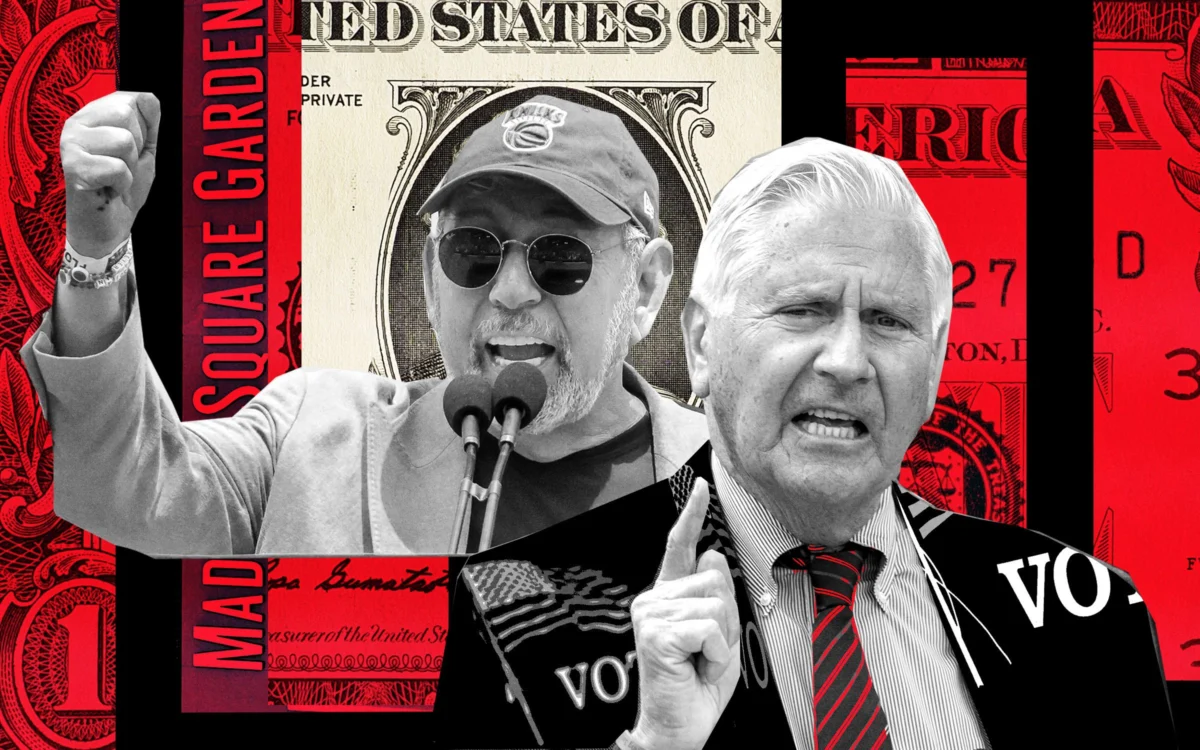
The landscape of New York State politics is witnessing an extraordinary influx of capital from James Dolan, the enigmatic owner of Madison Square Garden, whose vast financial contributions are now largely directed towards Republican gubernatorial nominee Bruce Blakeman. This significant pivot in Dolan’s political allegiances and spending strategy is reshaping the state’s electoral dynamics, particularly as Blakeman champions an agenda heavily focused on advanced surveillance technologies and a hardline stance on immigration, mirroring practices already controversially deployed across Dolan’s extensive entertainment empire.
The Unlikely Alliance: Dolan’s Shift and Shared Ideologies
Last November, Bruce Blakeman, currently the Nassau County Executive, laid out a vision for New York’s suburbs that included erecting a "wall" of sophisticated spy gear, comprehensive license plate readers, and biometric surveillance systems along the border with New York City. This ambitious and contentious proposal has since found a powerful financial backer in James Dolan, whose family and various business entities have poured millions of dollars into Blakeman’s campaign and affiliated Republican committees. This support is particularly notable given Dolan’s previous financial backing of the incumbent Democratic Governor, Kathy Hochul, in the last election cycle, as highlighted by Politico.
Dolan’s substantial investment in Blakeman, a candidate currently trailing Governor Hochul by nine points or more in most polls, appears counterintuitive in a state traditionally dominated by Democrats and amidst predictions of a "blue wave." New York has not elected a Republican governor since George Pataki in 2002, and statewide elections typically favor Democratic candidates by significant margins. However, a closer examination reveals a shared ideological alignment, particularly concerning the expansion of surveillance capabilities and a common affinity for former President Donald Trump. Blakeman’s platform, which embraces data centers, AI deepfakes, Flock Safety surveillance, enhanced cooperation with ICE, and even the controversial concept of private militias, resonates with Dolan’s own operational philosophy. Madison Square Garden, under Dolan’s stewardship, is known for its extensive network of cameras that capture the faces of nearly every patron, a system actively used by corporate security to identify and, at times, deny entry to critics or those involved in legal disputes with the organization. This confluence of interests positions Dolan as a significant, albeit mercurial, player in the state’s political arena, leveraging his financial might to champion a political agenda that directly aligns with his business practices and personal worldview.
Blakeman’s Vision: A State Embracing Advanced Surveillance and Hardline Policies
Bruce Blakeman’s political ascent has been marked by a pronounced shift towards a "MAGA" (Make America Great Again) alignment, a transformation that saw him secure the Nassau County Executive position in 2021 by a narrow margin of 2,000 votes. Since then, he has consistently championed policies that reflect this conservative pivot. His promise of a surveillance "wall" along the New York City line, articulated on Fox News after Mayor Zohran Mamdani’s victory, underscores a commitment to mass technological monitoring. This "wall" is envisioned to include license plate readers that automatically scan and store vehicle data, facial recognition technology capable of identifying individuals in real-time against databases, and a dense network of video cameras, effectively creating a digital barrier between the city and its suburbs. Such a system raises significant concerns among civil liberties groups about pervasive tracking and potential misuse of personal data.
Beyond this proposed barrier, Blakeman has been a fervent proponent of the Trump administration’s mass deportation initiatives. In Nassau County, he ordered local detectives to collaborate directly with ICE (U.S. Immigration and Customs Enforcement), transforming county jails into holding facilities for individuals caught in immigration crackdowns. A Newsday investigation subsequently revealed that less than five percent of these jailed immigrants possessed violent criminal records, challenging the narrative often used to justify such aggressive enforcement and raising significant civil liberties concerns regarding due process and human rights. Furthermore, Blakeman’s recruitment of dozens of armed "special deputies" has drawn criticism, with many observers perceiving them as akin to a personal militia, an unusual and potentially unsettling development for local governance and law enforcement accountability. The proliferation of Flock Safety cameras under Blakeman’s leadership has also made Nassau County one of the most surveilled areas in the nation, with a camera reportedly installed every 9.5 miles of road, according to the activist group DeFlock. These automated license plate readers (ALPRs) continuously collect data on vehicle movements, contributing to a vast surveillance infrastructure that some argue compromises individual privacy.
This pervasive surveillance infrastructure, coupled with Blakeman’s embrace of AI deepfakes in campaign advertising – a controversial tactic involving the manipulation of media to create misleading representations of opponents – paints a picture of a politician willing to deploy cutting-edge, often ethically debated, technologies to achieve his political objectives. His support for data centers, which consume vast amounts of energy and have faced environmental backlash for their carbon footprint and demands on local power grids, further contrasts with Governor Hochul’s efforts to impose a statewide moratorium on their expansion, citing climate concerns. Blakeman, however, has dismissed such moratoriums as "crazy," indicating a preference for technological expansion over environmental regulation.
Dolan’s Surveillance Empire and Mounting Regulatory Pressure
James Dolan’s aggressive deployment of surveillance technology is not confined to political aspirations; it is a core feature of his business operations. His entertainment venues, which include the iconic Madison Square Garden, the futuristic Sphere in Las Vegas, and the historic Radio City Music Hall in Manhattan, are equipped with sophisticated arrays of security cameras integrated with advanced video management systems and facial recognition programs. Dolan himself has publicly asserted that this extensive surveillance is a primary reason why MSG is "the most secure venue in the country." However, this security-centric approach has ignited a fierce backlash, drawing intense scrutiny from local and state authorities and civil liberties advocates.
Opposition to Dolan’s use of facial recognition has reached a critical juncture in New York City. A majority of the City Council members are now advocating for a bill designed to regulate biometric surveillance, reflecting growing public and political concern over privacy rights and the potential for discriminatory application of such technology. The proposed legislation seeks to establish guardrails, transparency requirements, and potentially restrict the use of facial recognition in public-facing venues, directly impacting MSG’s current practices. Simultaneously, state lawmakers have introduced legislation aimed at revoking Madison Square Garden’s substantial property tax break, an exemption that has accrued to over a billion dollars over decades. This legislative effort underscores a broader movement to hold MSG accountable for its practices and its significant financial advantages, particularly given its contentious relationship with local government.
Further complicating Dolan’s position is a federal government initiative to take over the $8 billion renovation of Penn Station, located directly beneath Madison Square Garden. While this massive infrastructure project could potentially yield over $500 million for Dolan’s company, state and local authorities are expected to retain significant oversight and decision-making power regarding its execution and financial disbursements. This presents another potential point of friction, as Dolan’s company would likely need to navigate various governmental approvals and mandates. Adding to the legal pressures, the New York Attorney General’s investigation into MSG’s deployment of facial recognition technology continues to progress, a source familiar with the matter confirmed to WIRED. This probe examines whether MSG’s use of the technology complies with existing privacy laws and consumer protection statutes. Even Mayor Zohran Mamdani, whose critiques of Dolan’s security practices were initially subdued, has seen his administration voice stronger concerns, with one commissioner stating that "this kind of mass surveillance opens the door to abuse and discrimination." This escalating governmental scrutiny represents a substantial challenge to Dolan’s unbridled use of surveillance and his company’s long-standing financial benefits.
The tension between Dolan and public officials reached a peak even amidst the recent triumph of his New York Knicks, who secured their first NBA title in 53 years. During the NBA Finals and the subsequent championship parade, Dolan’s organization reportedly clashed with the Mayor and the Police Commissioner over security protocols and control of the celebratory events. A source described Dolan as having "micromanaged the Knicks parade like it was his own sweet sixteen," indicating his deep desire for control even in public civic events, a trait that extends to his political engagements. This ongoing friction with government entities highlights the high stakes for Dolan in influencing political leadership that might be more amenable to his business interests and operational methods.
The Financial Leverage: Unpacking Dolan’s Strategic Donations
James Dolan’s recent financial commitments to Bruce Blakeman represent a significant escalation in his political spending, positioning him as potentially the largest individual donor in New York Republican politics. A review of city, state, and federal databases reveals a multi-faceted approach to this political investment. The Dolan family has directly contributed $108,000 to Blakeman’s campaign, with an additional $970,000 channeled to the local Nassau County Republican party, which has subsequently become Blakeman’s single largest contributor. Beyond these direct contributions, Madison Square Garden entities have further augmented this support by donating $2 million to Strong and Safe New York Inc., a political action committee (PAC) explicitly backing Blakeman’s gubernatorial bid. This super PAC, which lists MSG’s top government relations executive as an officer, has amassed an impressive $5.3 million overall, effectively mitigating Governor Hochul’s reported 9-to-1 cash advantage over Blakeman at the last filing deadline in July.
Dolan’s history of substantial political donations is well-documented, including nearly a million dollars contributed to Donald Trump’s reelection campaign and the Republican National Committee during the 2020 election cycle. However, his current investment in the New York gubernatorial race marks a new level of engagement. This strategic deployment of funds, even in a race where his preferred candidate faces an uphill battle, can be interpreted as an effort to cultivate influence and shape the political narrative. As one veteran strategist noted to WIRED, "Dolan can step into the breach and become the biggest player in [New York’s] Republican politics, donor-wise, and I’m sure his people are smart enough to know that." This suggests a long-term play, where establishing a dominant position within the state’s Republican apparatus could yield benefits regardless of immediate electoral outcomes, offering a direct line to policymaking and regulatory discussions. Even if Blakeman does not win the governorship, Dolan’s financial backing could solidify his influence within the state’s Republican Party, potentially affecting future legislative agendas and appointments.
The scale of Dolan’s current spending echoes his aggressive tactics in 2004, when Cablevision and MSG reportedly spent an estimated $30 million to successfully thwart Mayor Michael Bloomberg’s plan to build a football stadium on Manhattan’s west side. In that instance, Dolan’s firm funded the "New York Association for Better Choices," an organization that launched a massive public relations campaign, including full-page newspaper ads and TV commercials, and enlisted influential lobbyists, including a former U.S. Senator. The current campaign for Blakeman, relying heavily on AI-generated content, including deepfake ads lampooning Governor Hochul, demonstrates a similar willingness to employ innovative, and sometimes controversial, methods to achieve political objectives. One recent anti-Hochul spot even repurposed footage from a 2011 comedian’s bit criticizing a Republican leader from Wisconsin, highlighting the unconventional and often misleading nature of these digital tactics.
Broader Political Battlegrounds and Countervailing Forces
Dolan’s influence extends beyond the gubernatorial race, subtly impacting local politics as well. While he largely avoided direct involvement in the previous year’s mayoral race, an MSG political action committee, the Coalition to Restore New York, injected over $400,000 into 11 City Council races. Seven of these candidates won and subsequently aligned to support Julie Menin for City Council President, who was perceived as a moderating force against Mayor Mamdani’s progressive agenda. Menin now holds a pivotal position, capable of advancing or allowing to lapse the Council’s bill aimed at curbing facial recognition technology. While she reportedly leans towards reforming and establishing "guardrails and parameters" rather than an outright ban, her stance remains crucial for Dolan’s interests. Her decision will significantly impact the regulatory environment for biometric surveillance in New York City.
The Mamdani administration has faced a "flurry of lawsuits" from a longtime outside counsel for MSG, while another former attorney has raised a million dollars for a political organization opposing the mayor’s agenda. These legal and financial pressures indicate a concerted effort to challenge Mamdani’s policies and influence the direction of city governance. Billionaire Republican donor John Catsimatidis suggested that Dolan’s support for Blakeman could be an indirect move against Mamdani, operating under the belief that "everybody believes the governor has oversight of the mayor." This intricate web of political maneuvers highlights a broader struggle for influence over New York City’s governance and regulatory environment, with the gubernatorial race serving as a potentially powerful lever.
Governor Hochul, however, is not without her own formidable financial allies. Her campaign and the state Democratic Party have received significant contributions from diverse sources. Notably, Nancy Shevell, Blakeman’s ex-wife and now married to Paul McCartney, donated $18,000 to Hochul. The Pegula family, owners of the NFL’s Buffalo Bills, contributed nearly $175,000 to Hochul and the state Democratic Party, a sum that followed state funding of $600 million for their new stadium, spearheaded by Hochul. Furthermore, Uber spent over $12 million in a six-month period supporting a PAC aligned with Hochul, who has proposed auto insurance reforms favorable to the ride-share giant. These examples underscore the dynamic and often transactional nature of political donations from powerful business interests on both sides of the political spectrum, each seeking to advance their agendas through financial leverage and secure favorable legislative outcomes.
The Implications: A High-Stakes Contest for New York’s Future
The convergence of James Dolan’s immense financial power with Bruce Blakeman’s surveillance-centric, Trump-aligned political agenda creates a high-stakes scenario for New York State. The ongoing investigations into MSG’s facial recognition practices, the legislative efforts to revoke its tax breaks, and the broader public discourse around privacy and civil liberties are all magnified by