admin
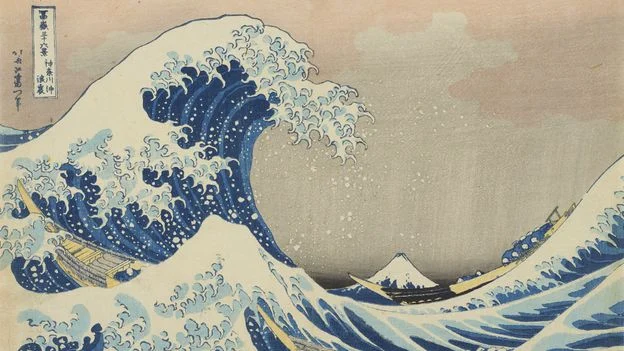
Katsushika Hokusai’s 1831 masterpiece, Under the Wave off Kanagawa—universally recognized today as The Great Wave—stands as one of the most potent and enduring symbols in global visual culture. Currently featured in a landmark exhibition at the Dulwich Picture Gallery in London, the print continues to exert a "peculiar power to befuddle" even the most seasoned art historians. While the image has been reproduced on everything from Japanese banknotes to digital emojis, the original woodblock print remains a complex study in suspense, perspective, and the precarious relationship between humanity and the natural world. This exhibition marks the first time the complete series of Thirty-six Views of Mount Fuji, along with ten supplementary prints, has been displayed in the United Kingdom, offering a rare opportunity to decipher the clues hidden within Hokusai’s most famous work.
The grip of The Great Wave on the collective imagination is perhaps best articulated through the eyes of the post-impressionist master Vincent van Gogh. In September 1888, Vincent and his brother Theo exchanged letters expressing their awe at the print’s visceral intensity. "These waves are claws," they noted, "the vessel is caught in them, you can feel it." This reaction highlights a significant aspect of Hokusai’s genius: the ability to evoke a sensory response that often overrides literal observation. For nearly two centuries, audiences have felt the impending crash of the Prussian Blue water more than they have seen the specific details of the composition.

The Compositional Anatomy of a Masterpiece
Despite its monumental reputation, Under the Wave off Kanagawa is a relatively small work, measuring approximately 10 by 15 inches. It is characterized by a remarkable economy of elements: three cargo boats, a surging sea, a lowering sky, and a distant, snow-capped Mount Fuji. However, the "invisibility" of certain details is indicative of the print’s psychological depth.
Most observers, including the Van Gogh brothers, frequently misremember the number of vessels depicted. There are, in fact, three oshiokuri-bune—streamlined cargo barges used to transport live fish to the markets of Edo (modern-day Tokyo). These boats are not mere incidental details; they are central to the narrative of human struggle. The crewmen, huddled and anonymous, cling to their oars as they navigate the "claws" of the cresting wave. The strange tendency for viewers to overlook these boats suggests that the wave itself functions as a psychological force, eclipsing the human element through sheer visual dominance.
The central ambiguity of the print remains its greatest mystery. Is it a portrait of the sublime power of nature rendering human pursuit puny and insignificant? Or is it a testament to human fortitude in the face of certain disaster? Some scholars suggest the print is a study in contrasts: the fleeting, chaotic nature of the wave (symbolizing life) set against the eternal, immovable presence of the mountain (symbolizing the soul). Mount Fuji, viewed through the swirling aperture created by the wave, acts as a divine observer—unflinching and protective, yet distant.

Historical Context and the Artist’s Reinvention
To understand The Great Wave, one must understand the circumstances of its creator. When Hokusai began the Thirty-six Views of Mount Fuji in the early 1830s, he was in his 70s and undergoing a profound personal and professional reinvention. Having survived a severe stroke and faced significant financial hardship, he became obsessed with the concept of immortality. Mount Fuji, long a site of religious pilgrimage and a symbol of eternal life in Japanese culture, became the focal point of his spiritual and artistic inquiry.
Hokusai belonged to the ukiyo-e school, or "pictures of the floating world." While early ukiyo-e focused on the hedonistic lifestyles of Edo’s urban centers—actors, courtesans, and teahouses—Hokusai was instrumental in pivoting the genre toward landscape and the lives of common laborers. The Thirty-six Views series was a technical and commercial gamble that utilized Prussian Blue, a synthetic pigment recently imported via Dutch traders. This "Berlin Blue" allowed for a depth and saturation previously unattainable with organic indigo dyes, giving The Great Wave its signature chilling intensity.
A Chronology of Hokusai’s Life and the Fuji Series
The development of Hokusai’s late-career masterpiece followed a timeline of personal resilience and artistic evolution:

- 1760: Katsushika Hokusai is born in the Katsushika district of Edo.
- 1770s–1790s: He apprentices as a woodblock carver and joins the studio of Katsukawa Shunshō, focusing on actor prints.
- 1820s: Hokusai suffers a stroke and experiences the death of his wife. His grandson’s gambling debts leave him in poverty.
- 1830–1831: Hokusai begins work on the Thirty-six Views of Mount Fuji. The Great Wave is published as part of the initial release.
- 1833: Due to the immense popularity of the series, the publisher Nishimuraya Yohachi expands the set from 36 to 46 prints.
- 1849: Hokusai dies at the age of 88, famously remarking on his deathbed that if heaven had given him five more years, he could have become a "true painter."
Decoding the Supporting Prints
The Dulwich Picture Gallery exhibition demonstrates that The Great Wave does not exist in a vacuum. By examining the other prints in the series, viewers can unlock the recurring themes of flux and perspective that Hokusai mastered.
Kajikazawa in Kai Province
This print features a lone fisherman perched on a rocky promontory, casting lines into the turbulent Fuji River. The fisherman’s body forms a triangle that echoes the shape of Mount Fuji in the background. The delicate fishing lines, nearly invisible, connect the man to the violent stream. When placed alongside The Great Wave, this image provides a more intimate look at the individual struggle of the crewmen. The lines suggest a fragile geometry of survival, tethering the ephemeral human to the eternal landscape.
Fujimigahara in Owari Province
In a display of compositional wit, Hokusai depicts a cooper fashioning a massive wooden barrel. The barrel serves as a circular lens through which a tiny, distant Mount Fuji is framed. This work highlights the "floating world" theme of perspective—how a mundane, man-made object can simultaneously frame and eclipse a sacred monument. It mirrors the way the wave in the Kanagawa print acts as a "domineering distraction" that momentarily obliterates the mountain it surrounds.

Reflection in Lake at Misaka in Kai Province
This print explores the illusory nature of reality. It shows a serene lake reflecting Mount Fuji; however, the reflection does not match the mountain above. While the actual mountain is barren (suggesting summer), the reflection is snow-capped (suggesting winter). This temporal trickery underscores Hokusai’s belief that nothing is static. In The Great Wave, the mountain’s snowy peak is often mistaken for a spray of foam, further blurring the lines between solid earth and fluid water.
Technical Data and Production Impact
The production of The Great Wave involved a collaborative "quartet": the artist (Hokusai), the carver, the printer, and the publisher.
- The Wood: The blocks were typically carved from mountain cherry wood for durability.
- The Print Run: It is estimated that between 5,000 and 8,000 impressions of The Great Wave were made during the Edo period. However, as the woodblocks wore down, the quality of later prints diminished, with lines becoming thicker and colors less precise.
- Surviving Copies: Today, only a few hundred original impressions are known to exist in major institutions like the British Museum, the Metropolitan Museum of Art, and the National Museum of Western Art in Tokyo.
- Economic Value: In the 1830s, a single print from the series cost about the same as a double helping of noodles. In 2023, a high-quality early impression of The Great Wave sold at auction for $2.8 million.
Broader Impact and Modern Implications
The Great Wave’s transition from a local Japanese landscape print to a global icon is a testament to the era of "Japonisme" in the late 19th century. Following the forced opening of Japan’s borders in the 1850s, Japanese art flooded Europe, influencing artists like Claude Monet, Edgar Degas, and Mary Cassatt.

In the contemporary era, the image has been repurposed as a symbol of climate change and the "tsunami" of modern data. Its inclusion on the Japanese 1,000-yen banknote, scheduled for wider circulation in 2024, cements its status as a cornerstone of national identity. Yet, as the London exhibition suggests, the true power of the image lies in its refusal to be fully "solved." It remains a masterpiece of the "floating world"—a work that focuses and refocuses the eye on the fluid boundary between the inner world of human emotion and the outer world of natural forces. By presenting the full series, the Dulwich Picture Gallery allows the public to see Hokusai not just as the creator of a single famous wave, but as a philosopher of the eternal flux.