admin
admin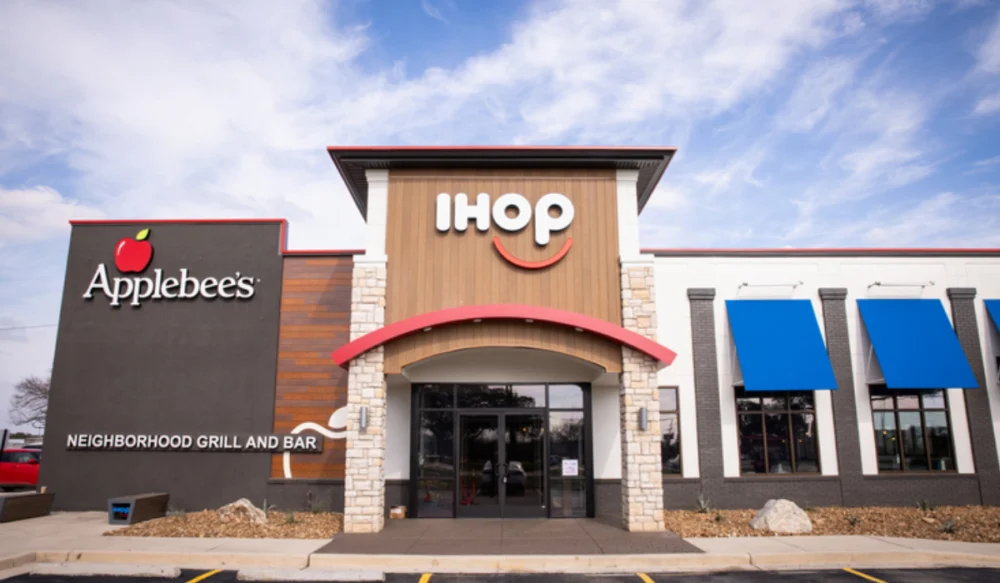
Dine Brands Global, Inc., the parent company of two of America’s most recognizable restaurant chains, has officially reached a milestone of 32 dual-branded Applebee’s Neighborhood Grill + Bar and IHOP locations operating within the United States. As of March 13, 2026, this strategic rollout represents a significant shift in the company’s domestic development strategy, moving toward a model that maximizes real estate efficiency and expands daypart coverage. The dual-branded concept, which features a shared kitchen and a unified back-of-house operation while maintaining distinct dining areas for each brand, is designed to capture a wider demographic of consumers from early morning breakfast seekers to late-night casual diners.
The expansion to 32 units follows several years of international testing and a carefully staged domestic pilot program. By integrating the two legacy brands under one roof, Dine Brands aims to address the rising costs of real estate, labor, and utilities that have pressured the casual dining industry over the last decade. This hybrid model allows the company to leverage the strengths of IHOP in the breakfast and brunch segments alongside Applebee’s dominance in the lunch, dinner, and "happy hour" periods, effectively ensuring that the building remains productive for nearly 24 hours a day.
The Strategic Evolution of Dual-Branding
The journey toward 32 domestic units began as an experiment in international markets, where Dine Brands first tested the synergy between IHOP and Applebee’s. Early prototypes in the Middle East and Latin America demonstrated that the two brands could coexist without cannibalizing each other’s sales. In these international markets, the dual-branded restaurants saw significantly higher average unit volumes (AUV) compared to standalone locations.
The logic behind the domestic expansion is rooted in the "four-wall economics" of the modern restaurant industry. Traditionally, an IHOP might see peak traffic between 7:00 AM and 2:00 PM, while an Applebee’s typically sees its highest volume from 5:00 PM to midnight. By combining these entities, Dine Brands eliminates the "dead time" associated with single-concept buildings. The 32 locations currently active in the U.S. serve as a testament to the company’s confidence that this model can scale within the nuances of the American market, where consumer loyalty to specific brands remains high.
Chronology of Development and Milestone Achievements
The timeline of this integration reflects a methodical approach to brand evolution. While the concepts were initially kept strictly separate to protect brand identity, the economic realities of the post-2020 era accelerated the need for shared infrastructure.
- 2016–2019: International Proof of Concept. Dine Brands launched its first dual-branded prototypes in international territories, including Kuwait and the United Arab Emirates. These units utilized a shared kitchen but often featured separate entrances.
- 2023: The Domestic Pilot. Following the success abroad, Dine Brands announced the first official domestic pilots. These were strategically placed in suburban markets where real estate costs were rising but demand for both family dining and casual dining remained robust.
- 2024–2025: Operational Refinement. During this period, the company focused on the technical challenges of the "back-of-house" (BOH). This included designing a kitchen layout that could handle the high-volume pancake production of IHOP alongside the grill-heavy requirements of Applebee’s.
- Late 2025: Accelerated Rollout. Encouraged by unit-level profitability, Dine Brands began converting existing underperforming standalone units into dual-branded sites and seeking new "prime" real estate for ground-up dual-branded builds.
- March 13, 2026: The 32-Unit Milestone. The opening of the 32nd location marks the successful transition of the concept from a "test phase" to a core component of the company’s growth pipeline.
Operational Synergies and Shared Infrastructure
The core of the dual-branded model is the shared kitchen, which Dine Brands executives have described as a "masterpiece of industrial engineering." In a standard dual-branded unit, the kitchen is positioned between two distinct dining rooms. This allows for a reduction in total square footage compared to two standalone buildings. A typical standalone Applebee’s or IHOP might require 5,000 to 6,000 square feet; a dual-branded unit can often operate efficiently in 8,000 to 9,000 square feet, representing a 25% to 30% reduction in the total real estate footprint.
Labor optimization is another critical driver. In the 32 units currently operating, staff members are often cross-trained to handle both menus. While the front-of-house staff may wear brand-specific uniforms depending on which side of the restaurant they are serving, the kitchen staff operates as a single team. This cross-training reduces the total headcount needed to run the building across three shifts, providing a buffer against the persistent labor shortages that have plagued the hospitality sector.
Furthermore, the dual-branded model simplifies the supply chain. While the ingredients for a "Moons Over My Hammy" equivalent and a "Bourbon Street Steak" are different, the logistics of delivery, cold storage, and waste management are consolidated. This consolidation gives Dine Brands greater leverage when negotiating with suppliers and reduces the carbon footprint associated with multiple delivery truck routes.
Economic Data and Performance Metrics
Data from the initial 32 units suggests a compelling financial narrative. According to industry analysts, dual-branded units under the Dine Brands umbrella have shown a marked improvement in EBITDA (Earnings Before Interest, Taxes, Depreciation, and Amortization) margins. By spreading the fixed costs of rent, property taxes, and insurance across two revenue streams, the break-even point for these units is lower than that of their standalone counterparts.

The "daypart" data is particularly revealing. In the 32 dual-branded locations:
- Breakfast/Brunch (6 AM – 11 AM): IHOP accounts for approximately 85% of transactions.
- Lunch (11 AM – 2 PM): A near 50/50 split between Applebee’s and IHOP, as consumers choose between breakfast-for-lunch or traditional casual dining fare.
- Dinner/Late Night (5 PM – Close): Applebee’s dominates with over 90% of transactions, bolstered by bar sales and appetizer promotions.
This seamless handoff between brands ensures that the "revenue per square foot" metric is significantly higher than the industry average for casual dining. Investors have responded positively to this efficiency, viewing the 32-unit milestone as a de-risking of the company’s portfolio.
Executive Outlook and Industry Reaction
While Dine Brands has been the primary mover in this specific pairing, the broader restaurant industry is watching the 32-unit rollout closely. John Peyton, CEO of Dine Brands, has previously noted that the dual-brand model is a "growth engine" that allows the company to enter markets that might not support a standalone IHOP or Applebee’s individually, but can support the combined strength of both.
Industry analysts suggest that this move is a defensive-turned-offensive strategy. "Dine Brands is essentially playing a game of Tetris with their dayparts," says Marcus Thorne, a senior hospitality analyst. "By reaching 32 units, they have moved past the ‘gimmick’ stage. They have proven that the American consumer is comfortable walking into a building and having the choice between a stack of pancakes and a rack of ribs, even if those choices are technically coming from two different brands."
There has been some pushback from brand purists who worry that the distinct "neighborhood" feel of Applebee’s or the "pancake house" nostalgia of IHOP might be diluted. However, Dine Brands has countered this by maintaining separate entrances and distinct interior design languages for each side of the dual-branded units. In most of the 32 locations, a customer sitting in the IHOP section would not immediately realize they are in the same building as an Applebee’s bar, and vice versa.
Broader Implications and Future Projections
The success of the 32 dual-branded units may trigger a wave of similar consolidations across the industry. Competitors like Focus Brands (which owns Auntie Anne’s, Cinnabon, and Jamba) and Yum! Brands (KFC, Taco Bell, Pizza Hut) have experimented with co-branding for decades, but the Dine Brands approach is unique in its scale—combining two full-service, sit-down concepts rather than quick-service "express" counters.
Looking ahead, the roadmap for Dine Brands likely includes a further acceleration of these conversions. With 32 units as the current baseline, market projections suggest the company could reach 100 dual-branded locations by the end of 2028. This would involve not only new construction but also the "twinning" of existing standalone properties where adjacent real estate is available.
The implications for urban planning and commercial real estate are also significant. As developers look for "anchor" tenants that can provide consistent foot traffic throughout the day, the dual-branded Applebee’s/IHOP model presents an attractive option. It offers the stability of two established national brands while requiring the footprint of only one and a half.
As of March 2026, the 32 dual-branded restaurants stand as a successful marriage of convenience and commerce. For Dine Brands, the model represents the future of the company’s domestic footprint—a future where efficiency is paramount, and the boundaries between breakfast, lunch, and dinner continue to blur in the eyes of the American consumer. The company’s ability to maintain brand integrity while slashing overhead costs will likely remain a case study for the restaurant industry for years to come.