admin
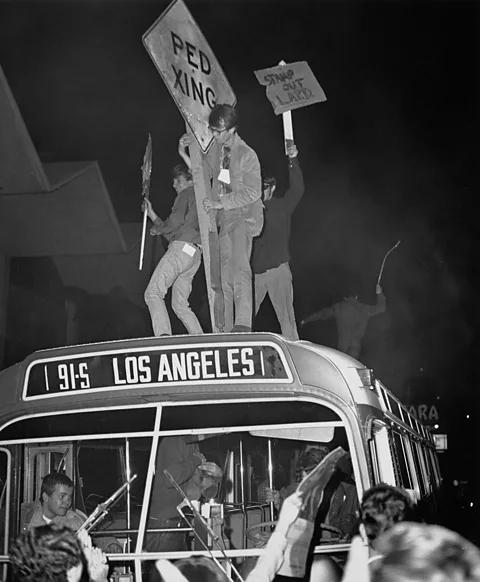
In the late autumn of 1966, a 1.7-mile stretch of Sunset Boulevard in West Hollywood became the epicenter of a cultural and political confrontation that would help define a generation. What began as a localized dispute over a 10:00 p.m. curfew for minors evolved into a series of demonstrations known as the "Sunset Strip riots." These events, while less destructive than the major urban uprisings of the decade, served as a critical bridge between the burgeoning rock-and-roll scene and the broader political radicalization of American youth. On November 26, 1966, the tension reached a boiling point outside Pandora’s Box, a prominent alcohol-free club, marking the third consecutive weekend of clashes between young protesters and the Los Angeles County Sheriff’s Department.
Historical Context: The Evolution of the Strip
The Sunset Strip occupies a unique geographic and legal space within the Los Angeles landscape. As an unincorporated section of the county, it historically operated under more lenient regulations than the surrounding city of Los Angeles. During the 1940s, this autonomy allowed the Strip to flourish as a playground for Hollywood elites and organized crime figures, populated by glamorous nightclubs like Ciro’s and the Mocambo. However, by the mid-1950s, the gambling and high-stakes nightlife had largely migrated to Las Vegas, leaving the neighborhood in a state of economic transition.
By the early 1960s, lower commercial rents paved the way for a new type of establishment: the rock club and the coffeehouse. The Strip was transformed into the primary hub for the West Coast’s burgeoning music scene. Legendary venues such as the Whisky a Go Go, The Trip, and The Sea Witch became the testing grounds for bands like The Byrds, The Doors, and Buffalo Springfield. In 1965, new county permits established a two-tiered system for these venues. One tier consisted of traditional clubs serving liquor to those over 21, while the other comprised "teen clubs"—alcohol-free spaces designed for patrons aged 15 to 20. Pandora’s Box, situated on a traffic island at the intersection of Sunset Boulevard and Crescent Heights Boulevard, became the most famous of these youth-oriented establishments.

The Catalyst: Curfew and Conflict
The rapid growth of the youth scene brought thousands of teenagers from the suburban valleys into West Hollywood every weekend. This influx created significant logistical and social friction. Business owners represented by the Sunset Plaza Association and the Los Angeles Chamber of Commerce viewed the "long-haired" youth as a nuisance that deterred wealthier patrons from the area’s upscale restaurants. Residents complained of traffic congestion, noise, and "loitering."
In response to lobbying from these groups, the West Hollywood Sheriff’s Department began a strict enforcement of a dormant 1939 curfew law. The ordinance required anyone under the age of 18 to be off the streets by 10:00 p.m. unless accompanied by an adult. By the summer of 1966, police tactics had escalated from simple dispersal to mass arrests and reported instances of physical intimidation. Concurrently, city officials utilized eminent domain laws to condemn Pandora’s Box, planning to demolish the club to widen the intersection. This dual threat—the loss of their physical space and the restriction of their movement—provided the spark for organized resistance.
Chronology of the 1966 Demonstrations
The formal protests began on November 12, 1966. Organized by local teenagers and supported by Al Mitchell, the manager of the Fifth Estate coffeehouse, the first demonstration saw an estimated 1,000 to 2,000 participants. Protesters carried signs with slogans such as "Let Us Alone" and "Blue Fascism." While the initial gathering was intended to be peaceful, the atmosphere soured as traffic became paralyzed. A minor collision involving a car of off-duty servicemen sparked a brawl, and the situation devolved when demonstrators began rocking a city bus. After passengers were evacuated, a teenager discharged a fire extinguisher inside the vehicle, and a nearby liquor store window was shattered. Police responded with billy clubs to clear the boulevard.
The following weekend, November 19, saw continued unrest, but it was the events of November 26 that cemented the riots in cultural history. On this night, as police moved to enforce the curfew with what witnesses described as "storm trooper" tactics, the violence intensified. Stephen Stills, the lead singer of Buffalo Springfield, was present and witnessed the heavy-handed police response. Deeply affected by the sight of officers beating young demonstrators, Stills returned to his home in Laurel Canyon and wrote "For What It’s Worth." Though often associated with the anti-Vietnam War movement, the song was specifically inspired by the Sunset Strip police actions, capturing the paranoia and tension of the era with the lyrics: "There’s a man with a gun over there / Telling me I got to beware."

Official Responses and Media Representation
The reaction from the establishment was swift and largely condemnatory. Mainstream newspapers, including the Los Angeles Times, ran headlines describing the events as a "Long Hair Nightmare" and "Anarchy on Sunset Strip." Editorial boards blamed the unrest on adolescent irresponsibility and parental failure. The LAPD’s Hollywood commander publicly alleged that the protests were the work of "left-wing groups and outside agitators," a common rhetorical strategy used during the 1960s to delegitimize youth-led movements.
However, the youth had their own media outlets and advocates. The Los Angeles Free Press, an influential underground newspaper, provided detailed accounts of police brutality that contradicted official reports. Furthermore, the celebrity community began to take a public stand. Jack Nicholson and Peter Fonda were noted participants in the demonstrations; Fonda was notably arrested during one of the sweeps. Sonny and Cher also made an appearance outside Pandora’s Box in December, attempting to mediate between the youth and the authorities.
To provide a legal defense for the arrested teenagers, the Community Action for Facts and Freedom (CAFF) committee was formed. This group included club owners, talent managers like Jim Dickson and Brian Stone, and civil rights lawyers. CAFF sought to challenge the constitutionality of the curfew and the use of eminent domain to shutter venues, marking one of the first times the Los Angeles music industry organized for political action.
Supporting Data and Cultural Impact
The economic and legal pressure eventually achieved the goals of the Sunset Plaza Association. Despite a brief, defiant reopening on Christmas Day 1966—where Stephen Stills performed "For What It’s Worth" for the first time in public—Pandora’s Box was demolished by the summer of 1967. The "teenybopper" scene was effectively pushed out of the Strip, as the county revoked the permits for alcohol-free dance halls.

The musical output resulting from the riots provided a lasting record of the conflict. In addition to Buffalo Springfield’s anthem, The Mamas and the Papas released "Creeque Alley," which referenced the changing scene, and Frank Zappa’s Mothers of Invention addressed the tension in "Plastic People." The film industry also capitalized on the events with "exploitation" movies like Riot on Sunset Strip (1967), which was filmed and released within months of the initial protests to capitalize on the national fascination with the "hippie" phenomenon.
Analysis: A Formative Activist Experience
While the Sunset Strip riots were relatively small in scale compared to the 1965 Watts Riots or the 1968 Democratic National Convention protests, their historical significance lies in their role as a "political education" for suburban youth. Music historian Peter Doggett notes that these clashes taught young people that the government and law enforcement could be adversaries rather than protectors.
The protests also highlighted the limitations of the movement. While the Strip activists attempted to align themselves with other marginalized groups—such as the gay community in Silver Lake, which was facing its own struggle against police raids at the Black Cat tavern—they largely failed to build lasting coalitions with Black or Chicano activists. This lack of intersectionality limited the immediate political impact of the protests, as they were often viewed by the broader public as a "middle-class" rebellion over the right to party.
Nevertheless, the radicalization that began on the Strip in 1966 bore fruit in 1968 and beyond. The 16-year-olds who were chased by police in West Hollywood in 1966 became the college students who led the anti-war marches and the "Clean for Gene" McCarthy campaign two years later. The trajectory of Stephen Stills’ career mirrors this shift; by 1970, he would write "Ohio" with Crosby, Stills, Nash & Young, a song responding to the Kent State shootings, representing the final transition of the "long-haired" youth from social nuisances to a potent political force.

The Sunset Strip riots remain a pivotal moment in the history of Los Angeles, illustrating the friction between urban development, economic interests, and the emergence of a distinct youth culture. The transformation of the Strip from a site of spontaneous protest to a sanitized commercial district was a precursor to modern debates over gentrification and the regulation of public space. Ultimately, the events of 1966 proved that even a localized dispute over a curfew could signal the start of a seismic shift in the American social fabric.