Jia Lissa
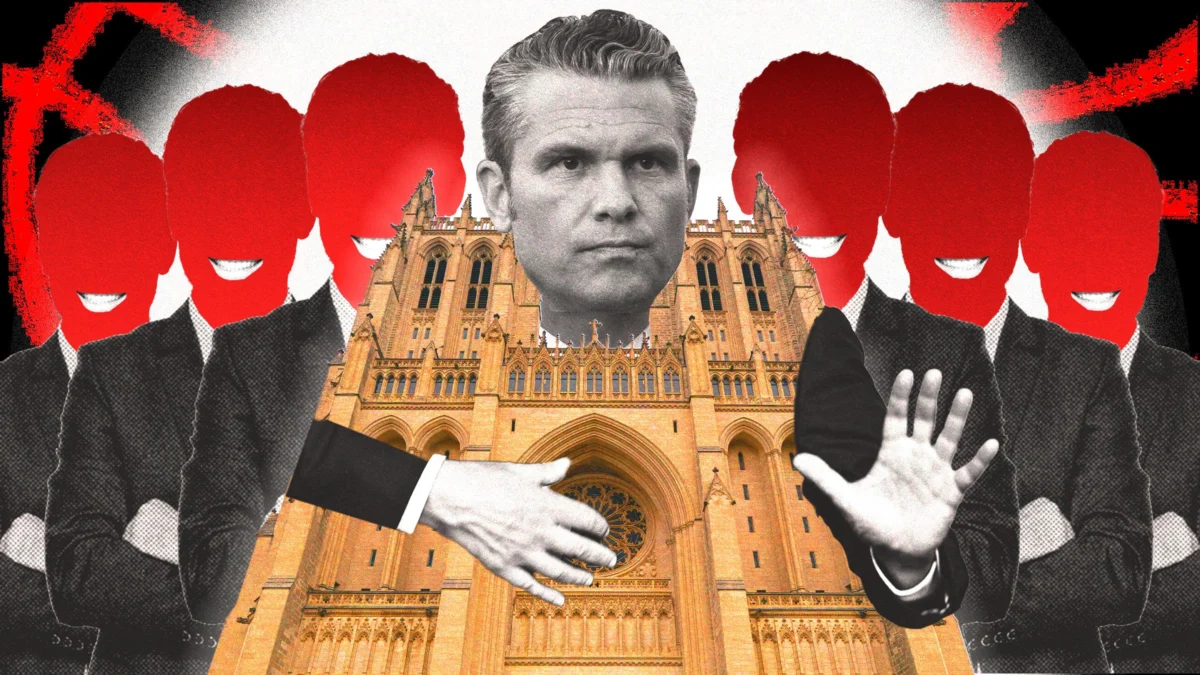
On a crisp Sunday morning in April, just minutes from the majestic dome of the US Capitol, a striking scene unfolded along a section of Washington, D.C.’s Pennsylvania Avenue. A formidable line of black SUVs stood sentinel alongside stretches of yellow police tape, while uniformed men in military-style gear, armed with long guns, guarded the entrance to a building adorned with mirrored windows and a discreet door. This fortified perimeter marked the location of Christ Church DC, a relatively new place of worship that has emerged on Capitol Hill within the last year, now drawing an increasingly influential congregation from the highest echelons of government.
A Convergence of Power and Faith
That particular Sunday, the pews of Christ Church DC hosted an extraordinary assembly of high-ranking government officials. Among them were the intelligence chief of Homeland Security, America’s leading international health diplomat, and the government’s international finance chief. They had gathered not for a policy briefing, but to hear a sermon. The pastor, acknowledging the church’s strategic location, quipped, "It gives a whole new meaning to worshipping in the presence of your enemies." He then delivered a more pointed message, asserting, "We’ve asked the government to fix us, and we’re more enslaved than ever." This sentiment encapsulates the core ideology of the church and its burgeoning influence within the federal apparatus.
Christ Church DC’s establishment approximately a year ago coincided with a significant political event: the confirmation of Pete Hegseth as the US Secretary of Defense. Hegseth, a regular attendee of worship with his family, has since become a central figure in the church’s growing reach into government circles. The church itself is an outpost of Pastor Doug Wilson’s network, known as the Communion of Reformed Evangelical Churches (CREC), headquartered in Moscow, Idaho. Wilson’s long-articulated objective is nothing less than the transformation of America into a theocracy, where all societal institutions are reshaped according to his interpretation of biblical law. This vision includes public executions, the prohibition of non-Christians from holding public office, and a societal structure where women are expected to submit to their husbands rather than participate in the electoral process.
The Ideological Architect: Pastor Doug Wilson
Doug Wilson, a figure who describes himself as "paleo-Confederate," has cultivated his influence for decades, operating within a complex amalgam of historical Protestant traditions. His theological and political views are deeply controversial, marked by a staunch commitment to Christian nationalism. His network, the CREC, now encompasses approximately 160 churches and hundreds of affiliated classical Christian schools and colleges across the United States and internationally. This extensive groundwork is designed to disseminate his blueprint for a Christian nationalist society far beyond its Idaho origins. Wilson has consistently and explicitly stated his intention to build a new political and social order in America—one that positions the church at its very core and is governed exclusively by Christian men.
Wilson’s controversial stances extend to fundamental aspects of modern society and human rights. Through various affiliated media outlets, he has publicly declared that "women need to be pastored, and they need to be pastored by men." As recently as 2024, he advocated for the repeal of the 19th Amendment, which granted women the right to vote. His belief system also includes deeply unsettling views on historical injustices; in 1996, he co-authored a booklet that controversially described slavery as a "relationship based upon mutual affection and confidence." Furthermore, he has expressed that he does not believe "a Muslim should be able to hold political office" and has characterized immigration as a "deliberately fomented war on the American heritage and unremitting hostility to the culture."
Wilson refers to Washington, D.C., as "Babylon on the Potomac," a biblical moniker he employs to evoke a place corrupted by ungodly people. Despite his strong critiques of the capital, the church has strategically occupied three different locations since its establishment, with Wilson actively raising funds to acquire a permanent home near Capitol Hill. "We are here for the long haul," he wrote in a blog post earlier this year, emphasizing his commitment to establishing a lasting presence. He has also advised his podcast listeners against "going to DC and going native" or "[climbing] the greasy pole of ambition," instead asserting that D.C. "needs an infusion of God-fearing humans." While Wilson initially agreed to an interview with WIRED, he abruptly canceled, offering little explanation, but he has not shied away from touting his growing influence in government circles in past media engagements. "This is the first time we’ve had connections with as many people in national government as we do now," Wilson told the Associated Press in 2025, shortly after speaking at the opening of his new D.C. church.
Secretary Pete Hegseth: The Catalyst for Connection
The significant rise in Wilson’s profile and the expansion of his network into the nation’s capital would not have been possible without the pivotal role played by Pete Hegseth. According to Peter Bell, a researcher, theologian, and host of the podcast Sons of Patriarchy, which has extensively investigated Wilson for years, "Hegseth gave them an in." This assessment underscores the critical conduit that the Secretary of Defense has become for the CREC network.
Sean Parnell, chief Pentagon spokesman, confirmed Hegseth’s affiliation, stating, "The secretary is a proud member of a church affiliated with the Congregation of Reformed Evangelical Churches, which was founded by Pastor Doug Wilson. The secretary very much appreciates many of Mr. Wilson’s writings and teachings." Parnell later issued a second statement, defending the practice of faith within the department: "Staff at the Department of War have the liberty to practice their faith and attend any church they choose. It is shameful that WIRED is attempting to smear respected personnel for exercising their religious freedoms."
Hegseth’s deep engagement with the CREC predates his cabinet nomination. In 2022, well before his appointment by President Donald Trump, Hegseth relocated his family to the Nashville, Tennessee, area specifically to attend a CREC church and enroll his children in an affiliated classical Christian school. Following his narrow confirmation as Secretary of Defense last year, Hegseth wasted no time in introducing a monthly Pentagon prayer service. He brought his Tennessee pastor, Brooks Potteiger, to lead the inaugural session. In July, Potteiger officially assumed the role of pastor for Christ Church DC, further solidifying the link between the Pentagon and Wilson’s network. Potteiger, in a podcast with Wilson and other church elders before his move, expressed his enthusiasm, stating, "I believe this is significant. It energizes me… to see these young families, and especially the young Christian men, who are hungry for a soaring biblical view of the lordship of Christ over all things." Christ Church DC did not respond to requests for an interview with Potteiger.
As Secretary, Hegseth has consistently woven religious rhetoric into his official duties. He has invoked scripture when discussing the war in Iran, established an Office of Religious Affairs directly under his purview at the Pentagon, and used his position to assert that America is fundamentally a Christian nation. In a speech in late September, he declared, "Our department is, you might say, putting on the full armor of God, because while we wage physical war, we all know the real battle is spiritual. Live your calling. Stand firm. Preach truth. Minister to the flock." He has invited Doug Wilson to speak at Pentagon prayer sessions twice this year, with Wilson’s most recent address just last week reportedly encouraging military personnel in their desire for America to become a theocracy and to impose a Christian conservative social order.
A Growing Network: Officials Across Government
WIRED has identified around a dozen government officials who have attended services at Christ Church DC at least once since its opening. These attendees span various critical departments, indicating a broader infiltration of Wilson’s ideology beyond the Defense Department.
Within the Pentagon:
- Justin Overbaugh: Deputy Undersecretary of War for Intelligence and Security. A former US Army officer, Overbaugh was working in risk management in Florida until Hegseth nominated him. He now handles highly sensitive military intelligence and counterintelligence matters. Overbaugh is an attendee of Christ Church DC and is slated to give a seminar in Tampa, Florida, in January titled "Serving Christ in the Pentagon."
- Nate Halverson: Chief of Staff to the Assistant Secretary of the Navy for Manpower and Reserve Affairs. Halverson, a 2006 graduate of New Saint Andrews College (a university co-founded by Wilson in Moscow, Idaho), was appointed to this senior Pentagon leadership role in October, despite having no prior military background. His position involves recruiting for the Navy and Marine Corps and overseeing policies affecting all military and civilian personnel and their families. Before joining the Pentagon, Halverson spent 15 years in sales for a workforce management software company.
- C. Scott “Sonny” Duncan: Senior Counselor to the Secretary of the Navy. Duncan, who describes himself as an "executive servant leader" on LinkedIn, was recently promoted to this influential position, enabling him to help shape decisions impacting the entirety of US Navy operations. A former Marine pilot, Duncan retired in 2023 to fly commercial planes and work part-time at Chick-fil-A. His retirement as a lieutenant colonel was driven by his objection to the military’s Covid-19 vaccine requirements, a stance that garnered him positive attention in right-wing media. Last year, Hegseth made Duncan a key contact for an initiative focused on "Reinstating Service Members Negatively Impacted by the Coronavirus Disease 2019 Vaccination Mandate."
- Stuart Scheller: Senior Adviser to the US Undersecretary of War for Personnel and Readiness. Scheller, also a former Marine lieutenant colonel, was court-martialed in 2021 after pleading guilty to showing contempt and disrespect for senior military officials following the chaotic withdrawal from Afghanistan.
- Ryan Higgins: Senior Adviser for Religious Issues at the Pentagon and a key aide to Hegseth. A recent CNN investigation revealed that Higgins had shared numerous racist and homophobic social media posts targeting immigrants and Muslims. CNN also reported that Higgins has played a crucial role in shaping Hegseth’s Christian nationalist messaging at the Pentagon.
Beyond the Pentagon:
- Bethany and Matthew Kozma: This Trump administration couple, who have attended Christ Church DC with their children, are significant figures. Bethany Kozma serves as the Director of Global Affairs at the Department of Health and Human Services, acting as America’s top international health diplomat. She is known for her strong positions against abortion and transgender rights. Matthew Kozma is the Department of Homeland Security’s Undersecretary for Intelligence and Analysis, overseeing issues related to counterterrorism, counterproliferation of weapons of mass destruction, and critical infrastructure protection. Both were contributors to Project 2025, a blueprint for a potential second Trump term.
- David Vandenberg: An immigration judge in the Justice Department’s civil rights division. Hired last year and seated last month, Vandenberg previously served as an assistant US attorney in New Mexico and Texas. During his time in Texas, colleagues reportedly complained of alleged volatile behavior.
- Brantley Mayers: Counsel to the Assistant Attorney General for the DOJ’s civil division and a former fellow at the conservative Claremont Institute think tank. Mayers frequently acted as a spokesperson for the DOJ, notably defending the Trump administration’s ICE occupation of Minneapolis. He was also referred for discipline in June after a federal judge ruled that the DOJ had engaged in "unsettling" practices in its efforts to subpoena a Rhode Island hospital over transgender care. The judge remarked at a May 2026 hearing, "That is dirty pool, in my opinion, and the Department of Justice have willfully done that in this case." Mayers represented the DOJ at this hearing.
- Stephen Duggan: Chief Financial Officer at the US International Development Finance Corporation (DFC), which invests in private-sector development projects overseas. Earlier this year, the head of the DFC faced questioning from Congressional Democrats regarding the agency’s investments and "potential entanglements" with the Trump family. Duggan previously served as CFO for Bentkey Ventures, a subscription-based streaming service offering "anti-woke" children’s content, owned by The Daily Wire.
- Andrew Braun: Defense policy adviser for Senator Mike Rounds (R-SD) and a former government relations manager at The Heritage Foundation, a conservative think tank. He has also attended church services.
- Paul Lindstrom: Briefly an offensive lineman for the University of Idaho Vandals football team, he worked as an executive assistant in the Office of the President until recently and has attended.
- Samuel Brown: Undersecretary for Memorial Affairs at the Department of Veterans Affairs.
WIRED reached out to all government officials mentioned in this story for comment. None replied, with the exception of a spokesperson for Bethany Kozma, who initially denied her attendance but did not follow up after being informed of WIRED’s confidence in her attendance. At Christ Church DC, these officials interact not only with each other but also with members of conservative think tanks, delegates from the broader CREC network, judicial clerks, venture capitalists, and lobbyists, fostering a robust ecosystem for their shared ideology.
Broader Implications: Christian Nationalism and Project 2025
The presence of so many high-ranking officials at Christ Church DC, coupled with Secretary Hegseth’s actions, highlights a concerning trend identified by civil liberties advocates: the increasing normalization and integration of Christian nationalist ideology within the U.S. government. Peter Bell emphasizes, "Wilson is explicit concerning his desire to see Christians in office—and only Christians in office—and a church at the foot of the Capitol is the clearest route toward that end."
This development aligns closely with the objectives of Project 2025, a comprehensive blueprint for a potential second Trump term. A core tenet of Project 2025 is a plan to infuse Christian nationalist ideology into all levels of the U.S. government. Following his initial inauguration, President Trump signed an executive order establishing a task force to investigate "anti-Christian bias" in government departments, and Christian nationalists were strategically placed in key roles across the administration. This attitude has been replicated across government departments; for example, the former Secretary of Labor initiated a monthly prayer service months after the creation of a White House Faith Office.
The implications for the separation of church and state, a foundational principle of American democracy, are profound. Critics argue that the open promotion of a specific religious ideology by senior government officials, particularly within the military, risks undermining religious pluralism, fostering an environment of exclusion for non-Christians, and potentially compromising the impartiality of government functions.
According to data from 2019, approximately 70 percent of active-duty service members identify as Christian. Mikey Weinstein, a former Air Force officer, attorney, and founder of the Military Religious Freedom Foundation (MRFF), estimates that about half of these adhere to Christian nationalist ideology. Weinstein believes that many emulate the ideology they observe from their leaders. He states that the vast majority of service members represented by his organization are Christians who feel alarmed by and powerless to challenge the Christian nationalism that has taken hold at all ranks, including the very top. This suggests a potential for internal division and discomfort within institutions designed to represent and protect a diverse citizenry.
Doug Wilson’s long-term strategy, as interpreted by Bell, is not about imposing a Christian culture from the top down, but rather cultivating it from the ground up. "Put Christians in office, legislate Christian morality, let that simmer among the populace, and Christian culture eventually emerges," Bell explains. The emergence of Christ Church DC, strategically positioned near the heart of American political power, and its growing influence among key government officials, suggests that this long-term vision is actively taking root, raising significant questions about the future trajectory of American governance and its secular foundations.