admin
Tate Britain has unveiled a comprehensive new exhibition titled Vanessa Bell & Duncan Grant: Inside Bloomsbury, marking one of the most significant explorations of the creative and personal partnership that defined British modernism in the early 20th century. Featuring more than 300 works, including paintings, ceramics, textiles, and decorated furniture, the exhibition delves into the fifty-year relationship between Vanessa Bell and Duncan Grant. While the showcase celebrates their pioneering role in bringing Post-Impressionism to Britain, it also confronts the "devastating deception" and the complex social dynamics that have made the Bloomsbury Group a subject of both admiration and intense criticism for over a century.
The exhibition highlights how Bell and Grant blurred the boundaries between fine art and domestic life, transforming their living spaces into canvases for experimental design. Central to this narrative is Charleston, the Sussex farmhouse that served as their sanctuary and studio. The curation includes a reconstruction of their Charleston studio and the 50-piece "Famous Women Dinner Service," a collaborative project featuring portraits of historical and mythical women. According to co-curator Thomas Kennedy, the collaboration on these plates was so seamless that it remains difficult to distinguish which artist painted which piece, symbolizing the deep intellectual and artistic fusion of their partnership.

A Chronology of the Bloomsbury Group and the Charleston Era
The origins of the Bloomsbury Group date back to 1904, following the death of Sir Leslie Stephen. His children—Vanessa, Virginia (later Woolf), Thoby, and Adrian—moved from the rigid Victorian atmosphere of Kensington to the more bohemian district of Bloomsbury. This move served as the catalyst for a weekly gathering of intellectuals, including the economist John Maynard Keynes, the author E.M. Forster, and the art critic Clive Bell, whom Vanessa married in 1907.
By 1910, the group’s influence expanded through the efforts of Roger Fry, who organized the landmark exhibition "Manet and the Post-Impressionists." This event introduced British audiences to the works of Gauguin, Cézanne, and Matisse, fundamentally altering the trajectory of domestic art. In 1913, Fry, Bell, and Grant co-founded the Omega Workshops, a design enterprise intended to integrate avant-garde aesthetics into everyday objects.
The move to Charleston in 1916 was prompted by the First World War. As conscientious objectors, Duncan Grant and his then-lover David "Bunny" Garnett were required to engage in agricultural work to avoid imprisonment. Vanessa Bell relocated the household to the Sussex countryside to support them, establishing a domestic arrangement that defied the era’s social norms. For the next several decades, Charleston became a living laboratory for their "radical design" philosophy, where every surface—from walls and doors to bedspreads and lampshades—was hand-painted with bold, abstract patterns.

The Intersection of Art and Personal Complexity
The Tate exhibition does not shy away from the intricate and often painful personal lives of its subjects. Vanessa Bell lived in an open marriage with Clive Bell, while maintaining a lifelong romantic and professional bond with Duncan Grant, who was gay. This arrangement was part of the Bloomsbury Group’s broader rejection of Edwardian morality, embracing polyamory and queer identity long before such concepts were socially or legally accepted in Britain.
However, this progressive exterior masked a "devastating deception" regarding the paternity of Vanessa’s youngest child, Angelica. Although raised as the daughter of Clive Bell to ensure her social standing and inheritance, Angelica was actually the biological daughter of Duncan Grant. This secret was kept from her until she was 18 years old, a revelation that she later described in her 1984 memoir, Deceived with Kindness, as shattering the "precarious paradise" of her upbringing.
Dr. Jon King, author of Vanessa Bell and Charleston: Motherhood, Queerness and the Domestic Imagination, notes that Grant’s painting The Hammock, Charleston (c. 1921-3) perfectly encapsulates this tension. While the work appears to be a familial idyll, King points out that the figures are emotionally isolated within the frame. Angelica is depicted walking away from the central group, a visual metaphor for the psychological distance created by the family’s secrets. The irony of the situation was compounded when Angelica later married David Garnett—her father’s former lover—a union that her parents reportedly failed to discourage despite the complex history involved.

Supporting Data: The Artistic Output and the Omega Legacy
The sheer volume of work produced by Bell and Grant underscores their commitment to the democratization of art. The Tate exhibition draws from the extensive archives of The Charleston Trust and the Yale Center for British Art to demonstrate the breadth of their influence:
- The Omega Workshops (1913–1919): During its six-year run, the workshops produced hundreds of unique designs. The Tate exhibition features rare surviving textiles and furniture that show how the group used bold, rhythmic patterns to break away from the floral motifs of the Arts and Crafts movement.
- The Famous Women Dinner Service (1932–1934): Commissioned by Kenneth Clark, this set of 50 plates depicts figures ranging from Cleopatra to Greta Garbo. It is considered a landmark of early feminist art, predating Judy Chicago’s The Dinner Party by four decades.
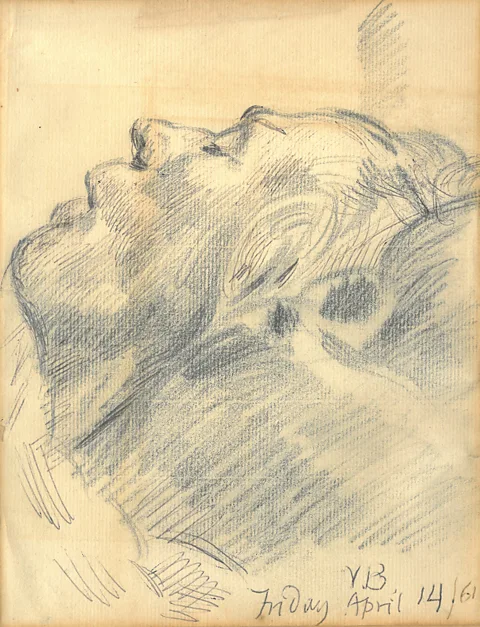
- Portraiture as Record: The exhibition includes numerous portraits Bell and Grant painted of each other. A recently discovered 1961 pencil drawing of Vanessa by Duncan, created shortly after her death, serves as a poignant final record of their fifty-year intimacy.
Analysis of their technique reveals a shared palette. Conservators at the Tate discovered that Bell and Grant frequently used the same tubes of paint while working side-by-side on different canvases, such as their respective 1914 still-life paintings of a mantelpiece. While their materials were the same, their styles remained distinct: Bell favored structural, bold blocks of color, while Grant often experimented with collage and more fluid, decorative lines.
Critical Reactions and Allegations of Elitism
Despite their contributions to modernism, the Bloomsbury Group has faced persistent criticism for being an insular, upper-middle-class clique. Contemporary critics such as Wyndham Lewis attacked the group in his 1930 novel The Apes of God, satirizing what he viewed as their self-congratulatory taste-making and salon politics. Lewis and others argued that their "radicalism" was a luxury afforded only by their private incomes and social status.

Further scrutiny has been directed at the group’s internal contradictions. Historian Alison Light, in Mrs. Woolf and the Servants (2007), highlighted the irony of the sisters’ "bohemian" lives, which were entirely dependent on a traditional domestic staff. While Bell and Woolf advocated for female independence, their own freedom was facilitated by the labor of working-class women who did not share in their progressive liberation.
Additionally, the group’s legacy is complicated by evidence of antisemitism in their private correspondence. While Leonard Woolf, Virginia’s husband, was Jewish, Virginia’s diaries occasionally contained derogatory remarks that reflected the casual prejudices of the British upper class of the time. These "darker sides" of the group have led some historians to view them not as true revolutionaries, but as a privileged coterie that was "progressive" only when it suited their personal interests.
Broader Impact and Modern Implications
The enduring fascination with the Bloomsbury Group suggests that their experiments in living and art still resonate in the 21st century. Thomas Kennedy argues that their role in introducing Post-Impressionism to the United Kingdom "changed the face of British art" by breaking down the barriers between fine art and decorative craft. This philosophy—that art should permeate every aspect of the observable world—paved the way for modern interior design and the contemporary "lifestyle" aesthetic.

Moreover, the group’s navigation of queer identity and non-traditional family structures is being re-evaluated through a modern lens. While Angelica Bell viewed her upbringing as a deception, modern scholars like Dr. Jon King suggest that the group was attempting to forge a "queer family" model at a time when such lives were criminalized. The discovery of over 400 homoerotic drawings by Duncan Grant in 2020, which had been hidden for decades to avoid legal repercussions, further illustrates the hidden pressures they faced.
Ultimately, Vanessa Bell & Duncan Grant: Inside Bloomsbury presents a duality. It celebrates the "joy" and "creative freedom" that Vanessa’s granddaughter, Virginia Nicholson, remembers from her childhood at Charleston, while acknowledging the emotional toll of their radical experiments. The exhibition serves as a reminder that the Bloomsbury Group’s greatest work of art may not have been a single canvas or a book, but the attempt to construct a world entirely on their own terms—however flawed that world may have been. As the Tate exhibition demonstrates, their legacy remains as vibrant, colorful, and divisive as the patterns they painted on the walls of Charleston.