admin
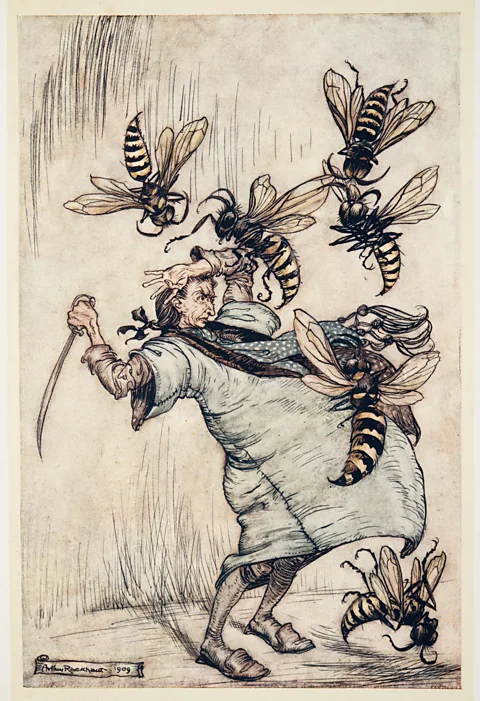
Since its initial publication in 1726, Jonathan Swift’s "Travels into Several Remote Nations of the World. In Four Parts. By Lemuel Gulliver, First a Surgeon, and then a Captain of Several Ships"—commonly known as Gulliver’s Travels—has occupied a unique and often contradictory space in the global literary canon. While the image of a shipwrecked adventurer pinned to the ground by thousands of tiny Lilliputians has become a staple of children’s folklore, the original manuscript was conceived as a biting, misanthropic indictment of the human race. In the three centuries since its debut, the work has been systematically "chopped, changed, and adapted," leading to a cultural schism between the "fantastical nursery tale" known to the public and the "excoriating satire" intended by its author.
Swift’s primary objective, as articulated in his correspondence, was not to entertain but to "vex the world." Writing to Alexander Pope in 1725, Swift famously stated that his goal was to prove that man is not a "rational animal" but merely an animal "capable of reason." This distinction serves as the foundation for a narrative that targets the British Crown, the Church of England, the legal profession, and the burgeoning scientific community of the 18th century. However, the sheer imaginative power of Swift’s world-building—spanning lands of giants, floating islands, and talking horses—allowed the story to transcend its topical origins and evolve into a broader "Gulliveriana" that continues to permeate modern media.

A Chronology of Alteration: From Radical Satire to Children’s Classic
The transformation of Gulliver’s Travels began almost immediately upon its release. Because of the novel’s incendiary political content, it was published pseudonymously in October 1726. The first edition, printed by Benjamin Motte, was intentionally altered to protect the publisher from charges of sedition. Motte excised some of the more aggressive political screeds and inserted passages praising Queen Anne to mitigate the author’s sharp critiques of the monarchy.
By the mid-18th century, the book’s popularity among younger readers prompted a new wave of adaptations. The high cost of the original volumes led to the rise of "chapbooks"—inexpensive, abridged versions of popular stories. These booklets focused almost exclusively on the first two voyages: Gulliver’s time in Lilliput (the land of the small) and Brobdingnag (the land of the giants). These sections offered the most visual and physical comedy, making them ideal for simplification.
A pivotal moment in the sanitization of the text occurred in the 1790s, when publisher Francis Newbery released a version that fundamentally reshaped the narrative for a juvenile audience. Newbery’s edition removed the third voyage to Laputa—a complex parody of the Royal Society’s scientific experiments—and the fourth voyage to the country of the Houyhnhnms. By removing the final voyage, in which Gulliver becomes so disgusted by humanity (the "Yahoos") that he chooses to live in a stable with horses, publishers successfully stripped the work of its bleakest misanthropy.

The Victorian Backlash and the Era of Expurgation
During the 19th century, the literary reputation of Jonathan Swift underwent a significant decline, driven by Victorian sensibilities regarding morality and religion. While the imaginative elements of the story remained popular, the "scatological and sexual" components were deemed offensive. Swift’s use of "toilet humor"—including a famous scene where Gulliver extinguishes a palace fire in Lilliput by urinating on it—was viewed as a sign of a "diseased mind" rather than a satirical tool.
In 1853, William Makepeace Thackeray, author of Vanity Fair, described Gulliver’s Travels as "filthy in word, filthy in thought, furious, raging, and obscene." Similarly, the critic Edmund Gosse suggested that Swift’s chronic vertigo had led to a loss of mental control, manifesting as a "chronic misanthropy." Historian Hester Grant notes that the Victorians were largely responsible for "expurgating and stripping the ugly" from the text, leaving behind a "lovely, clean work of the imagination" that fit the era’s pedagogical needs.
This era of censorship ensured that for over a century, the majority of readers encountered a "bowdlerized" version of Gulliver’s experiences. The fourth voyage, which equates human behavior with that of the brutish, irrational Yahoos, was viewed as a "complete attack on humanity" and was frequently omitted from educational curricula.

Satirical Targets and the Context of "Exile"
To understand the "savage indignation" that fueled Swift’s writing, historians point to his personal and political biography. Born in Dublin in 1667, Swift spent much of his career as a political operative for the Tory party in London. His "glory years" ended abruptly in 1714 with the death of Queen Anne and the subsequent collapse of the Tory ministry. Displaced from the centers of power, Swift was appointed Dean of St. Patrick’s Cathedral in Dublin—a position he viewed as a form of "exile" in a "wretched, dirty, dog-hole."
This sense of betrayal and professional stagnation heavily influenced the themes of ingratitude and courtly corruption in Gulliver’s Travels. The "Big-endian" versus "Little-endian" war in Lilliput, for example, served as a direct parody of the religious conflicts between Catholics and Protestants, mocking the idea that millions had died over the "correct" way to break an egg.
Furthermore, Swift used the floating island of Laputa to critique British colonial policy toward Ireland. In the original text, the Laputians maintain control over the inhabitants of the land below (Balnibarbi) by hovering their island over rebellious cities to block out sun and rain, or by threatening to drop the island and crush them entirely. The city of Lindalino in the novel is widely recognized by scholars as a stand-in for Dublin. These passages were so politically sensitive that they were often suppressed in early English editions.

Supporting Data: The Transmedia Legacy of "Gulliveriana"
The enduring influence of Swift’s work is evidenced by its vast array of transmedia adaptations, which span genres, ideologies, and centuries. According to Daniel Cook, author of Gulliver’s Afterlives, the text is one of the most adapted works in literary history.
- Cinema and Television: From the 1939 animated classic to the 2010 live-action film starring Jack Black, the story has been reimagined for every generation of cinema-goers. It has also appeared in Soviet-era cinema as a critique of capitalism and in modern television series like Doctor Who.
- Literature: Titans of 20th-century literature, including George Orwell and Sylvia Plath, drew heavily from Swift. Orwell, in his essay Politics vs. Literature, labeled Swift a "Tory anarchist" and noted that the joyless, hyper-rational society of the Houyhnhnms prefigured modern totalitarianism.
- Linguistics and Computing: Perhaps the most surprising legacy of the novel is its impact on modern technology. In 1980, computer scientist Danny Cohen introduced the terms "Big-Endian" and "Little-Endian" to describe the order in which bytes are stored in computer memory, a direct reference to the egg-breaking controversy in Lilliput. Additionally, the term "Yahoo"—now synonymous with the global internet brand—was Swift’s name for the degenerate, human-like creatures encountered in the fourth voyage.
- Artificial Intelligence: Swift even appeared to predict the rise of automated knowledge. In the Grand Academy of Lagado, Gulliver observes a "frame" or "engine" that allows people to "write books in philosophy, poetry, politics, laws, mathematics, and theology, without the least assistance from genius or study." This passage is frequently cited by modern critics as a satirical precursor to Large Language Models and generative AI.
Implications: Misunderstanding as a Form of Survival
The fact that Gulliver’s Travels has survived for 300 years as a children’s book may be the ultimate irony for a writer who despised "dumbing down" culture. Abigail Williams, Professor of English at King’s College London, suggests that while Swift might "despair" at the loss of his specific political barbs, he might also be "delighted by the fact that it was being misunderstood."
The survival of the text in its sanitized form speaks to a fundamental tension in literature: the ability of a work to outgrow its creator’s intentions. By creating a world so vivid and imaginative, Swift provided the very tools for his satire to be converted into the "adventure story" he was originally mocking.

Today, scholars argue that the original, unedited voyages are more relevant than ever. In an era of political polarization, scientific skepticism, and debates over the nature of "rationality," Swift’s "savage indignation" offers a mirror to contemporary society. Whether viewed as a whimsical journey or a dark psychological study, Gulliver’s Travels remains a towering achievement that continues to "vex" and "divert" the world in equal measure. As Rudyard Kipling famously noted, Swift "tried to bring an indictment against all humanity, but left a book for children"—a testament to the unpredictable and enduring power of the written word.