admin
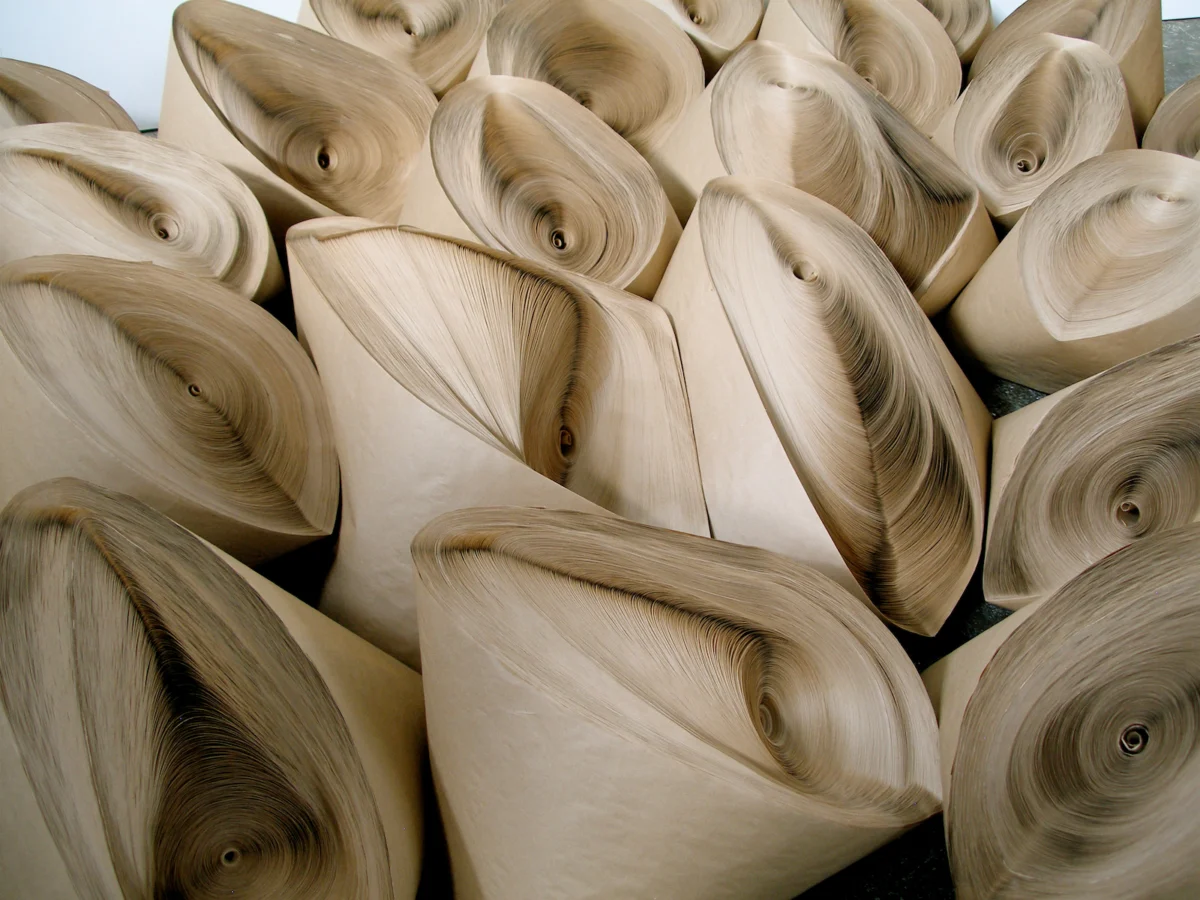
The Belgian art scene is currently playing host to a transformative exploration of medium and form as the Korean-born artist Jae Ko presents her latest solo exhibition, Striated, at the 22MUSE Gallery in Antwerp. Marking her debut solo appearance in Belgium, the exhibition serves as a comprehensive survey of Ko’s four-decade-long career, showcasing her unique ability to transmute the most ephemeral of materials—paper—into monumental sculptures that evoke the permanence of geological formations and the ancient rhythms of the natural world. Through a meticulous process of rolling, inking, and compressing thousands of yards of paper, Ko challenges the viewer’s perception of weight, durability, and the passage of time.
The Metamorphosis of Material: From Office Supplies to Fine Art
At the core of Jae Ko’s practice is a radical reinterpretation of paper. While the material is traditionally associated with the two-dimensional—the surface for a drawing or the vehicle for a written message—Ko treats it as a sculptural substrate equivalent to clay or stone. Her primary materials are notably mundane: discarded office supplies, recycled kraft paper, and rolls of adding machine paper. By selecting these mass-produced, utilitarian items, Ko engages in a form of alchemy, elevating the "ordinary" to the "extraordinary" through sheer labor and repetition.

The sculptures featured in Striated appear, at first glance, to be carved from exotic hardwoods or weathered sedimentary rock. Saturated spirals of ultramarine blue, deep forest green, and vivid magenta curl into forms that mimic tree rings, desert canyons, and glacial movements. It is only upon closer inspection that the individual edges of the paper become visible, revealing the thousands of layers that constitute each work. This tension between the fragility of a single sheet of paper and the perceived massive density of the finished sculpture is a hallmark of Ko’s aesthetic.
A Four-Decade Evolution: Chronology and Context
Jae Ko’s artistic trajectory is one defined by geographical and cultural synthesis. Born in Seoul, South Korea, she later moved to Japan to study, where she was exposed to traditional aesthetics and the rigorous discipline of Japanese craftsmanship. This period was formative in her adoption of sumi ink—a traditional calligraphy ink made from soot—which remains a staple in her process today.
In the 1990s, Ko relocated to the United States, eventually settling on the Eastern Shore of Maryland. This move marked a significant shift in her work, as the expansive wetlands and tidal rhythms of the Chesapeake Bay region began to influence her organic forms. Her career has since seen her work acquired by major institutions and commissioned for high-profile spaces, including the Facebook Headquarters and the American University Museum in Washington, D.C.

The exhibition at 22MUSE Gallery represents a pivotal moment in this timeline, as it brings together formative works from her early experimental years alongside a site-specific installation designed specifically for the Antwerp gallery’s architecture. By placing these works in dialogue, Striated allows viewers to trace the evolution of her technique—from smaller, more intimate coils to the expansive, flowing installations that now define her practice.
The Technical Process: Labor as a Record of Time
Ko’s methodology is an exercise in endurance and precision. The process begins with the unwinding of tightly coiled commercial paper rolls. These are then reshaped through a series of physical interventions: rolling, twisting, folding, stacking, and eventual compression. The "striations" referenced in the exhibition’s title are the fine parallel lines created by the edges of the paper, which function as a visual record of the artist’s labor.
A critical component of her process involves the use of liquids. Some sculptures are submerged in vats of sumi ink or vibrant pigments, allowing the paper to absorb the color through capillary action. This saturation does more than change the hue; it alters the structural integrity of the paper, causing it to swell and then harden as it dries. In some instances, Ko takes the experimental process further by burying the paper or exposing it to specific environmental conditions, allowing moisture and pressure to "sculpt" the material in ways that bypass direct human intervention.

This "slow art" approach stands in stark contrast to the rapid-fire production of the digital age. Each piece represents hundreds, if not thousands, of hours of manual manipulation. The resulting works are not merely objects but are accumulations of time itself, rendered in three dimensions.
Nature as a Blueprint: Forces of Growth and Erosion
While Ko’s sculptures are abstract, they are deeply rooted in the observation of natural phenomena. She has frequently cited the bristlecone pine—one of the world’s oldest living organisms, found in the American West—as a major inspiration. The way these trees are shaped by centuries of wind, ice, and sun is mirrored in the way Ko’s paper forms appear to have been molded by external forces.
The installations in Striated evoke a variety of topographical features:

- Geological Strata: The layered edges of the paper mimic the sedimentary layers of the Earth’s crust, suggesting deep time and the slow accumulation of matter.
- Dendrochronology: The circular, spiral forms resemble the growth rings of ancient trees, providing a narrative of life and environmental history.
- Fluid Dynamics: Despite their solid construction, many of the larger works possess a sense of movement, appearing like frozen waves or flowing lava.
By referencing these forces—erosion, growth, and movement—Ko creates a bridge between the synthetic world of manufactured paper and the organic world from which the paper originally descended.
Institutional Presence and Market Impact
The arrival of Jae Ko’s work in Antwerp is seen by art market analysts as a strategic expansion of her European footprint. 22MUSE Gallery, known for its focus on materiality and process-driven contemporary art, provides a fitting context for Ko’s labor-intensive works.
Historically, Ko’s work has performed well in both institutional and private sectors. Her large-scale commissions for corporate environments, such as the swirling cardboard installation at Meta (formerly Facebook) HQ, demonstrate the architectural versatility of her medium. Collectors are often drawn to the paradoxical nature of her work: it possesses the presence of heavy sculpture but remains light enough to be mounted on walls in ways that traditional stone or metal cannot.

Art historians suggest that Ko’s work fits into a broader contemporary movement that seeks to reclaim "craft" within the realm of fine art. By utilizing traditional materials like sumi ink alongside industrial paper, she bridges the gap between Eastern heritage and Western minimalism, a factor that has contributed to her broad international appeal.
Analysis: The Implications of Material Sustainability
In an era increasingly defined by environmental consciousness, Ko’s use of recycled and discarded materials carries significant weight. Although she does not frame her work primarily as environmental activism, the act of taking "waste" paper and turning it into high-value art is a potent commentary on the lifecycle of materials.
The exhibition Striated prompts a re-evaluation of value. In a consumerist society, paper is often treated as a single-use, disposable commodity. Ko’s work demands that we look at the material differently, recognizing its potential for longevity and its inherent beauty when subjected to care and time. This thematic resonance is particularly poignant in Antwerp, a city with a rich history in the printing and paper industries, adding a layer of local relevance to the exhibition.

Conclusion and Visitor Information
Jae Ko’s Striated is more than a display of technical virtuosity; it is an invitation to slow down and observe the complexities of form and the nuances of color. The exhibition successfully demonstrates that paper, when handled with the mastery Ko has developed over forty years, can be as commanding as any traditional sculptural medium. The site-specific installation at 22MUSE Gallery, in particular, offers a rare opportunity to see how Ko’s "paper flows" can redefine a physical space, turning a static gallery into a landscape of undulating texture.
The exhibition is a testament to the artist’s belief that the most profound beauty can often be found in the most humble of sources. As visitors walk through the gallery, they are reminded that every ridge, groove, and curve is a testament to a deliberate act of creation—a striking counterpoint to the transience of the modern world.
Striated remains on view at 22MUSE Gallery, located in the heart of Antwerp, Belgium, through November 28, 2026. The gallery is open to the public, providing an opportunity for art enthusiasts and students of design to witness the culmination of Ko’s formative and contemporary periods in a single, cohesive environment.