admin
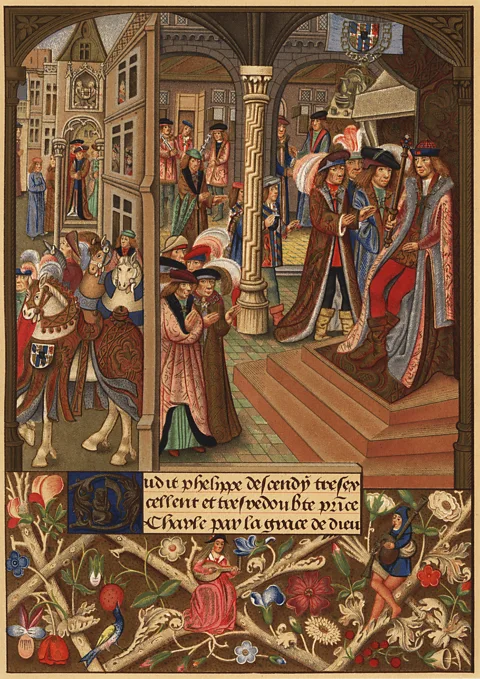
In the winter of 1472, the city of Dijon was a place of high political tension and physical peril. Jehanne, a woman of approximately 32 years from Lorraine, found herself at the center of a legal case that would, centuries later, challenge the prevailing academic understanding of medieval social structures and the treatment of sexual violence. Heavily pregnant and relatively new to the city, Jehanne was the victim of a violent assault that prompted a meticulous investigation by local authorities. The records of this case, preserved in 70 pages of densely inscribed parchment within Dijon’s municipal archives, serve as the foundation for historian Sara McDougall’s recent work, Justice for Jehanne. The case provides a rare, granular look at the intersection of law, morality, and geopolitical power in the 15th century, suggesting that medieval society was far more nuanced in its approach to victimhood than previously assumed.
The Geopolitical Context of 15th-Century Burgundy
To understand the stakes of Jehanne’s case, one must look at the volatile landscape of late medieval France. In 1472, Dijon was a primary seat of the Duchy of Burgundy, then ruled by Charles the Bold. The Duke was embroiled in a protracted and bitter conflict with King Louis XI of France. As the French King’s forces advanced through the Burgundian countryside, Dijon was placed under a state of near-constant military readiness.
To defend the city, Charles the Bold stationed various units of mercenaries around its perimeter. These soldiers, often poorly paid and loosely disciplined, became a source of significant friction between the ducal administration and the municipal government of Dijon. Historical records indicate a "reign of terror" perpetrated by these mercenaries, who frequently engaged in extortion, abduction, and assault against the local populace. The city authorities, tasked with maintaining order and protecting their tax-paying citizens, viewed the lawlessness of the Duke’s men as a direct affront to their local sovereignty. It was within this atmosphere of jurisdictional tension that the crime against Jehanne took place.

The Identity of the Plaintiff: Social Status and Symbolism
In the 15th century, identity was not verified by state-issued documentation but was instead constructed through community testimony and outward appearance. Jehanne identified herself as the wife of "Jehan of Relanges," though she was uncertain of her exact age—a common reality in an era where births were not systematically recorded for the lower classes.
Jehanne’s social standing was communicated primarily through her attire. Witnesses noted that she dressed with a level of elegance that commanded respect. Specifically, the use of a long hood draped over her hair served as a vital social signifier; in 1472, such a garment denoted the status of a "preudefemme," or a respectable, married woman of good standing. This visual "proof" of her morality was essential, as the legal system of the time often predicated the validity of a woman’s testimony on her perceived virtue.
A Chronology of the 1472 Investigation
The legal response to Jehanne’s assault was remarkably swift, driven by the municipal investigator Jaques Borestel. The following timeline outlines the progression of the case:
- January 3, 1472: In the evening, two local men arrived at Jehanne’s residence, demanding that she and her host accompany them. When they refused, one man recruited several of the Duke’s mercenaries from a nearby inn. Jehanne was subsequently dragged to a field and assaulted.
- January 4, 1472: Jaques Borestel, having received reports of the abduction of a pregnant woman, initiated an immediate inquiry. He interviewed Jehanne at her bedside, where she was recovering from the physical trauma. Despite her condition, she provided a detailed account of the attackers.
- January 5, 1472: Jehanne gave birth to a daughter. This event added a layer of urgency to the case, as the health of the newborn and the trauma inflicted upon the mother during the final stages of pregnancy were viewed as aggravating factors by the city officials.
- Late January 1472: Using Jehanne’s descriptions, Borestel apprehended the suspects. Under the "extraordinary" measures of the time—which included a form of torture similar to modern waterboarding—the men confessed to the crime.
- February 1472: Following the confessions, the city sentenced the men to death. However, the ducal authorities intervened, leading to a secondary investigation into Jehanne’s own history to determine her "legitimacy" as a plaintiff.
- March 1472: The case reached a jurisdictional stalemate. The mercenaries were eventually released on a legal technicality involving "clerical status."
Challenging the Rossiaud Thesis
The case of Jehanne is significant not only for its historical detail but for how it refutes long-held academic theories. For decades, the standard text on this subject was Jacques Rossiaud’s Medieval Prostitution (1988). Rossiaud argued that medieval society was so deeply rooted in "victim-blaming" that survivors of sexual assault were routinely ostracized, shamed, and forced into sex work to survive.

Sara McDougall’s research into the Dijon archives presents a direct counter-narrative. In Jehanne’s case, the community did not cast her out. Instead, neighbors and acquaintances provided her with shelter and protection when she was threatened by the mercenaries’ allies. Furthermore, the municipal authorities continued to pursue the case even after discovering that Jehanne’s personal life did not align with the "perfect victim" trope.
The "Preudefemme" Inquiry and the Reality of 15th-Century Morality
During the secondary investigation into Jehanne’s character, Borestel uncovered several discrepancies in her initial testimony. It was revealed that Jehanne had not seen her husband for years and had been living as the mistress of a priest, with whom she had fathered two other children.
In many modern interpretations of the Middle Ages, such a revelation would be assumed to end a woman’s legal standing. However, the Dijon records show a more pragmatic approach to morality. Jehanne admitted to her "sins," famously stating that it was "better to be loose with her body to make her living than resort to stealing from people."
The city’s prosecutors determined that her past "immorality" did not negate the crime committed against her. The fact that she had borne illegitimate children did not give the mercenaries the right to assault her. This indicates that 15th-century justice, while harsh, recognized a distinction between a woman’s private moral choices and her right to be protected from state-level or military-grade violence.

Jurisdictional Conflict and the "Benefit of Clergy"
The failure to execute the sentenced mercenaries was not a result of a lack of evidence or a lack of belief in Jehanne’s story. Rather, it was a result of a legal maneuver known as the "benefit of clergy." The ducal authorities, seeking to protect their military assets, claimed that the mercenaries were members of the minor clergy.
Under the laws of the time, clergy members were exempt from secular (municipal) courts and could only be tried by ecclesiastical courts, which rarely imposed capital punishment. Despite the absurdity of the claim—mercenaries were explicitly forbidden from bearing arms if they were true clergy—the municipal authorities lacked the political capital to challenge the Duke’s decree. After two months in prison, the men were released.
Broader Implications and Historical Analysis
The case of Jehanne serves as a corrective to the "Dark Ages" stereotype. It demonstrates a society where:
- Victims had agency: Jehanne was able to report a crime and be taken seriously by the highest level of city officials.
- Community support was prevalent: The idea of the "shamed outcast" is not supported by the testimony of Jehanne’s neighbors, who assisted her during her recovery and legal battle.
- Legal processes were rigorous: The investigation involved multiple interviews, cross-examinations, and a search for corroborating evidence, showing a high level of procedural sophistication.
While Jehanne did not receive "justice" in the form of the execution of her attackers, the existence of the 70-page record itself is a form of historical justice. It proves that her voice was heard and recorded with a level of detail usually reserved for the nobility.

Sara McDougall’s analysis suggests that the "shame" associated with sexual assault in the medieval period has perhaps been overstated by modern historians who viewed the era through a Victorian lens. In the 1470s, the focus of the Dijon authorities was not on the "purity" of the woman, but on the maintenance of civil order and the punishment of lawless elements that threatened the city’s stability. Jehanne’s story, though ending in the relative obscurity of a hospital job and a fragmentary historical trail, remains a testament to a woman’s resilience and a legal system’s attempt to uphold the rights of a stranger against the might of a ducal army.