admin
The Congo Basin, a vast and verdant expanse dominating much of Central Africa, has long captured the global imagination, akin to an unsolved mathematical enigma, a whispered legend of buried treasure, or an ancient, cryptic message unearthed from a dusty attic. Its allure lies in its profound mystery, its formidable scale, and the tantalizing promise of discovery. Spanning an area comparable in size to India, this colossal rainforest and river system is not merely a geographical marvel; it is a vibrant tapestry woven from the lives of approximately 150 distinct ethnic groups and a staggering array of biodiversity. Crucially, it plays a vital role as a critical counterbalance to global climate change. Yet, despite its immense significance, the region grapples with a stark deficit in scientific research funding and conservation initiatives, a paradox that amplifies its enigmatic status. For centuries, explorers, writers, and adventurers have been both inspired and confounded by its untamed immensity, a testament to its enduring power to captivate and challenge.

A Legacy of Exploration and Literary Echoes
The modern fascination with the Congo Basin can be traced back to the late 19th century, a period when European powers embarked on ambitious expeditions into the heart of Africa, driven by desires for fortune, scientific discovery, and imperial expansion. Among the most prominent figures of this era was the Welsh explorer Henry Morton Stanley. His arduous three-year trek across the Basin between 1874 and 1877 yielded the first detailed accounts of its interior, yet even after his monumental journey, he famously described it as "a region of fable and mystery." This potent combination of the unknown and the challenging deeply resonated with aspiring adventurers, including the young Polish sailor Józef Korzeniowski. Gazing upon maps of Africa, which then largely represented a blank canvas, he declared his intent to one day explore its depths.
Korzeniowski’s aspirations eventually led him to the Congo River, where, not long after Stanley’s expeditions, he captained a steamboat. His harrowing experiences during this period, tasked with retrieving an agent of the notoriously brutal Belgian trading company, left an indelible mark. He bore witness to the brutal realities of colonization and resource exploitation, describing it as "the vilest scramble for loot that ever disfigured the history of human conscience and geographical exploration." This profound disillusionment and the stark portrayal of human avarice and its devastating consequences would later find immortal expression. Józef Korzeniowski, under the pen name Joseph Conrad, transformed his harrowing experiences into literary history with his novella "Heart of Darkness," where the character of Mr. Klein became the enigmatic Mr. Kurtz, a potent symbol of the corrupting influence of unchecked power in the ostensibly "dark" interior.

Contemporary Encounters: Spectacle and Substance
In the 21st century, the allure of the Congo Basin continues to draw modern-day explorers, albeit with different motivations and through vastly different mediums. Ash Dykes, a Welsh extreme athlete, recently gained significant international attention through his viral TikTok videos documenting a perilous journey paddling down the Sangha River, a major tributary of the Congo River. These videos, which garnered millions of views, showcased Dykes’s preparations, the perceived dangers of his expedition, and his encounters with the natural world. While Dykes’s bravery is undeniable, his narrative often leans towards spectacle, amplifying the perceived risks to entertain a digital audience. His footage frequently contrasts his state-of-the-art inflatable boat and anxious demeanor with the calm competence of local inhabitants navigating the waterways in traditional wooden pirogues with remarkable grace.
Dykes’s expeditions have provided glimpses into the region’s rich cultural and natural heritage, including attending a hunt with the Ba’aka people, observing forest elephants at Dzanga Bai, and tracking Western lowland gorillas. These experiences, while thrilling, underscore a crucial point: much of what Dykes has showcased is accessible to travelers who engage respectfully with local communities and conservation efforts. His journey, though impressive in its physical demands, highlights a contemporary interpretation of exploration, where personal challenge and digital dissemination often take precedence.

A Voyage of Discovery Aboard the Princesse Ngalessa
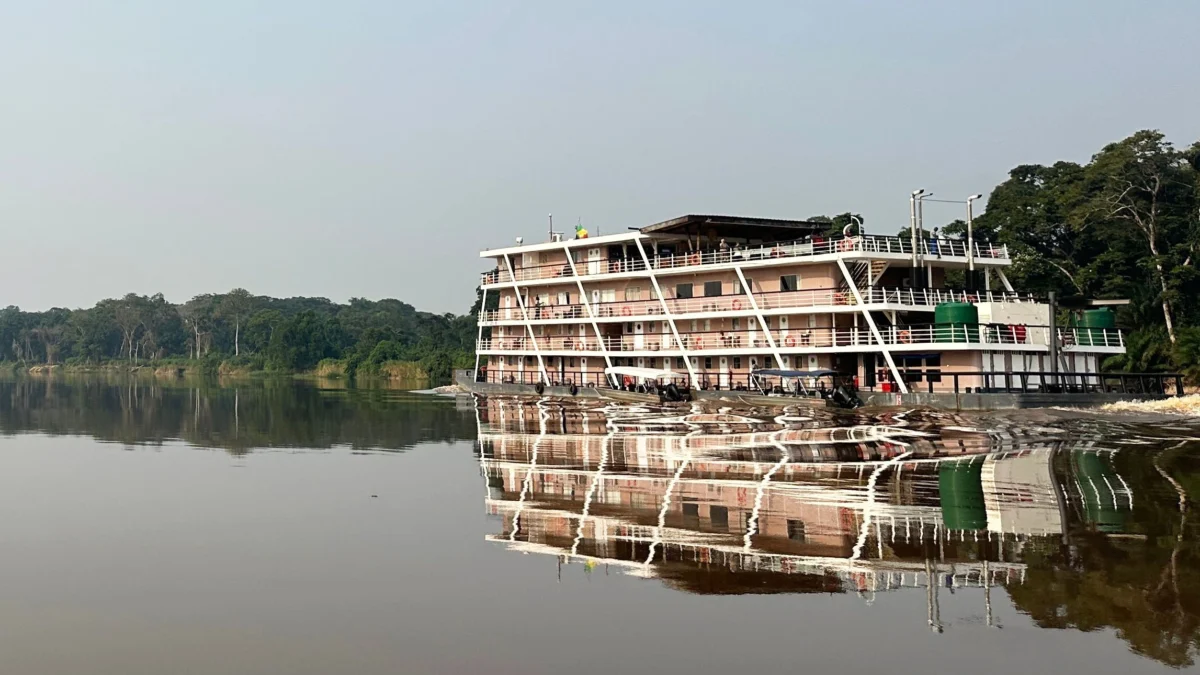
My own journey into the mystique of the Congo Basin was fueled by a long-held fascination with its inscrutable depths. The dream of traversing its mighty rivers and venturing into its ancient forests, punctuated by the imagined rhythm of distant drumbeats at dusk, finally materialized. My voyage began in Brazzaville, the capital of the Republic of Congo, aboard the Princesse Ngalessa, a multi-level riverboat operated by Ducret Expeditions. As the sole passenger cruise vessel navigating the Congo Basin, the Ngalessa and its crew are accustomed to the curious gazes of those who witness its passage. However, the ship’s arrival often elicits a far more engaged response in the riverside villages, where it represents a significant event, bringing vital goods, fostering community connections, and disseminating news from distant locales.
In stark contrast to the utilitarian and often environmentally taxing daka-dakas—flat-topped river barges that ply the routes between Kinshasa and Kisangani, belching plumes of dark, acrid smoke—the experience aboard the Ngalessa offered a profound level of comfort. Passengers enjoyed air-conditioned cabins, three meals a day, and private bathrooms, a luxurious juxtaposition to the rugged environment outside. Crucially, our journey was enriched by the presence of knowledgeable local guides whose deep familiarity with the region’s languages, customs, and people proved invaluable.

One particularly memorable encounter occurred in the riverside village of Ngabe, where we witnessed the appearance of an Ejengi, a forest spirit conjured from palm fronds. The Ejengi danced and twirled to the accompaniment of enthusiastic singing, drumming, and the joyous shouts of the assembled villagers. Our guide calmly reassured us, pointing out the spirit’s "dusty bare feet," a subtle reminder of the human performers behind the myth. Further along the river, we observed an Indigenous Luma woman skillfully transforming twigs into a pulp with medicinal properties for pain relief. Other days were spent kayaking through the ethereal beauty of the Alima River’s flooded forests, or engaging in friendly trade with local fishermen who skillfully maneuvered their slender pirogues alongside our imposing vessel to offer smoked fish and fresh fruit.
Reaching the Heart of the Forest: Sangha Lodge and the Ba’aka People
Eight days and approximately 600 miles after departing Brazzaville, the Princesse Ngalessa reached the frontier town of Ouesso on the Sangha River. My journey continued by launch boat, venturing into the Central African Republic, where I spent several days at Sangha Lodge. This eco-tourism pioneer, established by the legendary Rod Cassidy, has spent years fostering a deep connection with the local Ba’aka people. It was through Cassidy’s invaluable guidance that I had the profound opportunity to participate in a hunt with the Ba’aka. Witnessing their ancient skills firsthand as they expertly retrieved a duiker caught in their meticulously crafted nets was an extraordinary experience. The subsequent jubilation as they carried their bounty back to their village, accompanied by whoops and cheers, was a powerful testament to their deep connection with the land and their communal spirit.

Moments of Illumination and a Redefined "Heart of Darkness"
There are moments in travel that transcend mere sightseeing, moments that feel like stepping into an unseen dimension, where disparate observations coalesce to illuminate a deeper understanding. These moments can manifest as profound love, deep admiration, or even a sense of bewildering awe. Joseph Conrad, after his own transformative journey, famously stated, "Before the Congo, I was a mere animal." He was irrevocably changed by his experiences, a common outcome for travelers who approach new environments with open ears, eyes, and hearts.
Observing the Ba’aka hunters, their senses attuned to the subtlest rustle in the undergrowth, I felt a profound connection to humanity’s ancient past. Their uninhibited laughter and camaraderie following their successful hunt, the women proudly displaying their chipped teeth as a symbol of strength, and the men slapping each other on the back in shared triumph—this was a vision of happiness rarely encountered in the modern world.

Beyond the "Heart of Darkness": An Independent Spirit Requiring Protection
While the Congo Basin undoubtedly offers opportunities for great adventure and remains a place of raw, primal beauty, it is far from the metaphorical "heart of darkness" that Conrad’s title might imply. For Conrad, the true darkness lay not in the geography but in humanity’s capacity for exploitation and cruelty. The Congo Basin today stands as a testament to a different kind of strength: its independence. This magnificent region requires protection, not for any external benefit, but for its intrinsic value and the preservation of its unique ecosystems and cultures.
What truly distinguishes the Congo Basin is its self-sufficiency. It possesses few resources or inclinations for intrusive tourism, and it is not a territory to be "conquered." Most remarkably, it remains the ancestral home to peoples who have, for the most part, maintained their traditional ways of life, sustained by the vast forest and its life-giving waters. For outsiders, these elements can only inspire wonder and amazement. Despite the historical trauma and suffering inflicted by colonialism, the people of the Congo Basin exhibit a remarkable sincerity and warmth, often willing to share the profound beauty and richness of their homeland with respectful visitors.

One evening, as the Princesse Ngalessa drifted serenely northward, I stood on the ship’s upper deck, beneath a canvas awning. A bank of clouds gathered, darkening the sky before a brief but intense downpour commenced, punctuated by a flash of lightning. As the rain subsided, the sun reappeared, low on the horizon, casting a warm glow. The scent of damp earth rose, mingling with the faint, distant sound of drumming that soon dissolved into the immensity of the forest. The dinner bell rang, a gentle summons back to the present, but in that moment, a singular thought echoed: "I never want this trip to end." The Congo Basin, in its enduring mystery and untamed majesty, offers a profound encounter with a world that still pulses with an ancient, vital rhythm.