admin
admin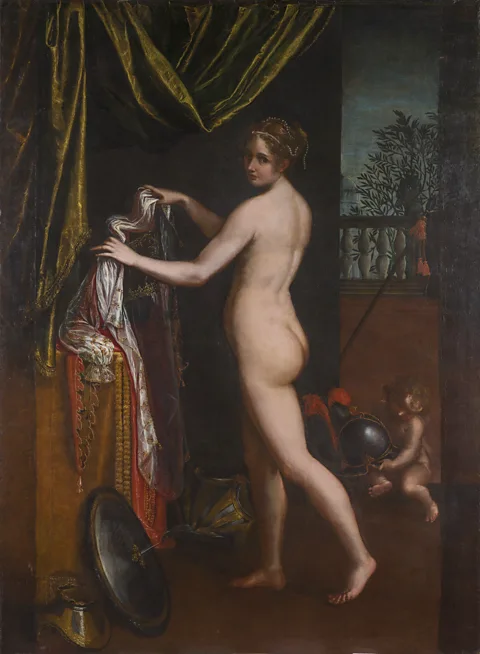
In the annals of art history, the Late Renaissance remains a period defined by rigid social hierarchies and the burgeoning moral oversight of the Counter-Reformation. Yet, within this restrictive environment, Lavinia Fontana (1552–1614) emerged not only as the first woman to be recognized as a professional artist working on the same commercial plane as her male counterparts but also as a pioneer of the female nude. While her public persona was that of a virtuous, cultured noblewoman, a recent re-evaluation of her portfolio reveals a startlingly different side: a creator of overtly suggestive, erotic works that often surpassed the audacity of her male peers. This duality—between the "prim" portraitist and the "bold" painter of the profane—offers a complex window into the life of a woman who navigated the highest echelons of Italian society through sheer technical mastery and strategic entrepreneurialism.
The two facets of Fontana’s career are best encapsulated by two vastly different works currently drawing renewed scholarly attention. The first is her 1577 self-portrait, in which she depicts herself at a spinet, draped in fine jewels and a high-collared gown. It is an image of domestic and intellectual propriety, with an easel positioned subtly in the background to signal her vocation without compromising her femininity. The second is the monumental Minerva in the Act of Dressing (1613), commissioned by Cardinal Scipione Borghese. In this work, the goddess is caught in a moment of vulnerability and transition, slipping into a robe while casting a gaze toward the viewer that art historians describe as simultaneously coy and suggestive. This latter work, completed just a year before her death, serves as the culmination of a career that spent decades pushing the boundaries of what a female artist was permitted to see, let alone depict.

The Socio-Political Climate of Renaissance Bologna and Rome
To understand the magnitude of Fontana’s achievements, one must consider the environment of 16th-century Bologna. During the Counter-Reformation, the Catholic Church sought to tighten its grip on artistic expression to ensure it aligned with moral and theological purity. Cardinal Gabriele Paleotti, the Archbishop of Bologna, was a central figure in this movement, authoring the Discorso delle pitture sacre e profane (1582), which laid out strict guidelines for artists. Paleotti argued that art should be clear, realistic, and, above all, conducive to piety.
Despite this "moralizing zeal," as described by contemporary historians, Bologna remained a city of intellectual vigor and relative progressive thought regarding women’s education. It was home to one of the world’s oldest universities, and the local nobility often took pride in their "illustrious women." This environment allowed Fontana to receive a formal education in the workshop of her father, Prospero Fontana, a prominent Mannerist painter. However, even within this supportive niche, the professional landscape for women was virtually non-existent. Fontana’s transition from a "lady painter" to a professional breadwinner for her husband and 11 children was an unprecedented feat in Western art.
Chronology of a Trailblazing Career
The trajectory of Lavinia Fontana’s career can be mapped through her shifting subject matter and her eventual move from the provincial success of Bologna to the high-stakes commissions of Rome.

- 1552: Born in Bologna to Prospero Fontana. She begins her training in an era when women were largely excluded from life-drawing classes, making her later mastery of the nude even more remarkable.
- 1577: Completes her famous self-portrait at the spinet, establishing her brand as a virtuous and educated artist. This same year, she marries Gian Paolo Zappi, a fellow artist who would eventually set aside his own career to manage hers and assist with the backgrounds of her larger works.
- 1580s: Fontana begins to win major commissions for public altarpieces, such as the Assumption of the Virgin for the Pieve di Cento. Simultaneously, she begins her foray into private erotic commissions, including Venus and Cupid (c. 1585).
- 1590s: Her reputation as a portraitist for the Bolognese nobility reaches its peak. Works like the portrait of Isabella Ruini as Venus show her ability to blend high-society portraiture with mythological eroticism.
- 1597: The death of her father, Prospero. Historians note a shift in her work following his passing, suggesting a newfound freedom from his artistic and financial oversight.
- 1603–1604: At the invitation of Pope Clement VIII, Fontana moves her family to Rome. She becomes a portraitist to the papal court and is elected to the Accademia di San Luca.
- 1613: Completes Minerva in the Act of Dressing for Cardinal Scipione Borghese, one of the era’s most influential and demanding patrons.
- 1614: Fontana dies in Rome, leaving behind a legacy of over 100 documented works—a staggering output for any artist of the period.
The Economic Necessity of Artistic Audacity
A critical factor in Fontana’s willingness to paint "scandalous" subjects may have been rooted in financial pragmatism. Her father, Prospero, had fallen out of fashion in his later years and had reportedly compelled Lavinia to sign a contract obliging her to hand over all her earnings to him until his death. This arrangement placed an immense burden on the young artist to maximize her marketability.
Enrico Maria Dal Pozzolo, author of Lavinia Fontana: Erotic Paintings, suggests that her venture into the erotic was a calculated "entrepreneurial choice." By painting nudes that were more tactile and suggestive than those produced by male artists, she offered a unique product to wealthy collectors. "In my opinion, she did it to show she was different… and to draw attention to her compositional boldness," Dal Pozzolo notes. This strategy allowed her to tap into the "culture of appreciation of female beauty" that was prevalent in Italian courts, where galleries were often dedicated to portraits of beautiful women.
Analysis of Major Erotic and Mythological Works
Fontana’s erotic works were not merely copies of male-centric tropes; they often introduced a level of intimacy and sensory detail that was revolutionary.

Venus and Cupid (c. 1585–1590)
In this early work, Fontana utilizes the classic mythological subject to showcase her skill in rendering textures. The use of pearls, delicate veils, and jewels serves to heighten the sensuality of the nude figure. Unlike many male artists who focused on the anatomical "ideal," Fontana focused on the tactile experience of the skin and the luxury of the setting.
Isabella Ruini as Venus
This work is particularly significant because it depicts a known noblewoman in a state of undress. Draped in the "flimsiest of gauze wraps," the portrait was intended for private viewing. It reflects the competitive social culture of Bologna, where poets and noblemen would rank the beauty of local women. By portraying Ruini as a goddess, Fontana elevated the sitter’s status while providing the patron with a highly eroticized image.
Three Female Nudes (c. 1600)
Recently attributed to Fontana, this painting on slate is a masterpiece of light and reflection. It is believed to be a contemporary "Judgement of Paris," featuring Maria de Medici as the central figure, flanked by Clelia Farnese and another unidentified noblewoman. The use of slate as a medium allowed the painting to have a reflective quality, meaning the viewer (the "Paris" of the moment) would see his own reflection among the nude goddesses as he gazed upon the work in his private chambers.

Mars and Venus (c. 1594–1595)
Perhaps her most audacious work, Mars and Venus depicts unbridled lust. Drawing inspiration from the recently discovered Roman statue Venus Callipyge (Venus of the beautiful buttocks), Fontana depicts Mars explicitly groping Venus. Dal Pozzolo points out that while male artists like Titian and Veronese had painted the pair, they had not "dared depict the goddess’s buttocks being touched." That a woman was the one to cross this boundary suggests a deliberate attempt to shock and captivate her audience.
Scholarly Perspectives and Modern Implications
The duality of Fontana’s life remains a subject of intense debate among art historians. Patrizia Cavazzini, a curator at The National Museum of Oslo, observes the stark contrast between the "proper" self-portraits and the suggestive nudes. "You think you have a very prim woman. Maybe not," Cavazzini suggests, hinting at a complex inner life that may have been at odds with public expectations.
Conversely, Elizabeth Cropper warns against viewing these works solely as a rebellion. "We shouldn’t necessarily believe that public social respectability denies private sexual eroticism," she states, emphasizing the need for a nuanced understanding of Early Modern women. Cropper suggests that the identification of the artist with her subjects—such as the theory that the 1604 Minerva is a self-portrait—is a common phenomenon that underscores the blurred lines between the creator and the creation in women’s art.

Legacy and the Restoration of a Master
For centuries, many of Fontana’s more "audacious" works were either hidden in private collections or misattributed to male artists. The prevailing Victorian-era view of art history struggled to reconcile the image of a mother of 11 with the creator of high-sensuality erotica. However, modern scholarship and exhibitions are finally placing Fontana in her rightful place as a central figure of the Late Renaissance.
The fact that Cardinal Scipione Borghese, one of the most discerning patrons in history, commissioned her to paint a nude for his villa in Rome speaks volumes about her status. As Dal Pozzolo notes, such a large painting could not be "hidden away." It was a statement piece, intended to be seen by the elite of Rome, proving that Fontana had successfully navigated the transition from a "novelty" female painter to a titan of the Roman art scene.
Today, Fontana’s work serves as a vital link between the restrained beauty of the High Renaissance and the dramatic, visceral energy of the Baroque. She paved the way for future generations of women, most notably Artemisia Gentileschi, by proving that a woman could not only master the "masculine" domain of the nude but could also command the market for it. Her dual legacy—as a virtuous professional and a daring eroticist—remains a testament to the "hidden multitudes" of women who shaped the course of Western art history from behind the veil of social propriety.