
 admin
admin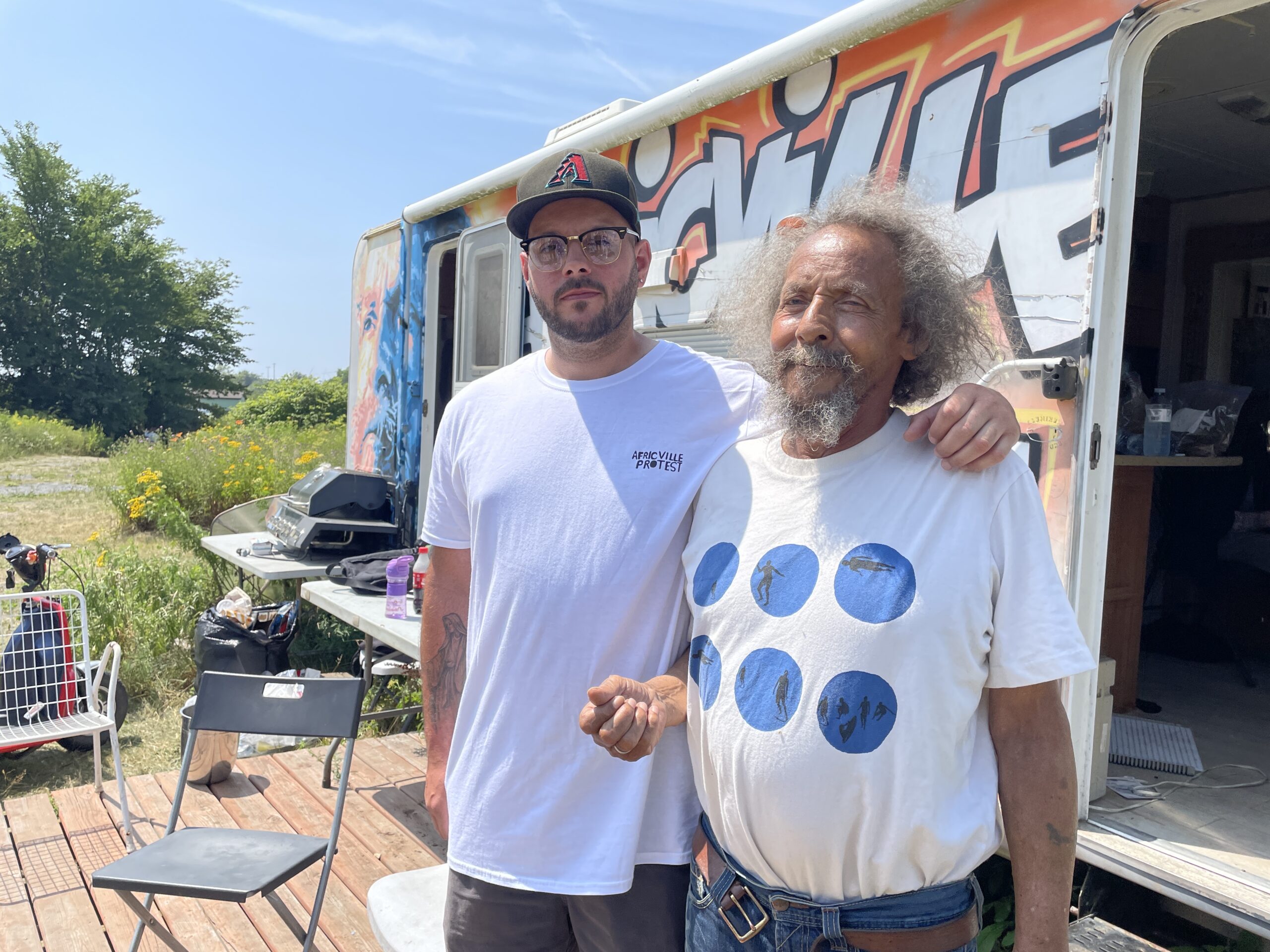
The shores of the Bedford Basin, once home to the vibrant Black community of Africville and for decades the steadfast post of activist Eddie Carvery, were marked with a new, somber distinction this week. Outside the familiar trailer that served as Carvery’s headquarters, flowers appeared, a poignant tribute signaling the end of an era. Eddie Carvery, the 79-year-old unwavering sentinel of Africville’s memory, passed away on Saturday after a period of declining health, leaving behind a profound legacy of perseverance and protest that spanned 55 years. His death marks not the conclusion of a struggle, but a transition, as the torch of his activism is passed to a new generation.
Carvery’s grandson, Eddie Carvery III, shared the news with a heavy heart, emphasizing the personal and profound impact of his grandfather’s life. “He was a father, he was a son, he was a grandfather, an uncle,” Carvery III recounted, detailing how his grandfather was surrounded by loved ones in his final moments. “We held his hands… Even through it all, he wanted to be nowhere but here in Africville, for his people, to continue his fight.” This sentiment underscores the deep, unwavering commitment Carvery held for the land and the community that had been systematically dismantled. The family, still grappling with their loss days after his passing, is joined by countless individuals who knew Carvery, now reminiscing on shared memories and the indelible mark he left on the collective consciousness of Halifax and beyond.
Africville: A Community Erased and a Legacy Reclaimed
To understand the singular dedication of Eddie Carvery, one must first grasp the profound injustice inflicted upon Africville. Established in the mid-19th century, Africville was a thriving, self-sufficient Black settlement nestled on the northern shore of the Halifax Peninsula, overlooking the Bedford Basin. Its residents, many descendants of Black Loyalists, Maroons, and formerly enslaved people, forged a close-knit community characterized by strong family ties, spiritual resilience, and a rich cultural identity centered around the Seaview African United Baptist Church. Despite its vibrancy, Africville was systematically denied basic municipal services by the City of Halifax for decades. Unlike predominantly white neighborhoods, it lacked paved roads, proper sewage systems, running water, and adequate public safety, often serving as a dumping ground for the city’s refuse, including an infectious disease hospital, a slaughterhouse, and a prison. This deliberate neglect fostered an environment that the city later exploited to justify its demolition.
The tragic chapter of Africville’s destruction began in the 1960s, under the guise of "urban renewal" and "slum clearance." Between 1964 and 1967, the City of Halifax, citing public health concerns and the need for industrial expansion, began the forced expropriation of Africville properties. Approximately 400 residents, comprising around 80 families, were displaced. The process was notoriously unjust: property owners received inadequate compensation, often a fraction of their homes’ actual value, and many were relocated to substandard public housing in unfamiliar parts of the city, tearing apart their social fabric. In a particularly cruel act, some residents’ homes were bulldozed while their belongings were still inside, and household items were transported to new locations in city dump trucks, a dehumanizing gesture that epitomized the city’s contempt. The demolition erased a physical community, but it could not extinguish the memory or the demand for justice. The land was subsequently rezoned for industrial use, a stark symbol of municipal indifference.
The Genesis of a Protest: Eddie Carvery’s Stand
It was against this backdrop of historical injustice and governmental disregard that Eddie Carvery began his protest in 1970. Having witnessed the destruction of his ancestral home and the dispersal of his people, Carvery felt an unshakeable duty to ensure Africville would not be forgotten. His demands were clear: a public inquiry into the expropriation process and comprehensive reparations for the people of Africville, encompassing not only financial compensation but also an acknowledgment of the profound cultural, social, and psychological damage inflicted.

Carvery’s protest was not a fleeting demonstration but a decades-long, solitary vigil. He established a camp on the former Africville site, a symbolic act of re-occupation and defiance. What started as a modest shelter evolved over the years, taking on various forms from tents to his more permanent trailer, becoming an enduring fixture on the landscape. His presence served as a constant, living memorial, a physical reminder of the community that once thrived there and the wrong that had been committed. He lived in harsh conditions, enduring the brutal Nova Scotian winters, the isolation, and the constant threat of removal by municipal authorities. His resilience was a testament to his conviction.
Jon Tattrie, author of The Hermit of Africville, a book chronicling Carvery’s life and protest, eloquently captured the essence of his mission. “If you look at the black and white footage of the bulldozers, it’s shocking enough, but Eddie saw that in full colour, with his own eyes,” Tattrie stated. “And I think what disgusted him the most was the indifference. They wanted it to be forgotten and Eddie would not let that happen. That was why he stayed out here — like that flame you see in a church — the eternal flame, he was that eternal flame here in Africville.” This metaphor powerfully conveys Carvery’s role as the unwavering keeper of a sacred memory, a beacon against historical revisionism and societal amnesia.
Decades of Defiance: The Hermit of Africville
For over five decades, Eddie Carvery resisted numerous attempts by the municipality to dislodge him from the Africville site. His persistence was a direct challenge to the authority that had once razed his community. He faced legal challenges, threats of eviction, and the psychological toll of isolation, yet his mission remained unyielding. His camp became a pilgrimage site for those seeking to understand the story of Africville, drawing journalists, historians, activists, and curious visitors. Through these interactions, Carvery ensured that the narrative of Africville, often sidelined in mainstream historical accounts, continued to be told from the perspective of those who suffered its loss.
His protest highlighted the deep-seated issues of racial injustice, systemic discrimination, and urban planning ethics that resonated far beyond the specific case of Africville. It brought national and even international attention to the plight of a marginalized community and forced uncomfortable questions about reconciliation and accountability. Carvery’s steadfast presence on the land served as a continuous, albeit silent, demand for justice, underscoring that while physical structures could be destroyed, the spirit of a community and the quest for truth could not be easily extinguished. His camp, often perceived as a solitary act, was in fact a powerful, sustained act of civil disobedience and a profound statement on land rights and historical memory.
Steps Towards Reconciliation, Unfinished Justice
Over the years, public awareness and pressure mounted, leading to various attempts at reconciliation by the City of Halifax and the Canadian government. In 2005, the City of Halifax formally apologized for the destruction of Africville, acknowledging the profound injustice. This was followed in 2010 by a significant step: the return of 2.5 hectares of land to the Africville Genealogy Society, along with a $3 million commitment to create the Africville Heritage Trust. The Trust subsequently oversaw the reconstruction of the Seaview African United Baptist Church on the original site, which now serves as a museum and cultural center, symbolizing the community’s spiritual heart and resilience. In the same year, then-Prime Minister Stephen Harper issued a formal apology from the Government of Canada for its role in the relocation and for the lasting damage inflicted.
While these actions were widely welcomed as important gestures, for Eddie Carvery, they did not fully address his core demands for a public inquiry and comprehensive reparations. His continued presence on the land, even after the apologies and the establishment of the museum, underscored his belief that true justice required a deeper, more thorough examination of the historical facts and more substantial forms of redress for the victims and their descendants. He maintained that an inquiry was crucial to fully document the wrongdoing, hold all responsible parties accountable, and ensure such an atrocity could never be repeated. For Carvery, the apologies, while meaningful, did not equate to the full recognition and recompense for the suffering endured by his community. His enduring protest served as a powerful reminder that reconciliation is a complex, multi-faceted process that requires ongoing dialogue and genuine commitment to justice, not merely symbolic gestures.

An Enduring Legacy: The Torch Passed On
Eddie Carvery’s passing leaves a void, but his fight is far from over. His grandson, Eddie Carvery III, who grew up at the protest camp, has unequivocally committed to continuing his grandfather’s mission. “My grandfather entrusted me with this fight and I believe everything that has happened has led me to this point,” he declared, standing feet away from his grandfather’s trailer. “My entire life, where we’re standing right now, this was my childhood. This is where I grew up, this was where I learned to be a man, where he showed me so many important things that have shaped me into the person I am today… None of this would be here if it wasn’t for him.” This powerful statement reflects not just a personal inheritance but a profound sense of responsibility to a community and a cause.
The passing of the torch to Eddie Carvery III signifies the intergenerational nature of the struggle for justice in Africville. It ensures that the demands for a public inquiry and comprehensive reparations will continue to be voiced, adapting to contemporary legal and political landscapes. The younger Carvery’s commitment carries the weight of history and the hopes of a community still seeking full healing and recognition.
The Broader Implications of Africville’s Fight
Eddie Carvery’s life and protest transcend the specific details of Africville. His story is a poignant testament to the power of individual perseverance in the face of systemic injustice. He became a symbol of resistance against institutional power, a living embodiment of the adage that "history is not just written by the victors." His decades-long vigil forced society to confront uncomfortable truths about racial discrimination, land dispossession, and the often-destructive consequences of urban development projects carried out without genuine community consultation or respect for human rights.
His legacy also highlights the ongoing discourse surrounding reconciliation with Indigenous peoples and other marginalized communities across Canada. The lessons from Africville, amplified by Carvery’s unwavering protest, resonate in contemporary discussions about land claims, environmental justice, and systemic racism. His life’s work underscores the importance of historical memory, the need for transparent processes in addressing past wrongs, and the ongoing quest for meaningful reparations that extend beyond apologies to tangible and holistic forms of justice.
The presence of Carvery’s camp for so long, and its continuation under his grandson, serves as a permanent reminder that true reconciliation is not a singular event but a continuous process. It demands an honest accounting of the past, genuine empathy for the victims, and a commitment to systemic changes that prevent similar injustices from occurring in the future. Eddie Carvery’s "eternal flame" may have dimmed with his passing, but the light of his dedication and the cause he championed continues to burn brightly, carried forward by his family and the enduring spirit of Africville. His life will remain a powerful inspiration for all who believe in fighting for what is right, no matter how long or arduous the journey.