Jia Lissa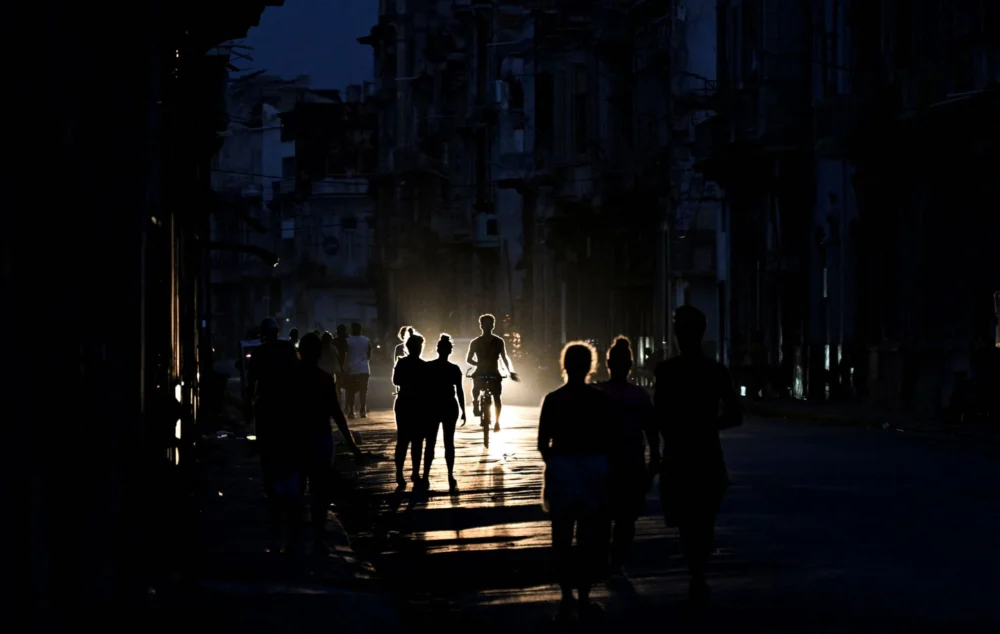
The pre-dawn gloom of Arroyo Naranjo, a municipality skirting the southern fringes of Old Havana, offers little solace. At 5:30 AM, Javier, 27, and his 64-year-old father, Elías, navigate the familiar, pockmarked streets, their steps short and cautious. The dense darkness, a consequence of yet another prolonged power outage, renders their hands invisible before their faces, a stark metaphor for the opaque future facing Cuba. Only the hushed murmurs of unseen neighbors, stirring in their homes, punctuate the heavy silence of this beleaguered suburb on the outskirts of the Cuban capital. Their shared journey is one born of necessity and hardship, a daily ritual in a country grappling with a multifaceted crisis.
For Javier and Elías, the discomforts of this morning are far from unusual. They haven’t had a shower in over 24 hours, their home having been without electricity for more than 16 hours. The power cut, a depressingly common occurrence, disastrously coincided with the day the aqueduct pumps water to their area, leaving neighborhood water tanks bone dry. Hunger gnaws at them; thirst is a constant companion. The meager provisions in their refrigerator—a small portion of chicken and the last two sausages from a once-larger pack—were hastily cooked on a makeshift charcoal stove crafted from stones and wooden boards on their rooftop. This improvised kitchen became a necessity weeks ago, as gas tanks in Arroyo Naranjo have not been refilled for over a month, a testament to the escalating resource scarcity. Sleep, too, has been a luxury. The oppressive heat, amplified by the absence of fans or air conditioning, combines with the putrid stench emanating from overflowing trash containers that now block traffic at the corner, creating an unbearable environment. Without electricity to power alarm clocks, the only way to ensure they rise on time for their mandatory duties is a restless, half-conscious vigil, their eyes serving as their own unreliable timekeepers.
A Nation on Edge: Geopolitical Tensions and Mobilization
This particular morning in January 2026, Javier and Elías were the first to arrive at the bus stop, awaiting transport for military exercises they are obligated to attend as reservists of the Revolutionary Armed Forces. Their participation, typically relegated to weekends, is a vestige of a long-standing national defense strategy. Javier works in the tourism sector during the week, while Elías is retired, but both are bound by the call to serve. Soon, five others joined them – four men and one woman – all sharing the same quiet apprehension. However, at 6:30 AM, a full 30 minutes after the scheduled arrival, the bus was a no-show. With a collective sigh of resignation, they dispersed, returning to their homes, the stark reality of their nation’s deepening crisis once again laid bare.
This scene unfolded barely two Sundays after the United States government, under President Donald Trump, orchestrated the removal of Nicolás Maduro from power in Venezuela. The dramatic shift in Caracas sent immediate shockwaves through Havana, prompting an aggressive and defiant stance from the Cuban regime. President Trump’s subsequent public declarations, such as his comment aboard Air Force One that “Cuba looks like it’s ready to fall, I don’t know if they’re going to hold out,” fueled an atmosphere of heightened alert. In response, the Cuban government initiated a series of measures, preparing for a potential “state of war” – a general mobilization strategy that has been a cornerstone of its defense doctrine since the 1980s, designed to counter perceived external threats.
Later, Javier, Elías, and the other civilians expecting to participate in the military exercises received official notification: the buses intended to transport reservists from Arroyo Naranjo and other municipalities were unable to operate due to an acute lack of fuel. The directive was concise and ominous: “Stay in touch and be alert.” Elías, reflecting on the incident, succinctly articulated the prevailing sentiment: “What happened to us sums up Cuba today. It’s a country that doesn’t have enough fuel for trucks to collect garbage from neighborhoods, and even though we are about to be invaded, we don’t have the resources to defend ourselves.” His words underscore the profound irony and the perilous state of the nation, caught between a rhetoric of defense and a reality of resource depletion.

Cuba’s Energy Lifeline Severed: The Venezuelan Fallout
The lack of fuel has plunged Cuba to the precipice of total economic and social collapse. The island nation, home to approximately 9.7 million people, relies heavily on a centralized energy infrastructure. Of its 16 thermoelectric power plants, a critical six are currently out of service, including two of the country’s largest electricity generators. This catastrophic operational failure, escalating significantly since early 2025, has forced the population to endure daily blackouts lasting anywhere from 12 to a staggering 20 hours across the country. These prolonged outages have crippled daily life, disrupting commerce, healthcare services, and educational institutions, and exacerbating an already dire humanitarian situation.
Cuba’s economy has contracted by more than 15 percent since 2020, a downturn intensified by the combined pressures of the long-standing US embargo, the global pandemic, and now, the abrupt cessation of Venezuelan oil supplies. The conversation with Javier and Elías was emblematic of the wider crisis; shortly after their video call, nearly 64 percent of the country plunged into darkness during the late afternoon and evening, precisely when energy demand peaks. This widespread power failure is a direct consequence of Venezuela’s diminishing capacity and, more recently, the US intervention.
Historically, since the tenure of Hugo Chávez, Venezuela had served as Cuba’s primary, indeed almost exclusive, oil supplier. This symbiotic relationship, often dubbed "oil-for-doctors" diplomacy, saw Cuba providing medical personnel and expertise in exchange for discounted crude oil. Nicolás Maduro continued this vital lifeline until his capture in late December 2025. It is no overstatement to assert that Cuba’s energy sector, and by extension its very survival, was intricately tied to Chavismo. In the two years preceding Maduro’s removal, Venezuela supplied over 50 percent of Cuba’s oil requirements, with estimated exports to the island reaching around 30,000 barrels per day in late 2025. This steady flow of crude was the lifeblood of Cuba’s thermoelectric plants, its transportation networks, and its agricultural sector.
The Economic Abyss: Widespread Disruption and Hardship
With Trump’s declaration that these shipments would cease, Cuba finds itself acutely vulnerable, cut off from its most crucial source of crude oil. The US president has openly stated his intention to exploit this vulnerability, aiming to force the demise of Castroism through economic strangulation. Beyond severing the Venezuelan supply, the US administration has also imposed tariffs and sanctions on other countries attempting to provide Cuba with oil, effectively isolating the island further and increasing pressure for negotiations.
The last substantial shipment of crude oil from Venezuela arrived in December 2025, carrying 598,000 barrels. This, along with a comparatively modest 84,900 barrels sent by Mexico’s Petróleos Mexicanos (Pemex) a week after Maduro’s capture, represents the entirety of the regime’s immediate reserves. While Cuba had hoped for continued support from Mexico, particularly under President Claudia Sheinbaum, intense pressure from the Trump administration has limited Mexico’s assistance to food and medicine, with no crude oil forthcoming.

According to analysis from the consulting firm Kpler, Cuba’s oil reserves are now in a critically precarious state. Imported crude oil is not merely a convenience; it is the fundamental input for the electrical system, the transportation network, and the entire national economy. Without it, essential services grind to a halt, industries cannot function, and the movement of goods and people becomes impossible. The Cuban leadership faces an agonizing choice: either engage in high-stakes negotiations with the Trump administration to seek the lifting of the crippling blockade and sanctions, or face an inevitable and total economic paralysis, with potentially catastrophic social consequences. The implications of this energy famine extend beyond daily inconveniences; they threaten the very fabric of Cuban society, exacerbating food shortages, crippling public transport, and creating an environment ripe for further civil unrest.
The Battle for Information: Internet Access as a Political Weapon
Amidst the energy crisis, another critical front in the struggle for Cuba’s future is internet access. The Trump administration, long before Maduro’s capture, had identified internet freedom as a key pressure point. A June 2025 White House fact sheet explicitly announced increased restrictions on the island, alongside an amplification of “efforts to support the Cuban people through the expansion of internet services, free press, free enterprise, free association, and lawful travel.” This policy highlights the US government’s understanding of the internet’s transformative power in challenging authoritarian regimes.
The expansion of internet services in Cuba, which began tentatively in 2015, marked a watershed moment. For many Cubans, it was their first direct exposure to the global web, and its impact was profound and immediate. The regime, which had for decades maintained an iron grip on information through its state-controlled media outlets, abruptly lost its monopoly on narrative. The emergence of social media platforms provided an unprecedented avenue for activists, artists, and opponents of the regime to share their work, disseminate their messages, and connect with a wider audience, both domestically and internationally. Coupled with the rise of independent digital media, this newfound connectivity empowered a dissident civil society that had long struggled to make its voice heard.
Six years later, in 2021, the burgeoning opposition gained sufficient strength and coordination to mount a significant challenge to the country’s status quo. Calls for an end to repression and human rights abuses resonated across the island, culminating in widespread protests in almost every city. Citizens took to the streets, demanding fundamental freedoms, an end to what they termed a dictatorship, and a new beginning for the nation. The regime’s response was brutal and swift: one documented death, over a thousand political prisoners, and forced exile for many others. Crucially, the government also moved to tighten its control over surveillance and internet access, recognizing its central role in facilitating the opposition movement.
Since the 2021 uprising, the Castroist government has prioritized the control of internet access as a critical component of its repressive strategy, aiming to prevent any future large-scale expressions of discontent. This effort manifests in several ways, from economic barriers to direct censorship and digital surveillance.
Digital Dissent and State Repression

The sole telecommunications company in Cuba, ETECSA, a state monopoly, has systematically raised its rates in a calculated move to reduce internet usage among the populace. Currently, Cubans can renew their phone data only once a month, at a cost of 360 Cuban pesos (approximately $1.25 USD) for six gigabytes. Should an individual require more data, an additional three gigabytes command a price of 3,360 Cuban pesos (approximately $7.55 USD). This pricing structure is prohibitive for the vast majority of Cubans. To put this in perspective, the additional data package costs more than the average monthly pension of retirees, which stands at 2,075 Cuban pesos (about $4.65 USD), and represents more than half the average monthly salary of state workers, typically around 6,506 Cuban pesos (about $14.60 USD).
The impact on internet consumption has been dramatic. According to the digital news portal Cubadebate, average monthly internet consumption was around 10 gigabytes before these punitive rate increases. Now, individuals are spending significantly less time online, simply because they cannot afford the data they once consumed. The dilemma faced by many Cubans is stark, as illustrated by the author’s own mother, residing in Havana. She recently messaged him on WhatsApp, stating, “It’s not that I don’t want to write to you, son, it’s just that the money isn’t enough to pay for food and the internet. It’s one or the other.” This poignant choice encapsulates the dire economic reality for ordinary Cubans, where basic sustenance is pitted against the ability to connect with the outside world.
Raising prices to curtail internet usage is merely one facet of the Cuban regime’s broader strategy to stifle messages of discontent. The other, more insidious part, is direct repression, which manifests through pervasive digital surveillance of opinions and online content, as well as the systematic blocking of most independent media outlets. The organization Prisoners Defenders has meticulously documented this "panoptic social control ecosystem," detailing its primary objective: “the neutralization of dissent, the inhibition of public debate, and the dismantling of independent social, civic, and political networks.” Their report, based on extensive surveys, revealed that a shocking “88 percent of those surveyed stated that authorities had cited their digital activity or messages as grounds for summonses, arrests, and interrogations.”
The chilling reality of this digital repression is evident in numerous cases. Aroni Yanko, for instance, spent a year and a half in prison for merely posting a meme on his WhatsApp status that depicted Raúl Castro, President Miguel Díaz-Canel, and Prime Minister Manuel Marrero naked and tattooed. Mayelín Rodríguez Prado received a staggering 15-year prison sentence following a Facebook post she made about protests in Nuevitas, a town in the Camagüey province. Víctor Manuel Hidalgo Cabrales endured a year and four months in prison for a Facebook post asking: “Hey, Las Tunas [a city in Cuba], what’s up? They turn it [electricity] on for four [hours] and then turn it off for five or six. Are we going to put up with this?” These cases serve as stark warnings, reinforcing the regime’s message that online expression carries severe consequences.
A Crossroads for Cuba: Negotiations Amidst Collapse
In the quiet of that Havana night, many hours after President Trump had posted the now-infamous image of Nicolás Maduro in a gray tracksuit, hands cuffed and eyes covered, aboard the warship that took him to the United States, Javier and Elías used the dwindling battery life on Javier’s phone. They had been without electricity for over 10 hours at that point. They reached out to the author, their voices laced with apprehension, asking if the news of Maduro’s capture and Trump’s subsequent warning that Cuba, now bereft of its Venezuelan lifeline, would be next, was truly authentic. “Yes, it’s true,” came the somber reply, accompanied by a photo of Maduro and a video of Trump addressing Cuba. In their next conversation, the author noted that both files had been deleted from Javier’s device. No explanation was sought, nor was one necessary; the unspoken fear of digital surveillance and its repercussions hung heavy in the air.
Cuba stands at a critical juncture, its future hanging precariously in the balance. The confluence of a severe energy crisis, exacerbated by the loss of Venezuelan oil, and relentless US economic pressure has pushed the nation to the brink. The regime’s traditional methods of control – propaganda and repression – are increasingly challenged by a digitally empowered, albeit heavily monitored, populace. The choice between negotiating with an adversarial US administration to alleviate the blockade and facing utter economic collapse is a profound one, with far-reaching implications for the lives of millions of Cubans. As the island grapples with daily blackouts, food shortages, and the stifling grip of digital repression, the scene of Javier and Elías navigating their dark streets in search of a bus that never came remains a potent symbol of a nation teetering on the edge of an uncertain future. The world watches, as Cuba’s leaders weigh the cost of defiance against the imperative of survival.